

Author:Wall Street CN
 Author | Huang Yu
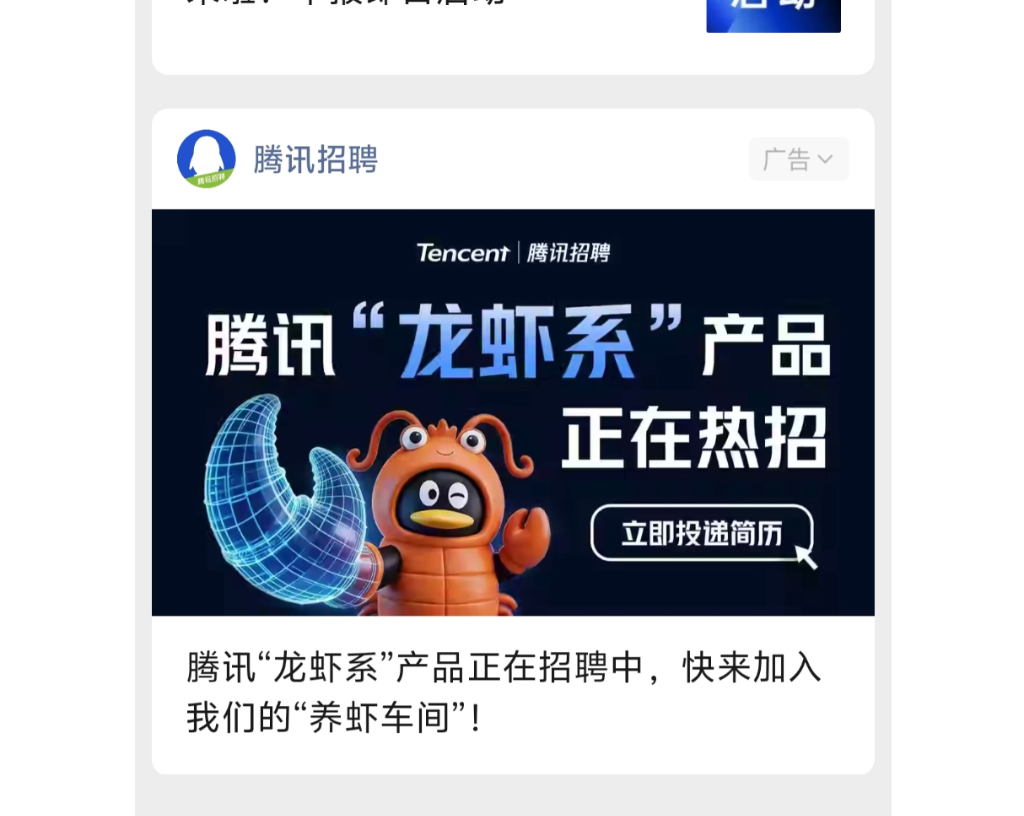
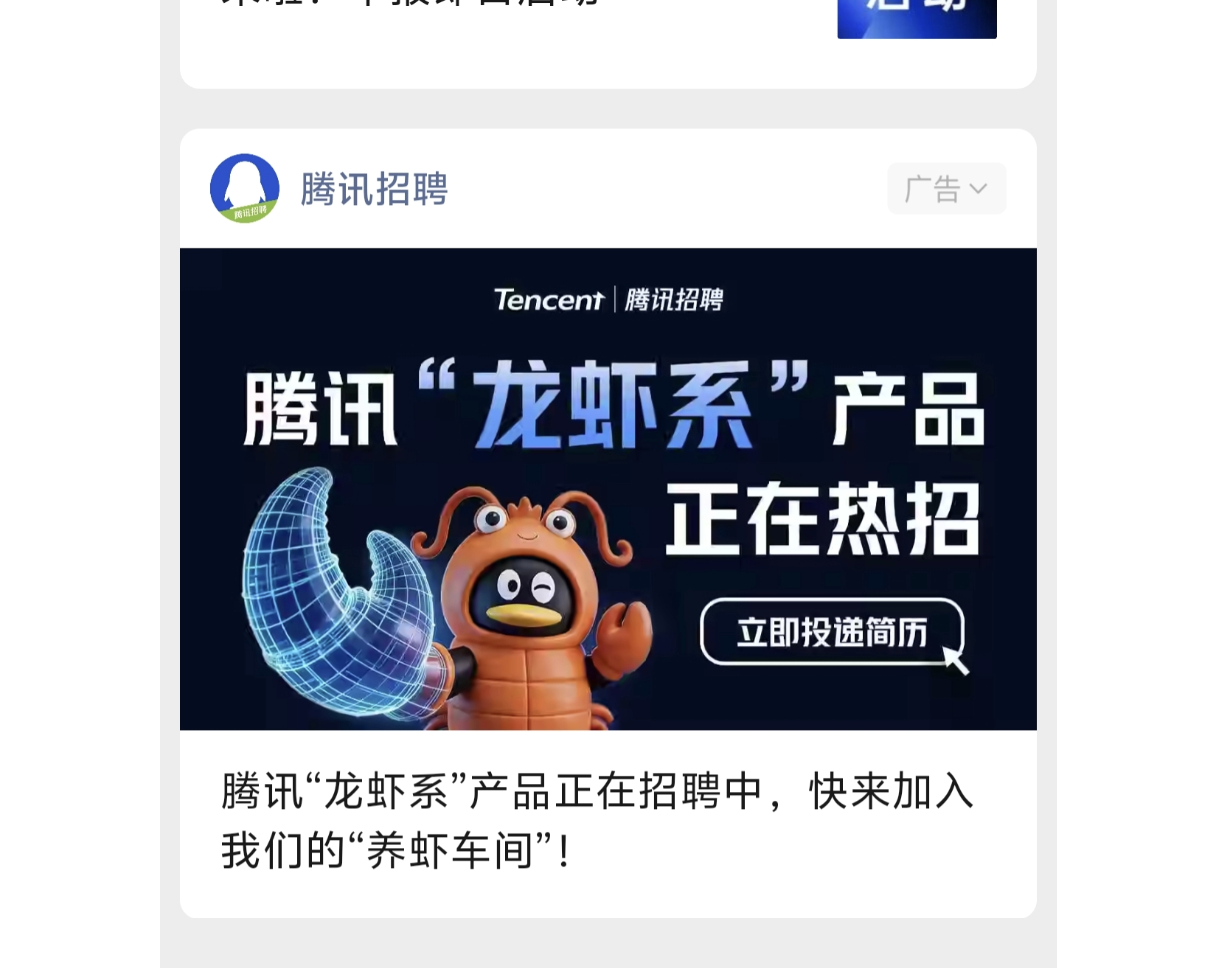
Wall Street News discovered that Tencent recently launched a large-scale recruitment drive for its "Lobster Series" products and is heavily promoting them on WeChat.
All positions in this recruitment are under Tencent CSIG (Cloud and Smart Industry Group), and the products involved include WorkBuddy, QClaw, Tencent Lighthouse, etc. Specific positions include Intelligent Agent User Growth Operations Manager, Data Engineering Leader, Full-Stack Development Engineer, Reinforcement Learning Algorithm Researcher, and AI Native Product Manager.
Against the backdrop of Tencent's recent rapid launch of a "lobster product matrix," this swift increase in recruitment of AI Agent-related talent undoubtedly further demonstrates Tencent's determination to develop a successful AI Agent product.
It's worth noting that when Tencent's AI assistant Yuanbao was first launched, it didn't engage in such a high-profile recruitment drive for product talent as it has this time.
In this wave of crayfish farming, Tencent can be said to be the most proactive company.
Starting in March, a matrix-style product plan centered around lobsters was launched, which they called the "Lobster Special Forces." This product matrix not only covers novice users but also targets hardcore developers and large enterprises.
Ma Huateng personally promoted Tencent's lobster meal package, saying, "Self-developed lobster, local lobster, cloud lobster, enterprise lobster, cloud desktop lobster, secure isolation lobster room, cloud security, knowledge base... and a batch of other products are coming soon."
This is a rare instance in this wave of AI big data that Ma Huateng has stepped in to support his own AI products.
During a recent earnings call, Ma Huateng also publicly discussed his thoughts on "shrimp farming" for the first time. He believes that "lobster" is a decentralized entry point that can better leverage Tencent's resource advantages, allowing various fronts to work together, and it has also inspired the WeChat Agent currently under development.
Tang Daosheng, Senior Executive Vice President of Tencent and CEO of the Cloud and Smart Industries Group, recently stated that the current application paradigm of artificial intelligence is shifting from "Chatbots" to "AI Agents." The implementation of AI is not just an algorithmic problem, but also an engineering one—as the gap in capabilities between mainstream large-scale models gradually narrows, the competition among companies is no longer about "whose model is stronger," but rather who can effectively utilize the model through engineering methods.
According to Tang Daosheng, in the future, every individual and every enterprise will be able to use standardized tools to quickly build their own intelligent agent applications, jointly constructing a decentralized and highly prosperous agent ecosystem.
In fact, Tencent, which was once questioned by outsiders for "falling behind" in this round of AI competition, has been quietly accelerating since the end of last year, including in the recruitment of AI talents and organizational restructuring and upgrading.
Tencent President Martin Lau pointed out that in the past few months, Tencent has carried out intensive organizational upgrades and workflow restructuring of the mixed-model team, while also rebuilding the entire pre-training and reinforcement learning infrastructure and further improving data quality.
Through a series of adjustments, Tencent hopes to create a more intelligent model while accelerating the overall iteration speed.
In terms of talent recruitment, while bringing in top talents such as Yao Shunyu, a former OpenAI researcher, at the end of last year, there were also reports that Tencent was offering double salaries to top researchers in ByteDance's AI department (especially the large model and multimodal teams), and had successfully recruited some key personnel.
During the Q3 earnings call last year, Martin Lau also pointed out that Tencent was actually recruiting more top talent, especially in the research field, to supplement its existing engineering team.
Tencent recruiters revealed that among the internship positions offered this year, technical positions have increased by 36%, product positions by 39%, and AI-related positions have also seen a significant increase. Furthermore, to embrace the changes brought by AI, an "AI application skills module" has been added to the resume submission requirements.
"We look forward to having more partners with an 'AI Native' mindset join us," said the Tencent recruiter.
At a critical juncture in the struggle for dominance in AI technology, tech giants are vying for AI talent in a manner akin to an arms race.
An insider at a leading video generation company told Wall Street News that the list of their AI technology team is not currently available on their internal OA system, in order to prevent other companies from poaching their talent.
Hudson, a talent solutions provider, released its "2025 Talent Trends Report," which points out that breakthroughs in AI have pushed talent demand to new highs, intensifying the competition for high-end AI talent and further exacerbating the scarcity of top talent.
Against this backdrop, top AI talents have gained the power to set their own prices.
According to Hander Data, the top 20% of AI talents in the industry can see a salary increase of 30%-50% when changing jobs. Among them, top researchers and engineers in the field of reinforcement learning have become the focus of competition among leading companies. Authors who have published papers in top international journals dominate the talent market, and their bargaining power far exceeds that of other competitors.