

Author:Currency Explorer
Market Review
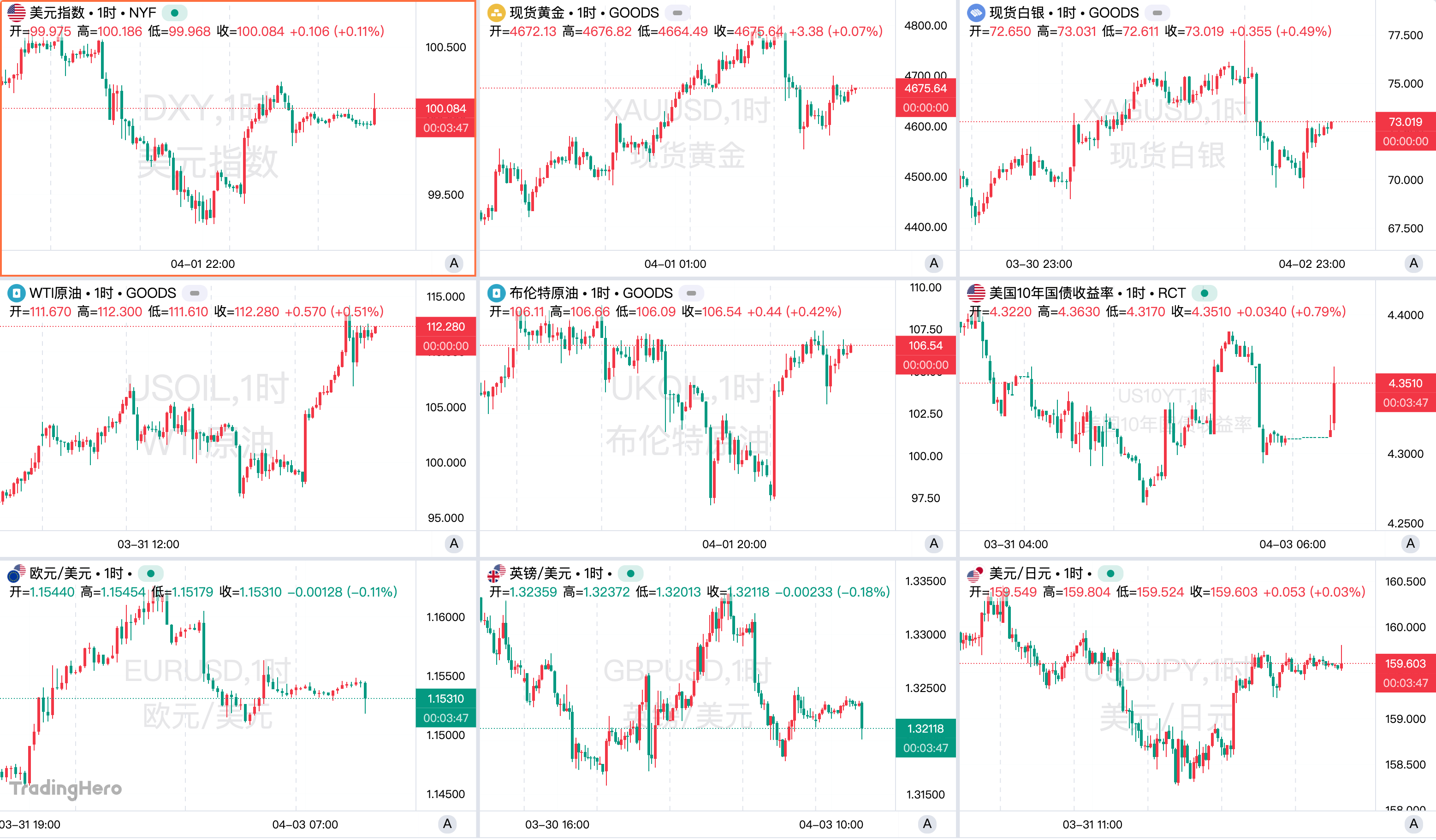
The US dollar index generally trended upwards this week, initially rising before falling back and then fluctuating. It initially surged at the beginning of the week, driven by tensions in the Middle East.The US dollar index hit a more than 10-month high.Subsequently, expectations of easing tensions subsided, but the dollar index strengthened again on Thursday amid deteriorating risk sentiment, fluctuating around the 100 level overall. Following Friday's non-farm payroll data, the dollar index broke through 100 again.
Spot gold prices initially rose this week but weakened later, remaining generally bullish. On Wednesday, driven by a declining dollar and expectations of easing tensions, spot gold prices climbed to near the $4,800 mark, reaching a new high since March 19; however, on Thursday...Trump's tough stance, soaring oil prices, and market concerns that high oil prices would drive up inflation and suppress interest rate cuts caused gold prices to retreat from their highs.Spot silver saw greater volatility this week, moving in tandem with gold but exhibiting greater elasticity.
International oil prices remain the most volatile asset this week.Oil prices initially fell briefly during the week due to ceasefire expectations, but then surged again on Thursday after Trump said he would continue to strike Iran in the coming weeks without specifying when the Strait of Hormuz would reopen. WTI crude rose above $110, while Brent crude returned to around $105.
Non-US currencies performed as a whole this week."A rebound at the beginning of the week, followed by a general pullback at the end of the week."The weekly gains of G10 currencies against the US dollar were almost entirely reversed.The yen also failed to strengthen due to its safe-haven appeal.The dollar rose above 160 against the yen at one point, after Japan's Ministry of Finance publicly warned that it would take action against speculative volatility.
US stocks were generally positive this week.A week of rebound amidst sharp fluctuationsThe market was closed on Friday for a holiday. The Dow Jones Industrial Average rose 2.96% this week, the Nasdaq Composite rose 4.44%, and the S&P 500 rose 3.36%.It recorded its largest weekly gain since November of last year.
Investment Banking Perspectives
Goldman Sachs believes the underlying logic of the gold bull market remains unchanged.We maintain our assessment of an upward trend.Huatai Securities points out that the logic for long-term asset reallocation in the gold market remains solid. OCBC Bank states that...Easing geopolitical risks provide support for gold prices.However, the return of expectations for interest rate cuts is the key driving factor.
ING believes thatThe reopening of the Strait of Hormuz will be a key factor in the weakening of the US dollar.TD Securities and Commonwealth Bank of Australia both pointed out that the US dollar will remain supported amid expectations of escalating geopolitical tensions.
Societe Generale predicts that the average price of Brent crude oil in April will be around $125 per barrel. Societe Generale also estimates that the average price of Brent crude oil in April may reach $125 per barrel.
Goldman Sachs raised its aluminum price forecast due to escalating supply disruptions. CITIC Securities believes...Supply disruptions continue to escalate, presenting investment opportunities in the aluminum sector.Guoxin Futures points out that aluminum price trends depend on the assessment of production capacity damage by relevant companies.
Nomura believes that inflation risks, coupled with policy changes,The expectation of a Fed rate cut has been postponed to September.Goldman Sachs is downplaying its expectations for a Federal Reserve rate hike this year.
Weekly Highlights
1. Powell signals "hold steady": Energy shock will not change interest rate path; inflation expectations become policy red line.
Amid escalating tensions in the Middle East and heightened energy price volatility, disagreements within the Federal Reserve regarding the path of monetary policy have resurfaced.
Federal Reserve Chairman Jerome Powell's speech at Harvard University on Monday conveyed a key signal regarding the current policy direction:Faced with short-term inflationary pressures driven by energy shocks, the Federal Reserve is inclined to keep interest rates unchanged and take a "penetrative" approach to related price fluctuations.
These dovish remarks prompted the market to quickly revise its earlier aggressive expectations for interest rate hikes and instead return to betting on future rate cuts.However, Friday's non-farm payroll data significantly exceeded expectations, cooling bets on a Fed rate cut in 2026. The US added 178,000 non-farm jobs in March, far exceeding the expected 60,000, marking the highest level since December 2024. The unemployment rate fell to 4.3%, and wage growth slowed to 3.5%. The end of the healthcare strike and rising temperatures were the main drivers.
The so-called "penetrating observation" refers to viewing rising energy prices as a short-term supply shock and not using it as a direct basis for adjusting monetary policy. Powell pointed out that energy price shocks are usually short-lived, while the transmission of monetary policy is lagging and difficult to offset such fluctuations in a timely manner. Therefore, hastily adjusting interest rates in the current environment may lead to the risk of policy mismatch.
However, Powell also clearly defined the policy boundaries. He emphasized that...Once rising inflation begins to affect public long-term expectations, the Federal Reserve will have to take action.Inflation has remained above target for the past five years, making it difficult for businesses and households to remain unmoved by a new round of price increases. He warned that if similar supply shocks recur, the public may gradually develop expectations of higher inflation, thus having a lasting impact on price formation mechanisms.
This statement largely aligns with the assessment of New York Fed President Williams. Williams stated that the Middle East conflict has already impacted the economy through supply chains and energy prices, and he projects that U.S. inflation will rise to 2.75% by the end of 2026. However, he believes...Current interest rates are still at an "appropriate level," and the Federal Reserve should maintain policy stability.Meanwhile, the US economy is projected to grow by 2.5% this year, with the unemployment rate declining slightly.
In contrast, there are differing voices within the Federal Reserve, some advocating for a more accommodative approach and others for a more cautious one. Governor Milan continues to call for interest rate cuts, arguing that policymakers should ignore energy price fluctuations in the absence of signs of prolonged inflationary spillovers, and has proposed...A possible path for a 100 basis point interest rate cut this year.
In contrast, Kansas City Fed President Schmid warned thatThe persistent impact of soaring energy prices on inflation should not be underestimated.Given the current high inflation levels, viewing rising oil prices as a short-term phenomenon carries risks; he worries that inflation may become sticky at around 3%.
St. Louis Fed President Musaleem, however, holds a more neutral stance. He believes...Current interest rates are sufficient to manage economic risks and do not require adjustment in the short term.However, if the economic environment changes, it will support adjusting policy interest rates in any direction if necessary.
2. The conflict between the US, Israel, and Iran continues to escalate: Trump did not agree to TACO, and Iran intends to charge fees in the Hormuz region.
Over the past week, the situation in the Middle East has deteriorated rapidly amid ongoing clashes between the United States, Israel, and Iran. The conflict has gradually spilled over from military strikes to energy, shipping, and regional security systems, with the Strait of Hormuz remaining a key node in the power struggle.
From the battlefield situation, the mutual attacks between Iran and the US and Israel have clearly escalated.Iran has launched more than 90 rounds of Operation True Commitment-4.It continues to launch missile and drone strikes against US military bases, Israeli military industrial facilities, and related energy and metal industry targets, and claims it will expand its strike range and accelerate the expulsion of the US military presence in the Middle East.
Iran's infrastructure has also been severely damaged, including the destruction of iconic bridges, the shutdown of the Isfahan steel plant, and damage to meteorological and pharmaceutical facilities. Power outages have also occurred in some areas. Iran claims that more than 115,000 civilian facilities have been damaged in the conflict.
The US and Israel have maintained a high level of military pressure. The US has struck more than 11,000 targets in Iran and continues to increase its troop presence in the Middle East, including expanding the deployment of A-10 attack aircraft and moving carrier strike groups. Israel claims to have used approximately 16,000 munitions, destroying thousands of targets, and continues to strike Hezbollah militants in Lebanon. Although Israel assesses that Iran's missile capabilities and command chain have been weakened, its military strain is gradually becoming apparent.
Political divisions have also intensified. On the one hand, US President Trump claims the war is nearing its end, even declaring regime change in Iran; on the other hand, he also states...The US will continue its "fierce strikes" in the coming weeks and threatens to further destroy Iran's critical infrastructure.Iran, however, firmly denies any intention to cease fire, emphasizing that its goal is to "completely end the war" and demanding security guarantees that it will no longer be attacked. The differences between the two sides on whether to negotiate and their war objectives remain significant.
Control of the Strait of Hormuz has become a key variable in this round of conflict. Iran has not only repeatedly threatened to restrict passage, but has also pushed for legislation to levy fees on transit vessels and negotiated a passage agreement with Oman. Although Iran has promised some countries to guarantee navigational safety, it has made it clear that the strait will not be restored to its pre-war state.
International rivalry surrounding the Strait is escalating. Britain plans to convene allies to discuss military options, while the EU calls for expanded maritime escort operations to prevent disruptions to key trade routes. Meanwhile, the UAE once considered joining forces with the US to forcibly breach the Strait, indicating...The Gulf states are facing the risk of being drawn into direct conflict.Some European countries have expressed reservations about the US actions, including refusing to provide airspace or military base support.
The spillover effects of the conflict have become apparent in a wider range of areas. Energy and industrial facilities in the Middle East have been frequently attacked, a large aluminum smelter in the UAE has been forced to shut down, and oil tankers and airport infrastructure have also become targets. The global security landscape has also been impacted, with rifts appearing within NATO due to disagreements over US policy, and European leaders publicly questioning the feasibility of related military and political decisions.
3. Buffett: I sold Apple too early; the current stock market correction is nothing.
In his first interview since stepping down as CEO of Berkshire Hathaway, Warren Buffett clarified that the company will maintain a wait-and-see approach in the current market environment, while also releasing his latest assessments on investment, macroeconomic policies, and philanthropic arrangements.
Facing a roughly 10% drop in US stocks from their peak, Buffett believes"This is nothing."And directly stated BerkshireAt present, "no opportunities have been found".The company holds over $350 billion in cash, mostly invested in U.S. Treasury bonds, and recently acquired $17 billion more in its holdings. He stated that he would only invest if the market experienced a significant downturn.
In terms of corporate governance, Buffett has gradually transitioned stock investment decisions to his successor, Greg Abel, who currently manages a stock portfolio of approximately $300 billion and will officially take over as CEO at the end of 2025. Buffett himself will no longer attend the May shareholders' meeting, participating only as an audience member.
At the position level,Warren Buffett admitted to selling his Apple shares too early, but still achieved a pre-tax profit of over $100 billion overall.Apple remains Berkshire Hathaway's largest holding, valued at approximately $61.96 billion, but its excessive proportion has drawn criticism from Warren Buffett, who stated that it is almost equivalent to the total of all other holdings and that he would only increase his stake if the price became more attractive. He also highly praised CEO Tim Cook, believing his management skills to be even superior to those of Steve Jobs.
On a macro level, Buffett supports the "zero inflation" target, believing that 2% inflation will erode wealth in the long run, but he places greater emphasis on the stability of the financial system. He praises Federal Reserve Chairman Powell for his swift interest rate cuts during the pandemic to avoid a credit crisis and considers him a "hero" alongside Volcker.
In philanthropy, Buffett announced the resumption of his charity lunch, but his donation plans to the Gates Foundation have encountered changes. He has donated approximately $50 billion since 2006, but...He has not been in contact with Bill Gates since the Epstein scandal.They will observe whether to continue annual donations. According to the arrangement, approximately $140 billion of his assets will be transferred to a family foundation managed by his children after his death.
4. Trump tightens tariff policies: High tariffs maintained on metals, tiered taxation for pharmaceuticals.
The Trump administration made key adjustments to the tariff system this week, maintaining tariffs on steel, aluminum, and copper products at a maximum of 50% while implementing tiered tariffs on imported pharmaceuticals, indicating that its trade policy is shifting from a comprehensive escalation to a structural reshaping.
Regarding metal tariffs, the new framework maintains high tariff rates while introducing exemptions and tiered mechanisms. The White House stated that...Goods with a metal content of less than 15% will be exempt from tariffs, while derivatives deemed to be "mainly composed" of the relevant metals will be subject to a 25% tariff.For products manufactured overseas but using only U.S. metals, the tax rate will be reduced to 10%. Certain industrial and electrical equipment will be taxed at 15% until the end of 2027 to support the domestic industrial base.
but,Many key derivative products, such as imported steel pipes, will still be subject to a 50% tariff.Furthermore, the tax will be calculated based on the overall value of the product, not its metal content. While this adjustment simplifies taxation rules, it also means that the actual tax burden on some products may increase. The market reaction was relatively mild; copper prices on the New York Mercantile Exchange rose initially but then fell back.
At the same time, the Trump administration further expanded its tariff toolkit, imposing differentiated tariffs on imported drugs. Under the new rules, higher tariffs will be imposed on patented drugs that are not manufactured in the United States and for which no price agreement has been reached with the government.The tax rate for some products can reach 100%.However, for economies that have already reached agreements, such as the EU, Japan, and South Korea, the tariff cap is 15%; companies that commit to producing in the US are subject to a 20% tariff rate, which can be reduced to zero if they sign a Most Favored Nation (MFN) pricing agreement.
It is worth noting that,Most large pharmaceutical companies have obtained exemptions through agreements.This means the new policy will primarily affect small and medium-sized pharmaceutical companies and raw material manufacturers. Analysis shows that of the $274 billion in pharmaceutical imports projected for 2025, approximately $12 billion will be subject to the full application of the high tariffs.
The policy aims to encourage production to return to the United States through cost pressures, but there is significant opposition from the industry. Biotechnology industry organizations warn that tariffs will increase R&D costs, exacerbate financial pressures, and potentially delay the launch of new drugs. Pharmaceutical companies face the dilemma of absorbing the costs or raising prices.
5. OpenAI raises $122 billion, valuation soars to $852 billion; scales back operations, bets on "super apps" for IPO.
This week,OpenAI announced the completion of a new funding round totaling $122 billion, raising its valuation to $852 billion.It has joined the ranks of the world's most valuable private companies. This record-breaking financing not only refreshes the scale of capital in Silicon Valley, but also paves the way for its IPO later this year.
This round of financing was led by industrial capital. Amazon, Nvidia, and SoftBank collectively invested approximately $110 billion, with Amazon initially contributing $15 billion and pledging an additional $35 billion after the company goes public or achieves general artificial intelligence. Venture capital firms such as Andreessen Horowitz and Sequoia Capital also participated with billions of dollars in investment.
It is worth noting that,This financing round was the first to be open to retail investors.The fact that over $3 billion in individual funds have been attracted through banking channels and ETFs run by Cathy Wood shows that the capital structure is shifting from institutions to a broader range of investors.
In terms of business strategy, OpenAI is proactively scaling back non-core businesses and strengthening its platform strategy. The company announced it will build..."Unified AI Super App" integrates ChatGPT, programming tools, browser, and intelligent agent capabilities.Meanwhile, the video generation product Sora and the shopping function within ChatGPT have been shut down, and resources have been centrally allocated.
Financial performance shows that its commercialization is progressing rapidly, but profit pressure remains.The company's monthly revenue has reached $2 billion.About 60% of its revenue comes from its consumer business, but external estimates suggest that its annual losses still amount to billions of dollars.It is not expected to be profitable before 2030.
6. SpaceX secretly informs SEC of its IPO push: $75 billion in funding and a $1.75 trillion valuation aiming for a record high.
According to foreign media reports, Elon Musk's SpaceX has secretly filed for an IPO with the U.S. Securities and Exchange Commission.The company plans to raise $75 billion, with a target valuation of $1.75 trillion.If all goes smoothly, it will surpass Saudi Aramco's $29 billion fundraising record in 2019, becoming the world's largest initial public offering in history.
The IPO, internally codenamed "Project Apex," was jointly underwritten by 21 investment banks, with Goldman Sachs, Morgan Stanley, JPMorgan Chase, Bank of America, and Citigroup serving as lead underwriters.The initial listing date is set for June 2026. The exchange has not yet been finalized, but the market generally expects Nasdaq to be chosen.
To secure this landmark project, Nasdaq has adjusted its index inclusion rules.Large IPOs are allowed to be included in the Nasdaq 100 index as early as 15 days after listing.Based on Invesco QQQ Trust's estimated size of approximately $360 billion to $370 billion, if SpaceX were to acquire a 1% to 2% weighting, it could bring in billions of dollars in passive funding.
In terms of issuance structure,SpaceX plans to allow retail investors up to 30% of the subscription quota to be offered.This is quite rare in large IPOs. This arrangement continues Musk's consistent capital strategy of emphasizing retail investor participation, which may further amplify market attention and subscription enthusiasm.
If the IPO is successful, SpaceX will not only rewrite the record for the largest global IPO, but will also make Musk the first entrepreneur to simultaneously lead two trillion-dollar publicly traded companies, the other being Tesla.
7. $2.5 Billion Hit Tool "Runs Naked": Anthropic Source Code Leak Shocks 21 Million Viewers
On April 1, artificial intelligence startup Anthropic confirmed that...Part of the internal source code of its programming tool Claude Code has been leaked.The company stated that the incident stemmed from a human error causing a problem with the release packaging process, rather than an external security breach. It did not involve customer data or credentials, and the company is currently taking measures to prevent similar incidents from recurring.
The leak spread rapidly on social media. At 4:23 AM Eastern Time that day, a post with a link to the relevant code was published on the X platform, and it had already garnered over 21 million views. Although the company emphasized that it did not involve sensitive information, the leakage of the source code itself means...Competitors and developers may use this to analyze the architecture and development logic of its core tools, potentially impacting its technological moat.
It's worth noting that this is Anthropic's second data-related incident within a week. Previously, Fortune magazine reported on March 27 that media outlets had discovered documents and materials related to the company's upcoming next-generation AI model in publicly accessible data caches.
8. New energy vehicle manufacturers release their earnings reports; Tesla's first-quarter deliveries fall short of expectations.
Tesla in 2026Total vehicle deliveries in the first quarter were 358,023 units, and total production was 408,386 units.This figure is lower than StreetAccount's estimate of 370,000 vehicles and also lower than the company's internal consensus of 365,645 vehicles as of March 26. Deliveries increased by 6% year-over-year—from 336,681 vehicles in the same period last year—but plummeted by 13% quarter-over-quarter. Even more concerning is the full-year trend: total deliveries in 2025 are projected to decline to 1.64 million vehicles from 1.79 million in 2024, marking two consecutive years of sales contraction.
The Model 3 sedan and Model Y SUV remain the absolute mainstays, delivering a combined 341,893 units this quarter, accounting for 97% of total deliveries. The Model S and Model X, however, have seen a continued decline, a fact confirmed by Musk on Wednesday.Their orders have "reached their limit," with only a small amount of inventory remaining.The company announced that a "formal ceremony" would mark the end of an era. Production lines at the Fremont plant will be converted to manufacture Optimus robots. The Cybertruck, which began deliveries in late 2023, has yet to become a mainstream success, while the all-electric Semi truck is expected to see increased deliveries in 2026.
on the other hand,Delivery data for emerging electric vehicle manufacturers in China for March has been released, indicating a clear market recovery.Data from the China Passenger Car Association (CPCA) shows that passenger car retail sales in March reached approximately 1.7 million units, a year-on-year decrease of 12.4%; new energy vehicle sales were around 900,000 units, with a penetration rate of 52.9%. Post-holiday consumption recovery, coupled with trade-in programs and new car launches, led to a significant rebound in the latter half of the month; discounts on gasoline vehicles remained at 24.2%, with rising oil prices suppressing demand. The Beijing Auto Show will kick off a new car cycle, and competition in the second quarter is expected to intensify, with leading brands potentially expanding their advantages.
Leapmotor delivered 50,029 vehicles, up 35% year-on-year and 78% quarter-on-quarter, with a cumulative total of 110,200 vehicles in the first quarter; Li Auto delivered 41,053 vehicles, up 55% quarter-on-quarter, with a cumulative total of 95,100 vehicles in the first quarter.
NIO delivered 35,486 vehicles, a year-on-year increase of 136% and a quarter-on-quarter increase of 71%, with a cumulative total of 83,500 vehicles in the first quarter, exceeding the upper limit of its guidance. XPeng delivered 27,415 vehicles, a quarter-on-quarter increase of 80% and a year-on-year decrease of 17.4%. Xiaomi Auto delivered over 20,000 vehicles, flat quarter-on-quarter but declining year-on-year; the new generation SU7, delivered since March 23, exceeded 7,000 units in 9 days, facing short-term pressure due to product transition.