

Author:Hapi explores RTP
Earlier this week, long-time crypto investor Santiago Roel Santos, founder and CEO of crypto private equity firm Inversion, said in an X post that the average discount on the “vast majority of crypto secondaries” is about 90%, compared to usual discounts of around 60–70% for locked tokens with standard vesting. He said it has “never been this bad.”
To understand what is really happening in crypto secondary markets, I spoke with multiple sources. Almost all of them said that while discounts have definitely widened in recent months, 90% discounts are token- and structure-specific and not a market-wide trend. "Supply-side discounts remain widespread, but ~90% discounts are not the market-wide norm," said Omar Shakeeb, co-founder and chief business development officer of SecondLane, a marketplace for crypto secondaries. "Roughly 60% of secondary demand is offered at a discount, with average discounted pricing in the -40% to -46% range. The more extreme end of the market exists, but it is concentrated in the tail: the bottom 10% of secondary opportunities were offered at -60% or deeper. So the broad market is clearly discount-heavy, but ~90% discounts should be viewed as isolated distressed cases rather than the clearing level across the market."
A similar pattern is seen on other crypto secondary platforms like OFFX and Acquire.Fi, where discounts are mainly driven by vesting structure.
Jonas Thiele, founder and CEO of OFFX, said on his platform, "Short schedules (≤12 months total) are offered at a ~40% median and have been largely flat. Mid-duration positions (13–24 months) sit around 50%. It is the long end — 36 months and above — where discounts have widened materially: from a 50% median pre-2025 to 60%+ in 2025 onwards, with a growing tail above 70–80%." He also said long-duration deals are harder to clear, as buyers are not comfortable taking that much time risk in the current market.
Jan Strandberg, co-founder and CEO of Acquire.Fi said assets on his platform with 1.5 to 2 years or more of lock and vesting are already seeing 70% or higher discounts, and longer timelines lead to deeper discounts.
Discounts have increased from around 50–60% in earlier cycles, several said. Even through the 2024 bear market, discounts were significant but not at today's levels, said Strandberg. He noted that projects like EigenLayer, Scroll, and Berachain then commanded “near-zero discounts” despite long vesting, because institutional conviction was high. That conviction is rebasing now, Strandberg said.
Why have discounts widened
Several factors, including weak market sentiment and demand, liquidity issues, token value accrual problems, and a shift toward equity, have led to rising token discounts in secondary markets, most sources said.
First, there is a large supply overhang. Jake Ostrovskis, head of OTC trading at Wintermute, said a significant value of tokens is unlocking every week, around $500 million to $1 billion. At the same time, demand has been weak, which is widening the gap between buyers and sellers, he said.
Second, liquidity has thinned. “Dedicated crypto capital has pulled back, marginal dollars have rotated into areas like AI, and institutions are entering on their own terms, focusing on regulated products and assets with clear economic value. That leaves a large portion of the token market without natural buyers,” said Brandon Potts, partner at Framework Ventures.
Third, there is an issue with token value accrual mechanisms leading to deeper discounts. Thiele said the 2021–2023 era of token launches was characterised by low float, high fully diluted valuation, and tokenomics that rewarded early insiders without tying value accrual to actual protocol revenue or usage. And as these token vesting schedules unlock, sell-side pressure from insiders looking to exit at any price is widening discounts, he said.
Even when protocols generate revenue, that value does not always flow to the token. Value often sits outside the token, with labs companies generating revenue while tokens sit with foundations. This creates a disconnect between value creation and token pricing, which buyers are now factoring in, Thiele said.
Fourth, investors are shifting away from locked tokens toward equity and liquid assets. "Today, VCs are mostly buying equities and liquid funds have no interest in illiquid discounted crap," said Jeff Dorman, chief investment officer at Arca.
Notably, Jan-Philip Grabs, co-founder of crypto investment advisory firm Areta, said high-quality equity secondaries are seeing much lower discounts, and in some cases even premiums to the last round, as investors focus more on fundamentals and clearer exit paths like M&A and IPOs.
This shift is also visible in the data. Shakeeb from SecondLane said equity now accounts for about 40% of total expressed interest on his platform and dominates larger deals. He said the average equity opportunity sits at $10.8 million versus $5.4 million for tokens, with equity dominating above $2 million ticket sizes.
As for the weakest sectors, these are seeing deeper discounts, especially gaming, where some assets are trading at around 80% discounts to spot, Shakeeb said. By contrast, stronger pricing is seen in areas with deeper institutional demand and clearer fundamentals.
Overall, a limited set of tokens is still seeing tighter discounts. These are usually tokens with clear value accrual, shorter lockups, strong ecosystems, or those that can be hedged in liquid markets. “Liquid, hedgeable tokens where buyers can enter a perp [perpetual futures] short or purchase puts to offset downside dramatically change the economics of a secondary purchase,” Thiele said.
Most sellers in secondary markets today are funds, employees, or early participants looking for liquidity, while buyers are limited to a small set of opportunistic funds or existing investors, said Potts from Framework.
What lies ahead
Most sources said discounts can tighten, but only if market conditions and structural issues improve.
“Everything needs to change,” said Dorman from Arca. “Token issuers need to get better at structuring tokens. Exchanges need to get better at pricing token launches. VCs need to stop doing these token lockups that unlock based on nothing other than time."
Strandberg from Acquire.Fi also said current token structures, especially the standard 3–4 year vesting model, no longer work in a faster AI-era market where company-building timelines are shorter. He said shorter lockups could attract more investors and improve liquidity.
Strandberg added that he is cautiously optimistic for the second half of the year, as macro conditions are likely to improve and bitcoin and other assets are expected to perform better, which could tighten discounts.
Shakeeb from SecondLane said token performance after launch needs to improve, and the market needs better infrastructure to support institutional capital flow.
Several sources pointed to Hyperliquid as an example of the kind of projects the market is rewarding and needs more of: those with clear product-market fit, strong revenue, and sustainable business models. “The HYPE token is a good example of an asset that is being fundamentally valued on market cap or FDV relative to its business fundamentals (fees that are used for programmatic token buybacks),” said Mike Dudas, founder and managing partner at 6th Man Ventures.
TOP OF THE CHARTS
Crypto token secondary discounts in recent years
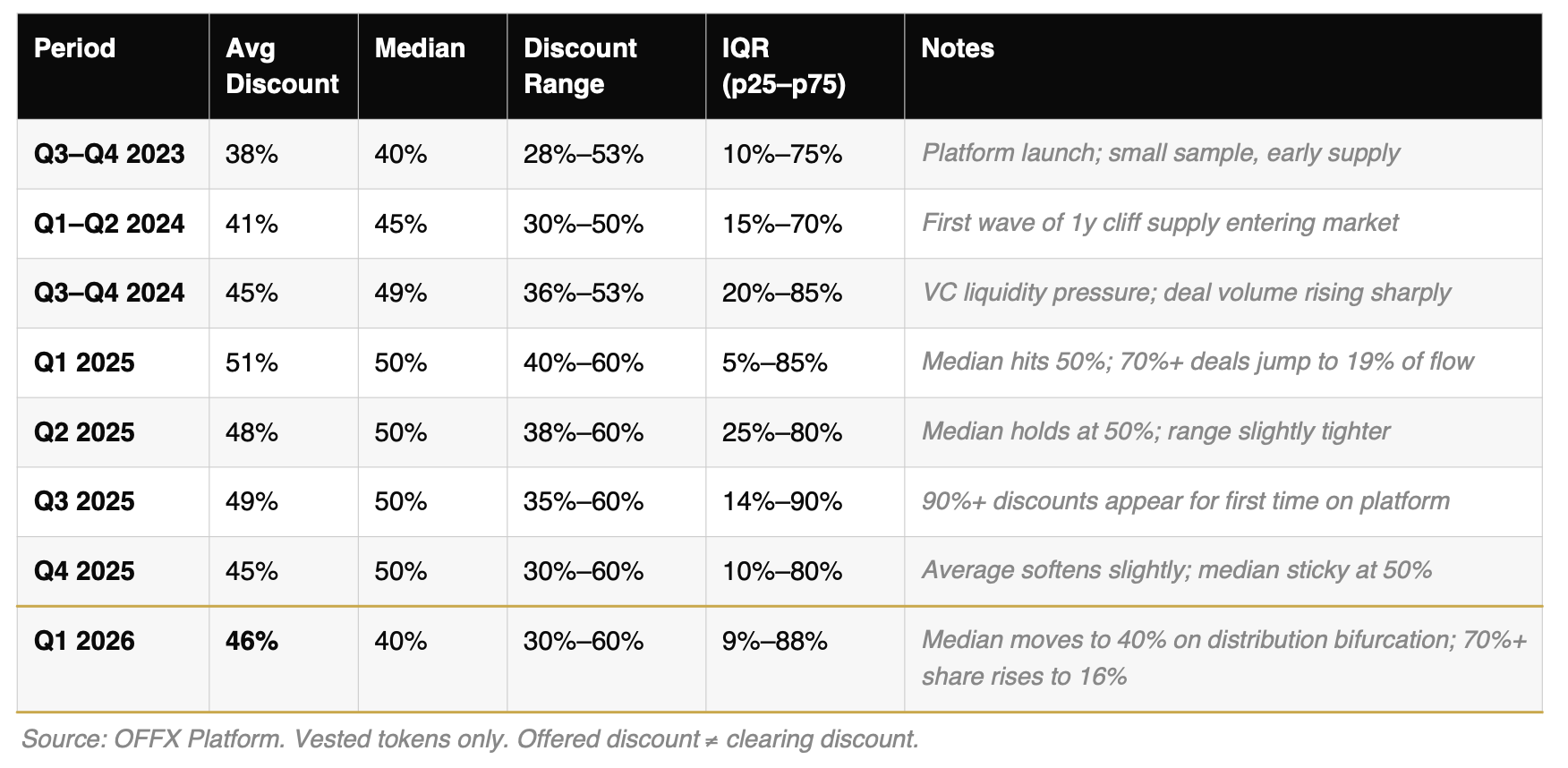
Discounts in crypto token secondary markets have mostly grown in recent years, based on data OFFX shared with The Block. OFFX has operated since August 2023.
Average discounts have moved from around 38% in late 2023 to around 45–50% in 2024 and 2025. Median discounts stayed close to 50% for most of this period, before dropping to around 40% in early 2026.
What has changed more is the range. Earlier, most deals were in a tighter band. Now the spread is wider. Discounts of 70% or more are appearing more often, and 90%+ discounts showed up for the first time in late 2025.
To subscribe to the free The Funding newsletter, click here.