
Blue Owl, at the center of the private equity credit storm, saw its stock price hit a record low.
Wall Street CN
3h ago
Ai Focus
Blue Owl shares fell 1.4% on Monday to close at $8.45, a record low below its previous low reached at the end of 2022. The stock hit an intraday record low last Thursday after the company announced it was restricting redemptions from two of its private credit funds following a surge in redemption requests.
Helpful
No.Help

Author:Wall Street CN

Shares of Blue Owl, the epicenter of the private lending storm, fell 1.4% on Monday to close at $8.45, a record low and below its previous low set at the end of 2022, driven by growing concerns about the health of the $1.8 trillion private lending market.
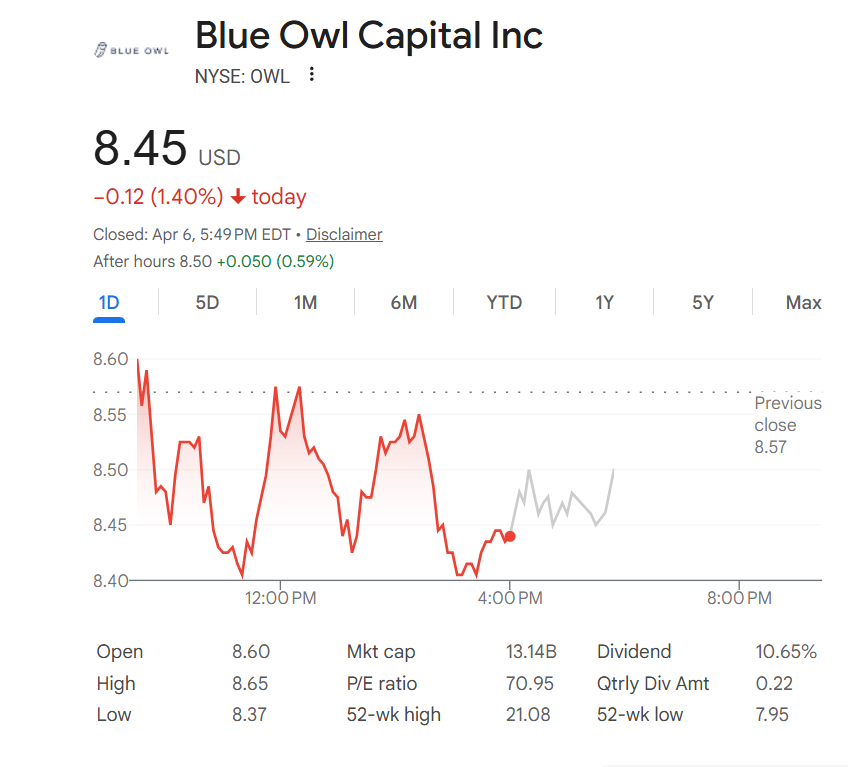
Previously, on Thursday of last week, Blue Owl announced that it was restricting redemptions from two of its private credit funds after a surge in redemption requests, and its stock price hit a record low during the day.

Blue Owl went public in May 2021 through a special purpose acquisition company (SPAC), a transaction formed by the merger of Owl Rock Capital Group and Dyal Capital Partners.

Business Development Companies (BDCs), a type of private credit fund targeting retail investors, are currently facing a surge in redemption requests due to growing market anxiety about their lending practices and exposure to companies vulnerable to artificial intelligence.

Blue Owl's stock has become a particularly popular bet on the continued deterioration of private credit due to its high exposure to software companies that may be replaced by artificial intelligence.

Blue Owl has just experienced its biggest quarterly drop ever and has fallen for eight consecutive months. Bearish bets on the stock reached an all-time high in early March.

Blue Owl owns multiple BDCs, a key channel for individual investors to participate in private lending. One of its technology-focused funds saw redemption requests exceeding 15% in the last quarter. During this period, the company had planned to merge two BDCs, but was forced to cancel the move due to concerns that it could cause significant losses for some investors.

In February, Blue Owl announced it had sold $1.4 billion in loans to meet investor redemption demands. In March, company executives defended the sale in a conference call with investors. Co-President Craig Packer stated that the deal "had no hidden terms or discounts."

Tip
$0
Like
0
Save
0
Views 393
CoinMeta reminds readers to view blockchain rationally, stay aware of risks, and beware of virtual token issuance and speculation. All content on this site represents market information or related viewpoints only and does not constitute any form of investment advice. If you find sensitive content, please click“Report”,and we will handle it promptly。
Submit
Comment 0
Hot
Latest
No comments yet. Be the first!
Related
The US private equity and credit fund industry is facing a "stampede crisis": If redemptions are not possible, what should the "net asset value" be?
The US private equity lending industry is experiencing a wave of redemptions, with giants like Cliffwater mired in a chain reaction of crisis. The core issue lies in the fact that while underlying funds restrict redemptions, upper-level funds continue to value assets at inflated "official net asset values," leading to a severe disconnect between book value and market reality. This accounting loophole has triggered a serious crisis of confidence, potentially accelerating an industry collapse and leaving investors with nothing.
Wall Street CN
·2026-04-05 11:18:05
178
The pressure on the private equity lending sector shows no signs of easing! Goldman Sachs barely holds its redemption limit, while Baring is forced to limit its lending activities.
There are clear signs of capital outflow from the private lending market. Goldman Sachs' funds saw redemptions close to the 5% cap in the first quarter, barely avoiding triggering restrictions, while Baring Private Equity was forced to cap its redemptions at 5% due to redemption requests reaching 11.3%.
Wall Street CN
·2026-04-07 02:32:16
358
After a missile hit an Amazon data center
A missile struck Amazon's Bahrain data center, disrupting AWS services and paralyzing payment and food delivery platforms, with direct losses potentially reaching billions of dollars. The fact that hyperscale data centers have been attacked in conflict highlights their status as highly "tempting" strategic targets—based on publicly available data, a 1GW data center represents a total investment of over $50 billion.
Wall Street CN
·2026-04-03 20:25:11
875
JPMorgan Chase CEO's letter to shareholders: Geopolitical risks outweigh everything, and private equity harbors hidden dangers!
It is worth noting that this Wall Street veteran is frequently "crossing boundaries," extending his reach into macroeconomic policy areas that go beyond banking itself, seemingly paving the way for a move into politics...
Jin10 Data
·2026-04-06 21:06:23
881
Bitcoin apparent demand hits record low; what’s next?
Finbold
·2026-04-06 18:02:29
735