


Author:Wall Street CN
Key points
I. The "Spring Festival + Qingming Festival" holiday boosted travel demand, and inbound tourism continued to grow rapidly.
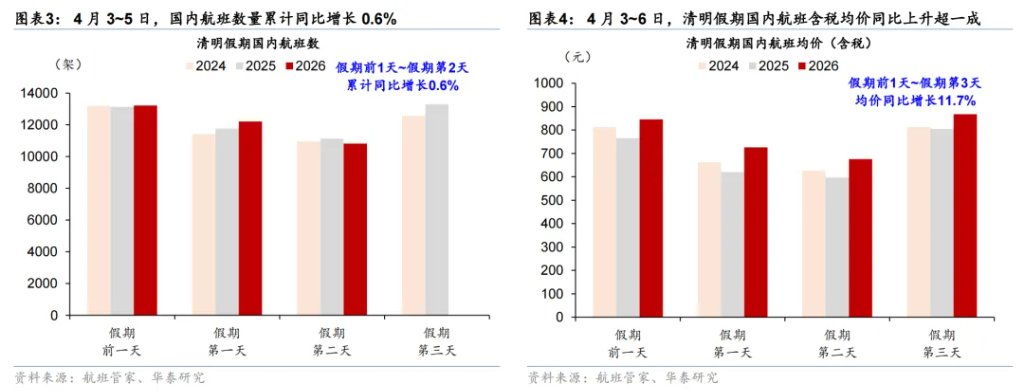
The combined Spring Festival and Qingming Festival holidays released a concentrated surge in residents' travel demand, resulting in a significant expansion of residents' travel radius compared to the same period last year, with self-driving tours dominating. From the first day to the second day of the Qingming Festival holiday, cross-regional population movement across society increased by 9.7% and 3.2% respectively compared to the same period in 2024 and 2025.Data from the Ministry of Transport shows that cumulative passenger flow by rail, waterway, highway, and civil aviation increased by 10.4%, 17.5%, 2.6%, and 4.1% year-on-year, respectively. Non-commercial passenger vehicle travel on highways and ordinary national and provincial roads increased by 2.8% year-on-year, accounting for over 80% of total passenger flow. Car rental, a popular mode of travel during the spring outing, also continued its structural upward trend: data from Shenzhou Car Rental shows that during this year's Qingming Festival holiday, the number of car rental bookings nearly doubled year-on-year, and intercity car rental bookings increased by nearly 2.5 times year-on-year. Flight Manager data shows that the average price of domestic air tickets for travel during the Qingming Festival holiday increased by 11.7% year-on-year.
Outbound and inbound tourism performed exceptionally well during the short holiday, possibly driven by the extremely high cost-effectiveness of Chinese tourism consumption, coupled with the fact that the Qingming Festival coincided with the overseas Easter holiday (April 3-6) this year.The National Immigration Administration predicts that the average daily number of inbound and outbound passengers at ports nationwide during this year's Spring Festival holiday will increase by 11.1% year-on-year, exceeding 2.3 million per day. Platform data shows that inbound tourism is more popular than outbound tourism. Data from Flightradar24 shows that domestic flight bookings for travel from April 1st to 6th exceeded 7.64 million, an increase of approximately 9% year-on-year; among them, bookings for inbound and outbound flights exceeded 1.42 million, an increase of approximately 16% year-on-year. Data from Qunar shows that during April 1st to 6th, the number of travelers with a travel radius of over 800 kilometers increased by more than 30%. Data from Ctrip shows that inbound tourism orders during the Qingming Festival holiday increased by nearly 90% year-on-year; inbound spending from European countries saw significant growth, with spending in Russia and Spain increasing by more than 1.5 times.
II. Multiple holidays combined to boost family and parent-child travel
The combined Spring Festival holiday and Qingming Festival extended the holiday, leading to an overall increase in tourism demand during Qingming, with a rise in the proportion of parent-child travel and family-oriented tourism.Several provinces, including Jiangsu, Zhejiang, and Sichuan, have announced pilot programs for the Spring Festival holiday, with many areas coinciding with the Qingming Festival to create a six-day break: a three-day Spring Festival holiday plus a three-day Qingming Festival holiday. Family travel has become the main driver of increased tourism spending during this holiday period, with parent-child trips, family trips, and multi-generational travel being particularly prominent. Data from Tongcheng Travel shows that nearly 25% of families traveling during the Qingming Festival are families, a significant increase compared to previous years, and over 60% of families are choosing 4-5 day trips. Meanwhile, bookings for theme parks, museums, zoos, science education sites, and study tours have increased.
The popularity of non-traditional tourist destinations and cultural tourism consumption is rising, and the main travel themes are expanding from flower viewing and spring outings to experiential consumption.Looking at hotel bookings and destination popularity, bookings for non-traditional popular destinations saw a significant expansion, with travel bookings to places like Wenchang in Hainan, Bortala in Xinjiang, and Pu'er in Yunnan all experiencing year-on-year growth exceeding 100%. In terms of travel activities, traditional flower viewing and spring outings still constitute the main theme of Qingming Festival travel, but there is a shift towards experience-oriented demand—data from Qunar shows that scenic spots such as Slender West Lake, Huangshan Mountain, Humble Administrator's Garden, Huangling in Wuyuan, and Yuantouzhu are among the most popular, while search popularity for theme parks has doubled year-on-year; cultural and museum visits, immersive cultural performances, tea garden tours, light outdoor activities, and destination consumption centered around local seasonal cuisine have also increased. However, as of the morning of April 6, this year's Qingming Festival film box office exceeded 246 million yuan, a decrease of over 30% compared to the 378 million yuan box office during last year's holiday.
Third, the demand for intelligent digital devices benefits from the optimization of the "trade-in" policy.
The consumer goods trade-in program has had a good start, with policy benefits for smart product consumption becoming increasingly apparent. According to data from the Ministry of Commerce, as of March 15 this year, the cumulative sales volume of related goods under the consumer goods trade-in program increased by 15.3% year-on-year, driving a 3.2% increase in sales revenue.At the product category level, policies for automobiles and home appliances, which are the focus of subsidies, have been optimized, while the subsidies for mobile phones and digital products have expanded, especially with the addition of new products such as smart home devices, smart bracelets, and glasses. In the first quarter of this year, the number and amount of subsidies for automobiles and home appliances may have declined year-on-year due to factors such as policy optimization. As of March 22, cumulative automobile retail sales this year have declined by 8% year-on-year. However, the number and amount of subsidies for mobile phones and digital products have increased year-on-year after the policy expansion—it is estimated that the total amount of national subsidies used in the first quarter of this year accounted for approximately 26% of the total annual subsidy usage.
text
I. The "Spring Festival + Qingming Festival" holiday boosted travel demand, and inbound tourism continued to grow rapidly.
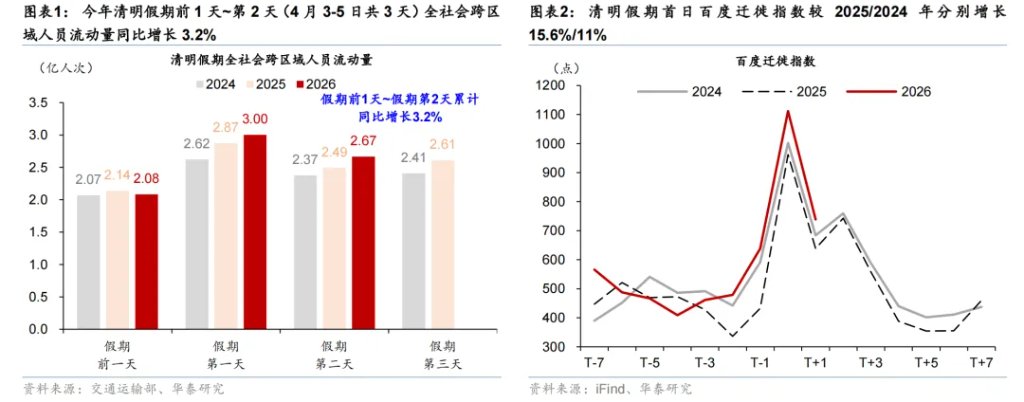
This year's Qingming Festival holiday saw continued high travel volumes from the Spring Festival holiday. Coupled with the implementation of spring breaks for primary and secondary schools in many parts of the country, resulting in a generally extended 6-day holiday combining a 3-day spring break with the Qingming Festival holiday, travel activity remained strong during the Qingming Festival. On a comparable basis, the first day of the Qingming Festival holiday and the second day of the holiday (April 3-5, a total of 3 days) saw significant travel activity.A total of 775 million cross-regional trips were made across society, representing a 9.7% and 3.2% increase in travel volume compared to the same period in 2024 and 2025, respectively (Chart 1). Compared to the same period in 2025, the frequency and radius of residents' travel activities during this year's Qingming Festival holiday expanded significantly. From April 3rd to 5th, the number of passengers transported by rail, waterway, highway, and civil aviation increased by 10.4%, 17.5%, 2.6%, and 4.1% year-on-year, respectively. Furthermore, data from Flight Manager (as of March 31st) shows that the average price of domestic air tickets for travel during the Qingming Festival holiday increased by 15.7% year-on-year.
-
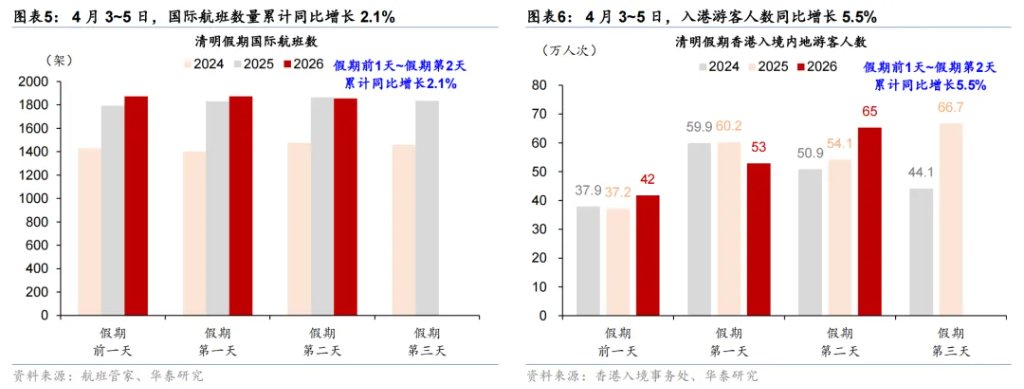
The cross-regional population movement in the whole society increased by 3.2% year-on-year from the first day to the second day of the Qingming Festival holiday this year (April 3-5, a total of 3 days).According to the cross-regional population flow depicted by the Baidu Migration Index, the travel enthusiasm of residents on the first day of the Qingming Festival holiday increased by 15.6% and 11% respectively compared to 2025 and 2024. The average Baidu Migration Index from April 3 to 5 also increased by 22.5% and 9.3% respectively compared to the same period in 2025 and 2024 (Chart 2). It is worth noting that this year's Qingming Festival holiday was the first to be a three-day holiday without any adjustments, coupled with the Spring Festival holidays in Sichuan, Jiangsu, Zhejiang, Anhui and other places, resulting in a maximum of 6 days of holiday, further expanding the travel radius of residents. Data from the Ministry of Transport also shows that the number of railway/civil aviation passengers from April 3 to 5 increased by 10.4% and 4.1% year-on-year, respectively; Flight Manager data shows that the number of domestic/international flights from April 3 to 5 increased by 0.6% and 2.1% year-on-year, respectively, and the average price of domestic air tickets increased by more than 10% year-on-year (Charts 3-5).
-
The combined Spring Festival and Qingming Festival holidays drove the growth of long-distance travel, significantly extending residents' travel radius.Data from Qunar also shows that the number of travelers with a travel radius of over 800 kilometers during the period from April 1st to 6th increased by more than 30% year-on-year, indicating that the combined Spring Festival and Qingming Festival holidays boosted residents' willingness to travel long distances and expanded their travel radius. Car rental, an important mode of travel during the spring season, also continued its structural upward trend—from April 3rd to 5th, the number of non-commercial passenger cars traveling on highways and ordinary national and provincial roads increased by 2.8% year-on-year, accounting for 85% of the total number of road travelers. Data from Shenzhou Car Rental shows that during this year's Qingming Festival holiday, the number of car rental bookings increased by nearly 100% year-on-year, and the number of intercity car rental bookings increased by nearly 2.5 times year-on-year; Haikou, Sanya, Kunming, Chengdu, and Nanning were among the most popular cities, with orders for SUVs suitable for family travel increasing by 42%. Data from the Ministry of Commerce also shows that during the Qingming Festival holiday, the number of intercity travelers increased by 15.1% year-on-year, and the number of car rental orders increased by approximately 40% year-on-year.
Outbound and inbound tourism performed exceptionally well during the short holiday, possibly attracted by the extremely high cost-effectiveness of Chinese tourism spending, coupled with the Qingming Festival and the overseas Easter holidays this year.The overlap of factors such as April 3-6 provided a boost.The National Immigration Administration predicts that the average daily number of inbound and outbound passengers at ports nationwide during this year's Spring Festival holiday will increase by 11.1% year-on-year, exceeding 2.3 million per day. Platform data shows that inbound tourism is more popular than outbound tourism. Data from Flightradar24 shows that domestic flight bookings for travel from April 1st to 6th exceeded 7.64 million, an increase of approximately 9% year-on-year; among them, bookings for inbound and outbound flights exceeded 1.42 million, an increase of approximately 16% year-on-year. Data from Qunar shows that during April 1st to 6th, the number of travelers with a travel radius of over 800 kilometers increased by more than 30%. Data from Ctrip shows that inbound tourism orders during the Qingming Festival holiday increased by nearly 90% year-on-year; inbound spending from European countries saw significant growth, with spending in Russia and Spain increasing by more than 1.5 times.
-
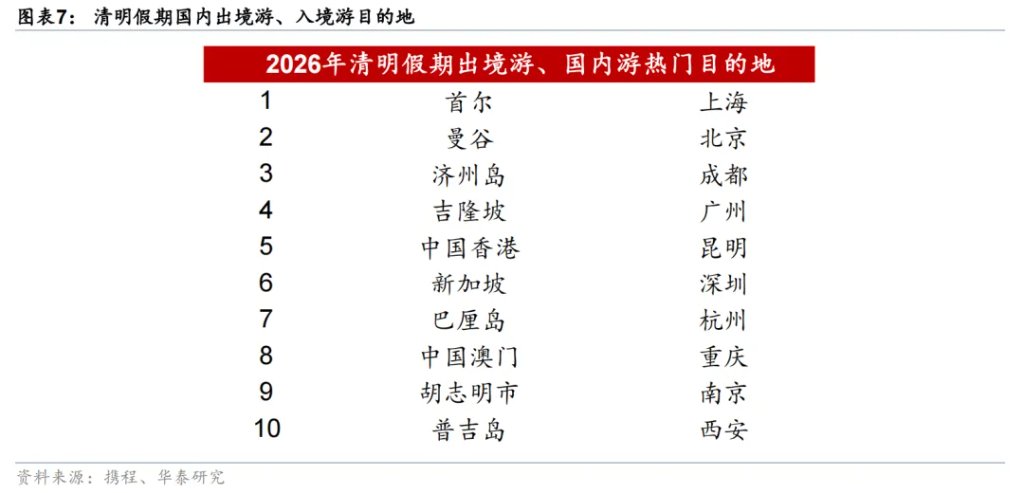
This year, many regions introduced spring break policies for primary and secondary schools, coupled with the five-day long holiday in Hong Kong and Macau, leading to a peak in outbound travel during the Qingming Festival holiday. This is evidenced by the 5.5% year-on-year increase in the number of tourists entering Hong Kong from the first day of the Qingming Festival holiday to the second day (April 3-5), and the 2.1% year-on-year increase in the number of international flights during the same period (Chart 6). Data from Ctrip shows that visa-free international destinations and destinations within a 3-4 hour flight radius are the top choices for Chinese tourists traveling abroad during the Qingming Festival holiday. Popular destinations include Kuala Lumpur, Bangkok, Bali, Chiang Mai, Singapore, Kota Kinabalu, Phuket, Seoul, and Jeju Island (Chart 7). Flights to South Korea saw a year-on-year increase of over 45%, and the popularity of travel guides combining Kuala Lumpur and Penang in Malaysia increased by 230% month-on-month. Bookings for "temple pilgrimage + spring market" combinations in Bangkok and Chiang Mai, Thailand, increased by 176% year-on-year.
-
The Qingming Festival holiday has become a new peak season for inbound tourism, with visa facilitation and the continued popularity of "China Travel" driving sustained growth in inbound tourism bookings.According to Ctrip data, inbound tourism orders during the Qingming Festival holiday saw a significant increase, with overall orders increasing by nearly 90% year-on-year. In terms of source countries, orders from visa-free countries increased by over 45% year-on-year, nearly three times the increase for non-visa-free countries. The top source countries included Australia, Uzbekistan, Canada, Turkey, Malaysia, and the United States. Turkish tourists saw a five-fold increase, Azerbaijani tourists a 4.5-fold increase, and Uzbek tourists a 4-fold increase. Furthermore, inbound spending from European countries saw a significant increase. Ctrip data shows that inbound spending from Russia and Spain increased by over 150%, while total spending from Italy, the Netherlands, and Belgium also recorded significant growth of 80%-150%. Ctrip data also indicates that the 2026 Qingming Festival coincided with the Easter holidays in Hong Kong and Macau, significantly boosting cross-border travel demand. Searches for inbound hotels increased by 250% year-on-year, with Hong Kong and Macau accounting for 60% of the demand. During the same period, overall inbound tourism orders increased by nearly 90% year-on-year, with orders from visa-free countries increasing by over 45%, significantly higher than those from non-visa-free countries.
II. Multiple holidays combined to boost family and parent-child travel
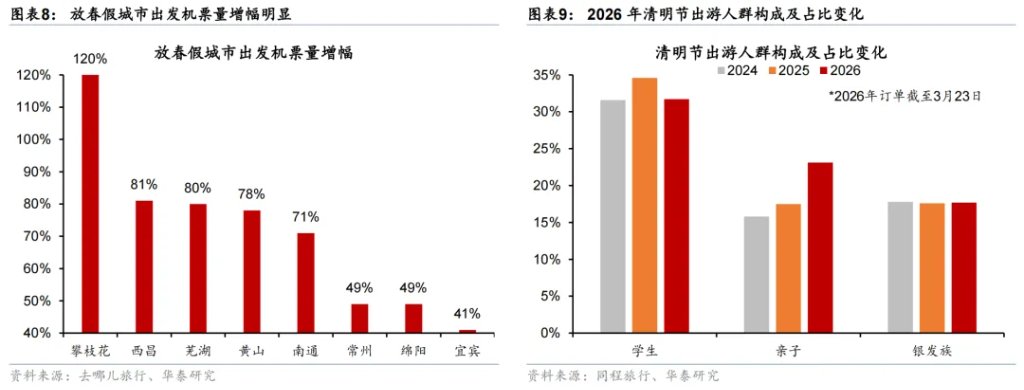
The combined Spring Festival holiday and Qingming Festival extended the holiday, boosting overall demand for tourism during Qingming, with a higher proportion of family and parent-child travel. In 2026, the Qingming holiday coincided with the implementation of spring break arrangements for primary and secondary schools in many regions. Several provinces, including Jiangsu, Zhejiang, and Sichuan, have already announced pilot programs for spring break, and in many places, the holiday dates are linked to Qingming, forming a 6-day long weekend of "3-day spring break + 3-day Qingming" (Chart 8). Data from multiple OTA platforms shows that parent-child travel may drive strong holiday travel bookings: Tongcheng data shows that as of March 23, search and booking activity for flights, hotels, homestays, and scenic spot tickets from April 1st to 6th nearly doubled year-on-year; Fliggy data shows that domestic hotel room nights booked during Qingming increased by approximately 40% year-on-year, and the number of domestic scenic spot tickets booked increased by over 70% year-on-year.
-
Family travel became the main source of increased tourism consumption during this holiday period, with parent-child travel, family travel, and multi-generational travel being particularly prominent. Data from Tongcheng shows that nearly 25% of travelers during the Qingming Festival were families, a significant increase compared to previous years, and over 60% of families chose 4-5 day trips. Data from Qunar shows that from April 1st to 6th, air passengers aged 13-18 increased by approximately 85% year-on-year, and passengers under 12 years old increased by approximately 55%, significantly higher than other age groups (Chart 9). Meanwhile, bookings for theme parks, museums, zoos, science education sites, and study tour products increased, reflecting a stronger demand from families for companionship-oriented, educational, and comprehensive experiential consumption during holiday travel.
-
Residents' travel radius has expanded significantly, with a rise in the proportion of medium- and long-distance and cross-border travel. Unlike previous years where the Qingming Festival holiday was dominated by short-distance trips to surrounding areas, this year, supported by a six-day holiday, residents' travel distances have increased significantly, releasing some demand for medium- and long-distance travel. Data from Qunar shows that from April 1st to 6th, the number of travelers with a travel radius of over 800 kilometers increased by more than 30%; data from Tongcheng shows that domestic long-haul flight bookings of over 800 kilometers have seen rapid growth, and the search popularity for inbound and outbound flights has increased by more than 50% year-on-year. For outbound travel, destinations within a 3-4 hour flight radius, such as South Korea, Thailand, and Malaysia, remained highly popular, with flights to South Korea increasing by more than 45% year-on-year.
-
The overall travel pace shifted earlier, with a noticeable increase in passenger flow and prices during the early part of the holiday.Because families tend to travel earlier to avoid peak times during the Spring Festival holiday, while working people mainly depart around the start of the Qingming Festival holiday, this round of Qingming Festival travel peaks exhibits a "two-stage" characteristic. Tongcheng's 2026 Qingming Festival Travel Forecast Report shows that the first peak is expected on April 1st and 2nd, with average airfares rising by over 30% compared to the previous week; followed by a second smaller peak on April 3rd and 4th, with the return travel peak occurring on April 6th. In terms of price, although airfares have increased significantly around Qingming compared to the previous week, given the increase in fuel surcharges in April and the typically higher airfares during the May Day holiday, Qingming is still considered a "price window" for long-distance travel by some families.
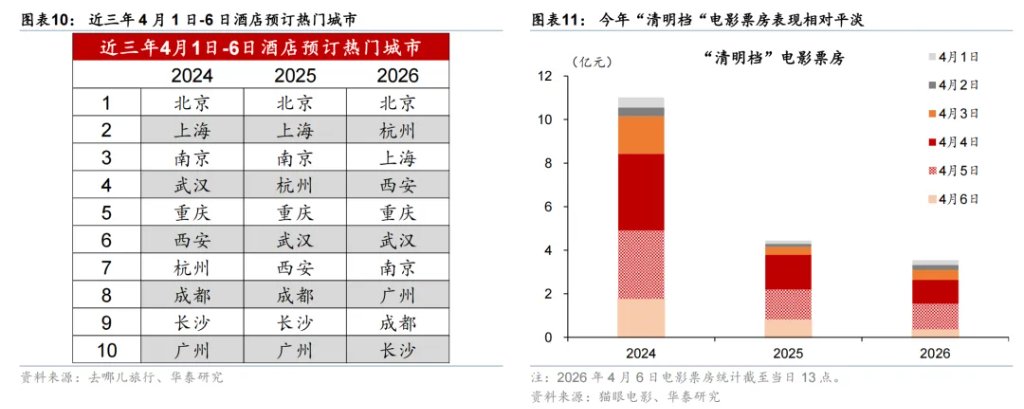
The popularity of non-traditional tourist destinations and cultural tourism consumption is rising, and the main travel themes are expanding from flower viewing and spring outings to experiential consumption.Looking at hotel bookings and destination popularity, traditional popular cities such as Beijing, Hangzhou, Shanghai, Xi'an, Chongqing, Wuhan, Nanjing, Guangzhou, Chengdu, and Changsha maintained high levels of activity, indicating that core cities still have significant advantages in terms of transportation accessibility, comprehensive cultural and tourism resources, and reception capacity. Traditional leisure and vacation destinations such as Haikou and Sanya saw a significant increase in bookings driven by the Spring Festival holiday, with hotel bookings increasing by more than 40% year-on-year. In terms of hotel bookings and destination popularity, booking growth for non-traditional popular destinations expanded significantly, with tourism booking growth rates for places like Wenchang in Hainan, Bortala in Xinjiang, and Pu'er in Yunnan all exceeding 100% (Chart 10).
In terms of travel activities, traditional flower viewing and spring outings still constitute the main theme of travel during the Qingming Festival holiday, but consumer preferences are extending towards content-oriented and experience-oriented demands.—Data from Qunar shows that scenic spots such as Slender West Lake, Huangshan Mountain, Humble Administrator's Garden, Huangling in Wuyuan, and Yuantouzhu are among the most popular, along with flower-viewing attractions. Searches for theme parks have more than doubled year-on-year. Demand for cultural and museum visits, immersive cultural performances, tea garden tours, light outdoor activities, and destination consumption centered around local seasonal cuisine has also increased. However, as of the morning of April 6th, box office revenue for films during this year's Qingming Festival exceeded 246 million yuan, a decrease of over 30% compared to the 378 million yuan box office revenue during last year's holiday (Chart 11).
Third, the demand for intelligent digital devices benefits from the optimization of the "trade-in" policy.
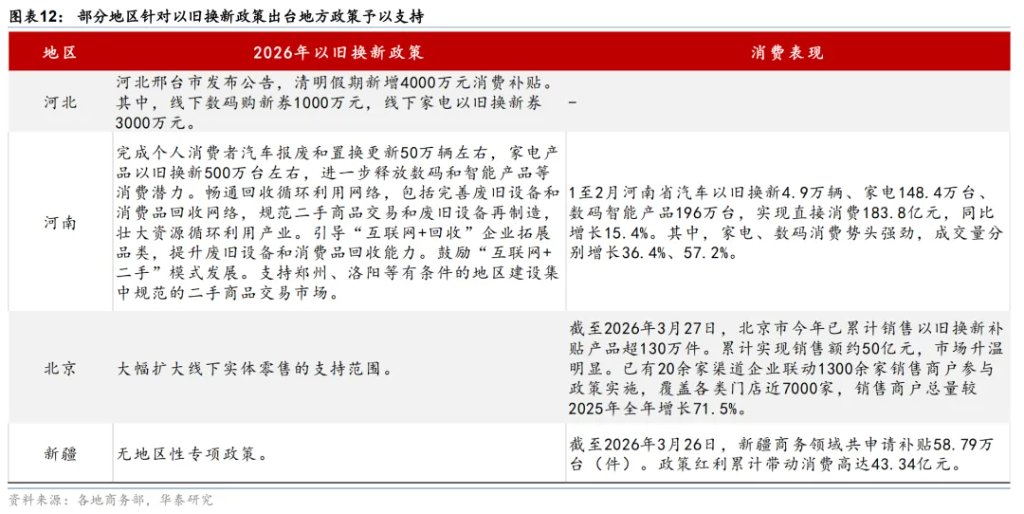
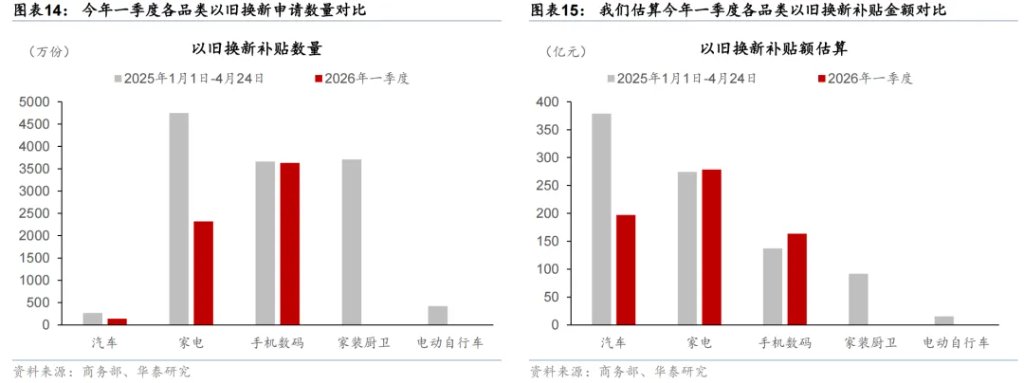
The trade-in program for consumer goods has had a good start, with policy benefits for smart products becoming increasingly apparent. According to data from the Ministry of Commerce, the number and amount of subsidies for automobiles and home appliances may have declined year-on-year in the first quarter of this year due to factors such as policy optimization. However, the subsidy amount for mobile phones and digital products has increased year-on-year after the expansion of the subsidy category. We estimate that this year...The total amount of national subsidies used in the first quarter accounted for approximately 26% of the annual subsidy usage.Various regions have also provided relevant policy support tailored to their local conditions. For example, Hebei Province allocated 40 million yuan in special subsidies before the Qingming Festival holiday, which was further divided into 10 million yuan in digital product vouchers and 30 million yuan in home appliance vouchers, guiding the recovery of offline physical retail through the "holiday effect." Beijing focused on improving channel penetration. By significantly expanding the scope of support for offline physical retail, it achieved an increase in the number of channel enterprises and merchants (Chart 12).
-
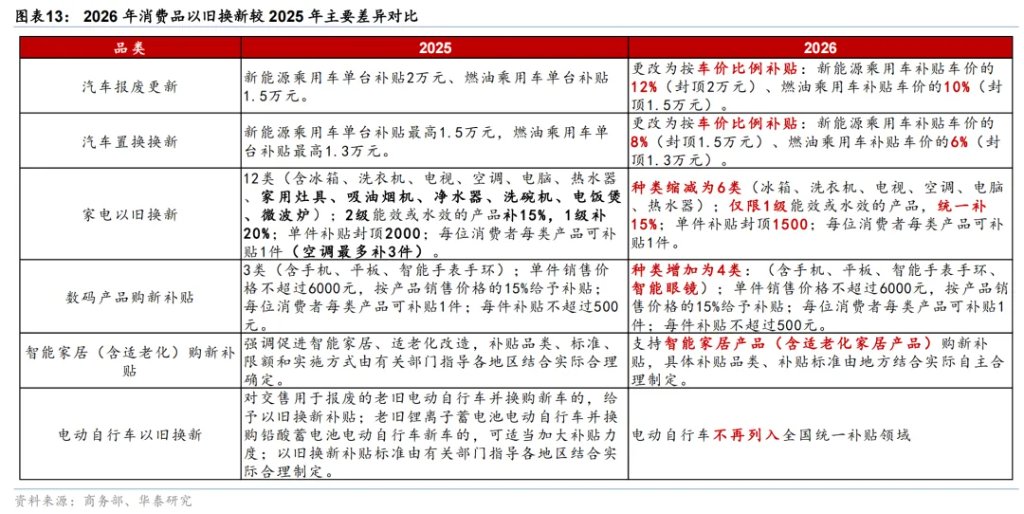
2026The annual consumer goods trade-in policy will continue, with total subsidies for the year estimated at approximately 250 billion yuan, a decrease of 50 billion yuan compared to the same period last year. (Category-based),The policies for automobiles and home appliances, which are the focus of subsidies, have been optimized, while the scope of subsidies for mobile phones and digital products has been expanded, especially with the addition of new products such as smart home devices, smart bracelets, and glasses.—The upper limit of automobile subsidies (scrapping and replacement) remains unchanged, but both have changed from fixed subsidies to proportional subsidies, which may reduce the total amount of subsidies, and the national subsidy standard may be unified; the categories of home appliance subsidies are more focused, reduced from 12 categories to 6 categories; and the subsidies for electric bicycles have been cancelled (Chart 13).
-
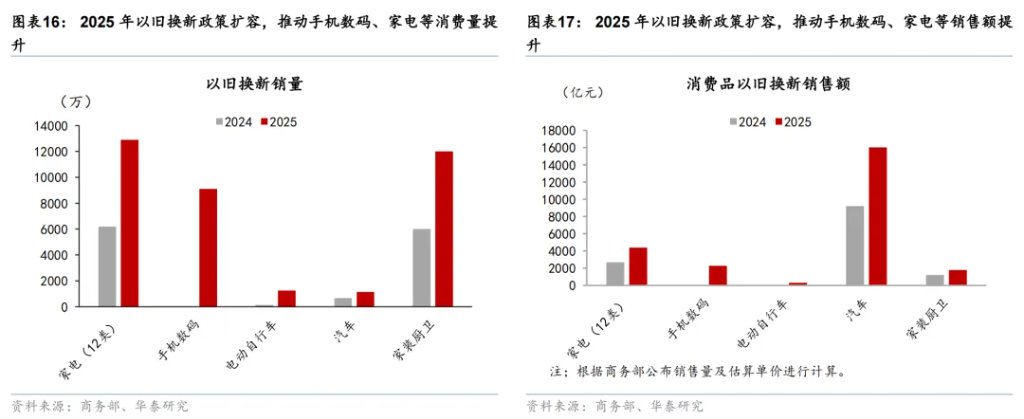
According to business big data,From January to March, sales of consumer goods under the trade-in program exceeded 433.17 billion yuan. We estimate that the national subsidies used for automobiles, home appliances, and mobile phones and digital products were approximately 20 billion yuan, 28 billion yuan, and 16 billion yuan, respectively, totaling about 26% of the annual subsidy usage.Specifically, the car trade-in program generated 228.69 billion yuan in sales. From January to March, the program received 1.408 million subsidy applications, driving new car sales of 228.69 billion yuan. Of these, 403,000 were for scrapping and replacing old vehicles, generating 51.96 billion yuan in sales; and 1.005 million were for trade-in subsidies, generating 176.73 billion yuan in sales (Charts 14-17). Furthermore, business big data shows that during the Qingming Festival holiday, sales of smart glasses and smartwatches/bands on key platforms increased by 3.2 times and 12.3%, respectively.
This article is sourced from: