


Author:Wall Street CN
The AI infrastructure boom has triggered a chip supply bottleneck, allowing Samsung Electronics to reap the benefits of price increases, with its quarterly profit approaching its total profit for the entire previous year.
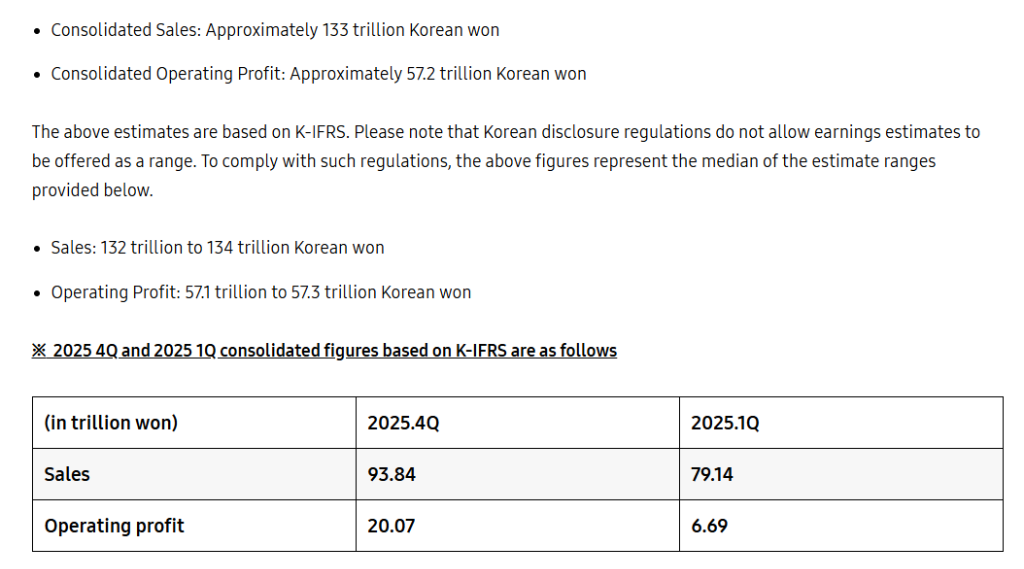
On April 7, Samsung Electronics released its Q1 2026 earnings forecast in Seoul. According to the official announcement, the company expects consolidated operating profit for the period from January to March this year to be approximately 57.2 trillion won (approximately US$37.9 billion), representing an increase of more than eight times compared to 6.69 trillion won in the same period last year.
This figure significantly exceeded market expectations. LSEG SmartEstimate had previously predicted Samsung's first-quarter operating profit to be 40.6 trillion won, but the actual result was about 41% higher. Meanwhile, the quarterly profit of 57.2 trillion won is close to Samsung's total operating profit for the entire year of 2025, and nearly doubles the previous quarterly record of 20 trillion won set in the fourth quarter of 2025.
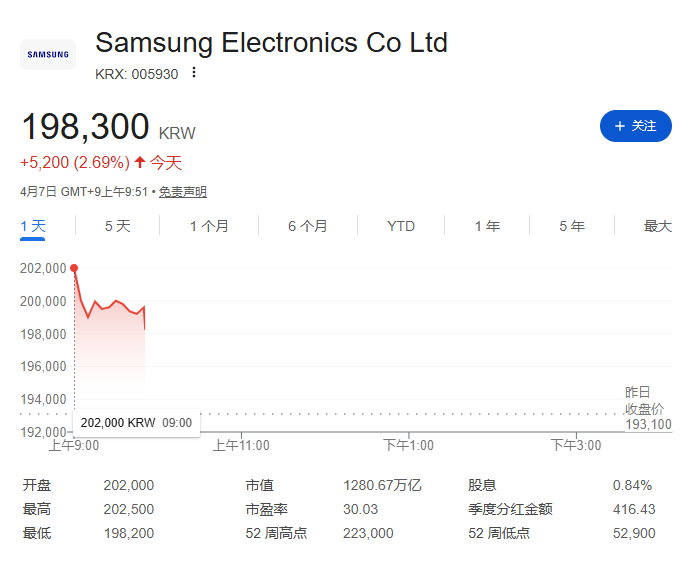
Following the announcement, Samsung's stock price rose as much as 4.6% to 202,000 won in early trading on Tuesday, outperforming the broader market index's gain of about 2%. The gains have since narrowed to less than 3%.
Chip price increases are the core driving force
Samsung's recent performance surge is rooted in the continued expansion of its AI data center construction.
A surge in demand for computing power has tightened the supply of traditional DRAM chips used in servers, causing prices to soar. According to Reuters, chip contract prices nearly doubled in the first quarter. Research firm TrendForce predicts that DRAM contract prices will rise by more than 50% in the current quarter.
Bank of America Securities analyst Kim Sunwoo explained the logic behind the better-than-expected results: "As clients anticipated further price increases, actual contract prices were higher than expected, which is why the results exceeded expectations."
Analysts estimate that Samsung's chip division generated approximately 54 trillion won in operating profit for the quarter, accounting for about 95% of the company's total profit. The mobile phone business contributed about 4 trillion won, benefiting from the digestion of low-cost component inventory.
First-quarter consolidated revenue is estimated at approximately 133 trillion won, representing a year-on-year increase of about 68%.
HBM catch-up progress
About a year ago, Samsung's CEO publicly apologized for the company's poor performance and stock price. At that time, Samsung was lagging behind its South Korean rival SK Hynix in supplying high-bandwidth memory (HBM) needed for Nvidia's AI chipsets.
Samsung is currently narrowing the gap with SK Hynix with its latest generation HBM4 chip, while also benefiting from the recovery in demand for traditional chips driven by AI inference – AI inference refers to the process of AI models such as ChatGPT generating responses in real time, which consumes a large amount of ordinary DRAM chips.
Meanwhile, U.S. memory chip manufacturer Micron Technology also announced last month that its third-quarter revenue would exceed Wall Street's expectations. This followed its record-breaking second-quarter results, which also benefited from strong AI demand and tight supply.
Hidden concern: The price increase cycle may have entered its later stages.
Despite the strong earnings, market concerns about future performance are growing.
Since the outbreak of conflict in the Middle East on February 28, rising energy costs and potential disruptions to the supply of key raw materials for chips have cast a shadow over the demand outlook for AI data centers. Samsung's stock price has fallen 11% since the outbreak of the conflict, although it is still up about 61% year-to-date.
"Concerns are growing that the memory price rally has peaked," said Ryu Young-ho, senior analyst at NH Investment & Securities. "It seems we've moved beyond the early stages of the uptrend and entered the later stages." He pointed out that how Samsung secures long-term contracts with its customers to maintain semiconductor profitability will be key.
TrendForce Senior Vice President Avril Wu also pointed out that DRAM spot prices fell last week because "end-user demand struggled to absorb the high prices." Spot prices are typically higher than contract prices, and their trend is considered a leading indicator of market sentiment.
In addition, Google's TurboQuant memory-saving technology, released last month, is also considered one of the reasons for the recent sell-off in memory chip stocks.