

Author:Chain Wizard
Original | Odaily Planet Daily@OdailyChina)
Author|Azuma (@azuma_eth)

On April 6, local time, the U.S. Treasury Department officially announced the latest developments regarding the "Trump Accounts"—Bank of New York Mellon (BNY) has been selected as the designated financial agent for the U.S. government to manage the initial accounts; Robinhood will partner with BNY as the brokerage firm and initial trustee for the "Trump Account".
All parties will work together to support the Treasury Department’s goal of ensuring that every eligible newborn American child can quickly and easily access a “Trump Account.”
What is a "Trump account"?
The so-called "Trump Account," also known as the 530A Account, is a tax-deferred investment account program established by then-US President Trump on June 9, 2025, under the "Big and Beautiful" Act. It aims to create government-sponsored savings accounts for the children of US citizens born between January 1, 2025, and January 1, 2029.
The initial funds for the "Trump account" came primarily from government grants, private donations, and family savings.Federal certification will provide $1,000 in initial funding for each account.Last December, Dell founders Michael Dell and his wife announced a donation of $6.25 billion to open accounts for 25 million children from regional families with a median income of less than $150,000, with each account receiving $250. Parents, friends, and other designated individuals can also deposit into the designated accounts, but can deposit a maximum of $5,000 per child per year.
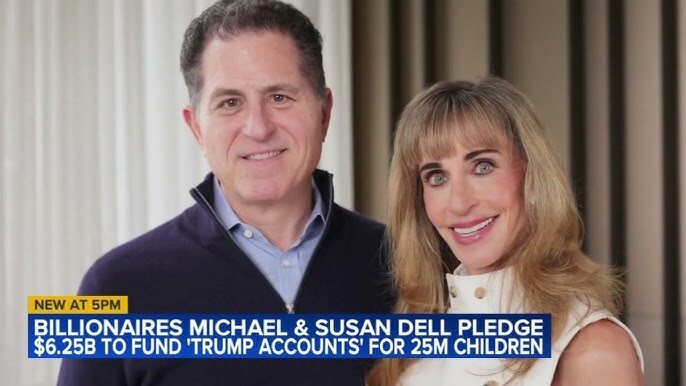
Odaily Note: Michael and Dell donated $6.25 billion, which Trump called "one of the most generous acts in American history."
On the investment front, the "Trump Account" will be limited to investing in low-cost funds or exchange-traded funds (ETFs) that track broad stock price indices such as the S&P 500, and cannot be used to invest in specific industry indices or sector indices. The use of funds is also restricted: before January 1st of the year the child turns 18 and becomes a legal adult, the funds in the account cannot be withdrawn for any reason (unless the child dies or the funds are transferred to another similar restricted account). After the child turns 18, the account will function like a traditional Individual Retirement Account (IRA).
According to the current plan,The Trump account is tentatively scheduled to begin accepting its first deposit on July 4, 2026 (the 250th anniversary of the Declaration of Independence).This comes just before the start of the 2026 midterm elections and is expected to become a key policy "killer move" for the Republican Party to win over voters.
What is the potential size?
According to Statista's statistics, since 2020, the average annual number of births in the United States has fluctuated around 3.6 million.
Using this data as a benchmark,During the planned coverage period from January 1, 2025 to January 1, 2029, the number of newborns in the United States is projected to reach approximately 14.4 million. If the federal government opens a $1,000 "Trump Account" for each child, this translates to a massive $14.4 billion.With the addition of potential private donations and household savings, this figure will continue to grow to tens of billions of dollars; if the plan continues as a long-term initiative beyond 2029, its potential size will be even more staggering.
Due to its long-term lock-up, passive investment, and continuous expansion characteristics, the "Trump Account" will essentially become a long-term passive fund pool with a potential size of hundreds of billions of dollars. Rather than simply serving as a child welfare benefit, this is more like establishing a long-term capital transfer channel between fiscal policy and the capital market, directly incorporating the next generation into the stock market system.
Biggest beneficiary: Robinhood?
Following the public announcement of the "Trump Account" plan, financial institutions such as JPMorgan Chase, Charles Schwab, and Robinhood began fierce competition surrounding related services.With the U.S. Treasury Department officially appointing Robinhood as the broker and initial trustee yesterday, Robinhood, having secured its "ticket," is expected to become one of the most direct beneficiaries of the program.
The most direct benefit lies on the user side. Based on the current policy coverage, the "Trump account" will correspond to tens of millions of newborn accounts, and the interaction between these accounts will be completed through a unified application—in other words,Robinhood will gain a pool of potential users who are already tied to the platform from birth, ranging in age from just one year old to before they were even born....More importantly, these users are not one-off customers, but potential customers with an extremely long lifecycle. Children's accounts will transition to long-term investment accounts similar to IRAs after they turn 18. This means Robinhood has the opportunity to directly handle these users' investment behavior as they enter adulthood, and further extend into more business scenarios such as ETFs, options, and even crypto assets. From a lifecycle perspective, this is almost the longest user path a brokerage firm can acquire.
The positive factors on the asset side should not be overlooked either.The funds in the "Trump Account" have a clear long-term lock-up characteristic, and are unlikely to flow out before the children reach adulthood. At the same time, the investment scope is limited to index funds. For securities firms, this type of fund is a high-quality custodial asset - with low volatility, long retention, and predictable size.Furthermore, Robinhood's core identity has historically been that of a "retail trading platform," with growth heavily reliant on market conditions and trading activity. The "Trump Account," however, introduces low-frequency, long-term, and passive investment funds, which aligns more closely with the characteristics of traditional wealth management funds. As the proportion of such funds increases, it will, to some extent, enrich Robinhood's business diversity and address its relative weaknesses.
at the same time,Policy endorsement also carries symbolic significance.By participating in the Treasury-led account program, Robinhood entered the U.S. government's financial infrastructure for the first time. This not only enhanced its institutional credibility but also provided new narrative space for its future expansion into retirement accounts, long-term investments, and wealth management.
From a political perspective, the "Trump Account" is a crucial policy bargaining chip for the Republican Party in the midterm elections; from a capital market perspective, this plan introduces an institutionalized long-term source of funding for the US stock market. Robinhood stands precisely at the intersection of these two perspectives.With millions of newborns who have not yet entered society having "automatically opened accounts," this policy design centered around voting has quietly paved the way for Robinhood's growth curve, which may last for more than a decade.