











Author:Encryption Tracker
Bitcoin global computing power has declined noticeably in early 2026, signaling mounting financial pressure across the mining sector.
Specifically, according to the Hashrate Index report, the network’s 30-day average hashrate fell to 1,004 EH/s in Q2 2026, down from 1,066 EH/s in the previous quarter. This marks a 5.8% decline, the sharpest contraction seen in several quarters.
This pullback coincides with a steep decline in Bitcoin’s price, which slid from $126,000 in October 2025 to $65,000 by February 2026, directly eroding mining revenues.
Consequently, profitability has deteriorated significantly. Hashprice, a key measure of miner earnings, has dropped to a record low of $27.89 per PH/s per day, underscoring the severity of the downturn.
Key Points
- The Bitcoin network hashrate declined 5.8% to 1,004 EH/s in Q2 2026, signaling weakening mining activity and sector-wide financial stress.
- A sharp price collapse in Bitcoin from ~$126K to ~$65K has severely reduced mining revenues.
- Miner profitability has deteriorated to record lows, with hashprice falling to about $27.89 per PH/s/day.
- High-cost mining rigs (with efficiency above ~25 J/TH) are becoming unprofitable, forcing large-scale hardware shutdowns and capacity exits.
- Around 252 EH/s of computing power is estimated to be offline, reflecting widespread miner retreat and consolidation.
Profitability Challenges Force Equipment Shutdowns
With margins tightening, many mining operations are struggling to remain viable. Equipment operating above 25 J/TH efficiency is now running at negative margins, rendering older machines economically unfeasible.
In response, operators have begun shutting down less efficient hardware to curb losses. This wave of retirements has taken a substantial amount of capacity offline, with an estimated 252 EH/s now inactive—much of it likely retired permanently.
Taken together, these developments reinforce a familiar pattern: mining activity is closely tied to price cycles, with economics outweighing external political or regulatory factors.
Global Distribution Remains Concentrated
Even as total capacity declines, the geographic distribution of mining power remains largely unchanged.
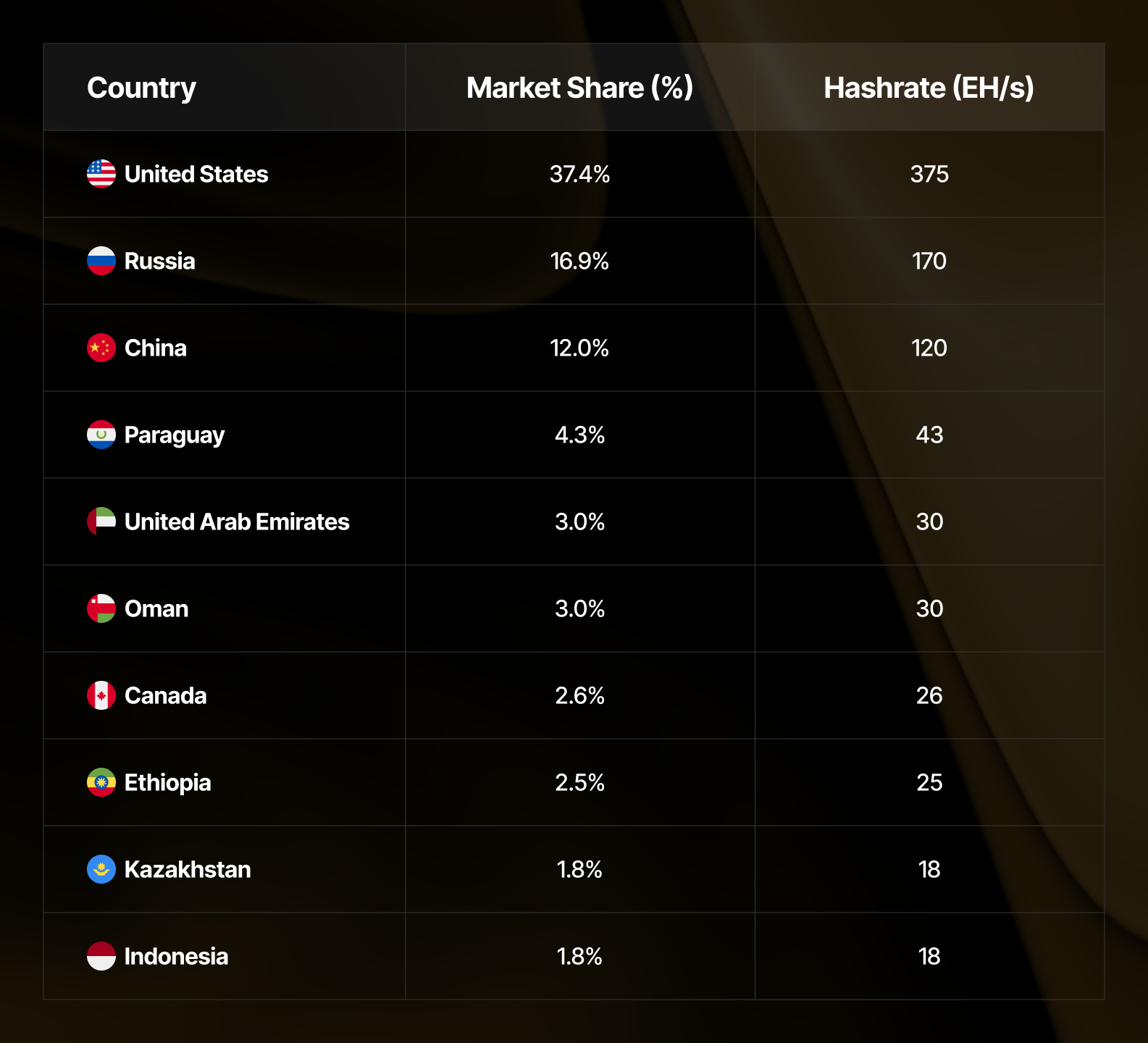
The United States remains the dominant player, accounting for 37.4% of global hashrate, or roughly 375 EH/s. However, its share has edged slightly lower due to equipment retirements and a gradual pivot by some operators toward artificial intelligence infrastructure.
Meanwhile, Russia holds second place with a 16.9% share, maintaining stability despite sanctions and regulatory uncertainty. China follows with 12%, although its capacity declined after compliance actions in Xinjiang in December 2025 eliminated around 13% of its operations.
Together, these three countries still account for nearly 65% of global Bitcoin hashrate, highlighting the network’s persistent concentration.
Emerging Markets Gain Momentum
While established leaders retain dominance, several smaller markets are expanding rapidly and reshaping parts of the mining landscape.
Kyrgyzstan stands out for exceptional growth, posting a 300% year-over-year increase and a 167% quarter-over-quarter rise. This expansion follows the introduction of clearer mining regulations in mid-2025, which helped attract new investment.
Similarly, Paraguay has strengthened its position, growing 54% annually and reaching 4.3% of global hashrate. Its progress is largely driven by professional mining operations entering the market.
At the same time, Laos and Finland have each doubled their capacity compared to last year, benefiting from abundant hydroelectric resources and favorable climate conditions, respectively.
Ethiopia has also moved into the global top tier, securing 2.5% of total hashrate and ranking eighth overall. Notably, this growth continued despite a government pause on new permits in mid-2025. By honoring previously approved projects, authorities maintained investor confidence and allowed expansion to continue.
Declines in Other Regions
In contrast to these growth stories, several regions are experiencing clear declines. Iran’s hashrate fell by roughly 7 EH/s during the quarter, largely due to ongoing geopolitical tensions.
Argentina recorded an even sharper contraction, with a 42% year-over-year decline driven by persistent macroeconomic instability. Brazil, however, presents a more nuanced picture. Its hashrate increased by 133% over the past year, reaching 3.5 EH/s.
Despite this strong growth, the report notes that upcoming quarters will be critical in determining whether this rise reflects long-term expansion or a temporary surge.
Bitcoin Network Difficulty Adjusts to Changing Conditions
Amid these shifts, Bitcoin’s network continues to self-correct. In early April 2026, mining difficulty increased by nearly 4%, following an earlier decline of about 8%, reflecting the protocol’s built-in mechanism for responding to changes in active mining capacity.
Taken together, these adjustments, along with shifting regional dynamics, illustrate a mining sector that remains highly responsive to market conditions.
According to the Hashrate Index report, the current phase is less about external disruption and more about the natural impact of price cycles on operational sustainability.