

Author:Wall Street CN
The landscape of sell-side research at securities firms in 2025 will be turbulent, with rankings undergoing dramatic shifts.
With the full implementation of the public fund fee rate reform, the once huge commission pie has shrunk. However, from another perspective, the new commission policy has brought the allocation of commissions back to the fundamentals of investment research, thus unfolding a new reshuffling perspective.
Based on the rankings, sell-side research has shown at least the following three trends this year:
On the one hand, teams with outstanding research capabilities in large institutions have gained new development advantages, thereby expanding their market share;
On the other hand, the original sales-oriented commissions have been greatly reduced, resulting in a significant drop in the rankings of some securities firms with outstanding sales capabilities.
Thirdly, and more importantly, the reduction in commissions led to a shift in the positioning of some small and medium-sized research institutions, with some institutions (partially) withdrawing from the research field, resulting in a rapid decline in their rankings.
In this shift where sell-side commissions have moved from the fast track of "scale expansion" to the narrow gate of "research competition," the world of sell-side firms has been completely upended.
Each of the top ten companies has its own reasons.
The 2025 public fund commission rankings were finalized in early April. The "Matthew effect" among the top players remained significant, with the top ten securities firms accounting for more than half of the market share. However, the internal rankings underwent a dramatic reshuffle and restructuring.
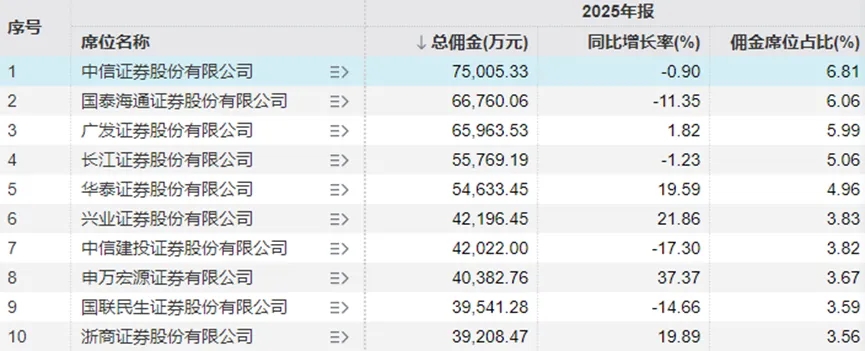
According to WIND data, CITIC Securities maintained its top position with total commissions of 750 million yuan. Although this represents a slight year-on-year decrease of 0.90%, its dominant lead remains unshaken. Guotai Haitong Securities, GF Securities, and Changjiang Securities followed closely behind, occupying second, third, and fourth place respectively. The top four positions remained unchanged from the previous year, demonstrating the stability of the "top-tier" group.
From the perspective of the increase in actual commissions received, Huatai Securities, Industrial Securities and Zheshang Securities emerged as the biggest winners, with year-on-year growth rates approaching or exceeding 19%, demonstrating extremely strong aggressiveness.
Huatai Securities ranked fifth in commission rates, a position previously held by CITIC Securities.
In addition, Shenwan Hongyuan Securities made a strong comeback with an astonishing increase of 37.37%, jumping directly from 13th place at the end of 2024 to 8th place.
Publicly available information shows that in 2025, Wang Sheng was internally promoted to director of Shenwan Hongyuan Research Institute, succeeding Zhou Haichen. Wang Sheng was previously Shenwan's chief strategist, leading the institute's transformation towards "research + investment research/industry research/government research".
In stark contrast, CITIC Securities and Guolian Minsheng Securities faced significant challenges in the fierce competition, with their commission income declining by 17.30% and 14.66% respectively, dropping from 5th and 6th place in 2024 to 7th and 9th place today. Of course, being in the top ten still proves that these two institutions still have strong research capabilities.
Overall, the commission war in 2025 is no longer simply a competition of scale, but also a contest of service resilience and transformation speed.
The close-quarters combat among the mid-tier teams
The commission-based reform is a major change in China's securities industry in recent years, aiming to reduce commission fees and enhance market competitiveness. This means that securities firms will no longer rely on high commission income, but will instead attract clients by improving the quality of research services, professional capabilities, and innovation. For companies that fail to adapt in time, this reform may lead to a loss of market share and the risk of being eliminated from the market.
Under this trend, the competition for rankings from 11th to 20th is no longer about the common prosperity of the incremental market, but rather about the extreme squeezing of the existing market share, presenting a stalemate where "every millimeter counts".
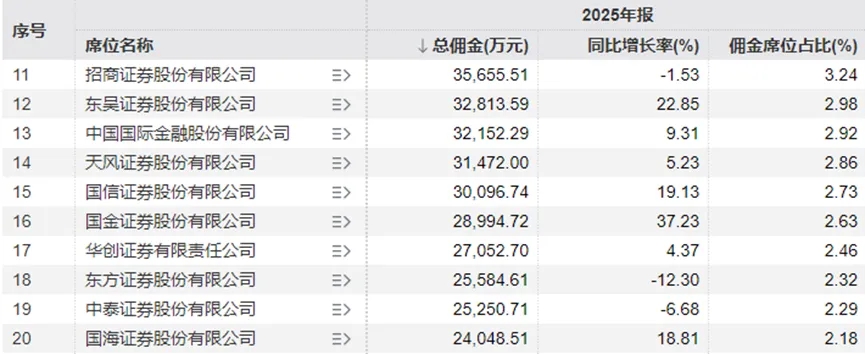
In this group, China Merchants Securities ranked 11th with total commissions of 357 million yuan (8th in 2024). Historically, China Merchants Securities has been a regular in the top ten.
However, the pursuers behind them are close behind, with Dongwu Securities (328 million yuan) and CICC (322 million yuan) trailing them by a negligible margin.
A notable feature of this tier is the dramatic divergence in growth momentum: Guojin Securities (rising from 21st to 16th) and Dongwu Securities (rising from 16th to 12th) have become exemplary in breaking through against the trend, with year-on-year growth rates of 37.23% and 22.85% respectively, demonstrating that even under the pressure of fee reductions, a precise and proactive research service positioning can still open up market opportunities.
Zishitang's analysis of publicly available information reveals that: Su Chen is the head of the Guojin Securities Research Institute. This sell-side team initiated its 3.0 reform in 2021 and launched a talent strategy in 2024, continuously attracting top analysts and making significant moves. The management of the Dongwu Securities sell-side team has distinct characteristics. Currently, it adopts a co-head management model, with the core person in charge being the head, Guo Jingjing, a female leader with a senior sales background. The co-heads are Zeng Duohong (who also serves as the chief economist for electric and new energy) and Lu Zhe (who also serves as the chief economist).
In contrast, Dongfang Securities and Zhongtai Securities saw slight reductions in their commission rates, falling by 12.30% and 6.68% respectively. Both saw changes, with Dongfang Securities inviting senior research director Huang Yanming to join them in April 2025. Zhongtai Securities, on the other hand, has been experiencing personnel changes among its research staff, which has also attracted attention.
Overall, the ranking changes in this range are actually a brutal test of the service premium capabilities of securities firms' research business during the "reduction in quantity and improvement in quality" cycle.
Intense competition fueled by the "dark horse" surge
The rankings of brokerage commissions, from 21st to 30th, exhibit a near-rebirth-like fluctuation.
This is understandable. Research institutions in this region are usually the first to challenge this segment after personnel restructuring or the addition of big names, and it is also the segment that established institutions must defend after several twists and turns. Often, changes in a few key positions involving big names, resulting in adjustments to commissions, can lead to drastic changes in rankings.
Against the backdrop of commission reforms, this tier of securities firms has become the most dramatic area on the entire list.
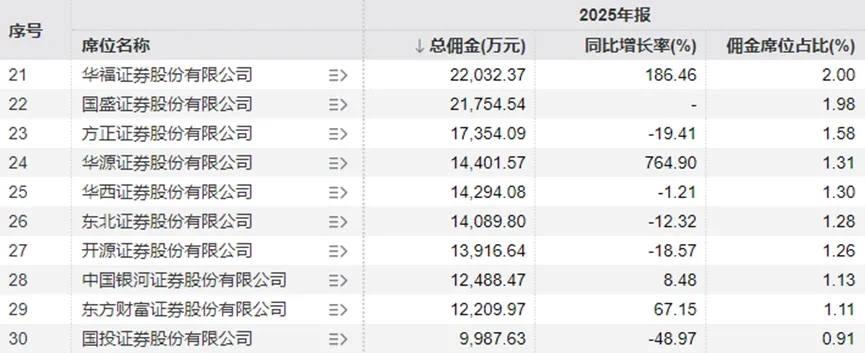
Huafu Securities and Huayuan Securities are undoubtedly the biggest "dark horses" of the year.
Huafu Securities made a strong breakthrough with a year-on-year increase of 186.46%, rising from 33rd place in 2024 to 21st place.
Huayuan Securities staged an astonishing turnaround, with its commission income surging by 764.90% year-on-year, leaping from the margins (from 58th to 24th place).
Huayuan Securities, formerly known as Jiuzhou Securities, changed its name after a shareholding change in 2023. The brokerage expanded its sell-side team significantly in 2024, yielding immediate results. Notably, the highly renowned Liu Yuhui joined as chief economist, and nearly 30 analysts were brought in to join the firm in 2024.
This extraordinary growth may stem from its precise bets on specific niche markets, or from its successful absorption of excess resources during a period of industry consolidation.
However, the other side of prosperity is brutal elimination.
Guotou Securities led the decline with a 48.97% drop, while Founder Securities and Kaiyuan Securities also recorded declines of close to or exceeding 18%. This precipitous drop starkly reveals that in the era of commission reduction, securities firms' sell-side market share is either advancing or declining, and they are facing a "survival crisis" of having their market share rapidly seized if they are not careful.
The Long Tail: Foreign Capital Divergence and the Breakthrough Battle of Small and Medium-Sized Securities Firms
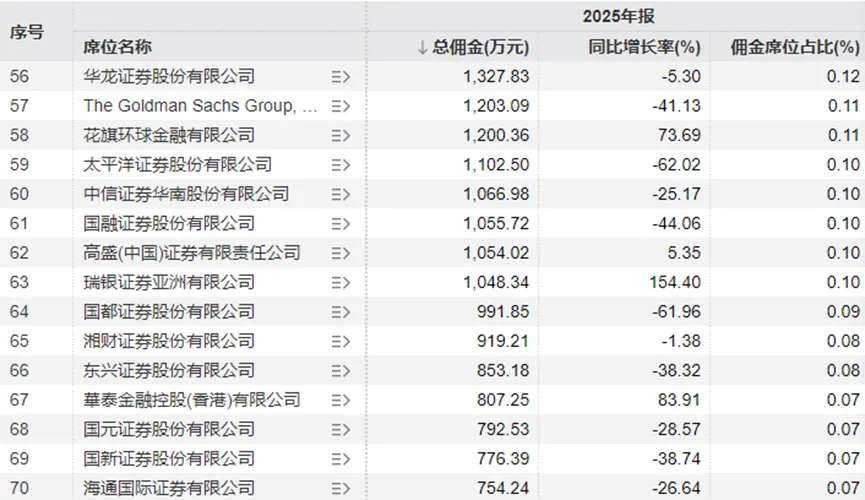
The 31st to 70th places on the list constitute the "long tail" of the industry. The competition here is no longer a simple ranking of scale, but an "ecological reconstruction" concerning survival space.
Amid the industry upheaval triggered by commission rate reforms, securities firms in this tier exhibited a striking dual characteristic: "differentiation from foreign capital" and "breakthrough of small and medium-sized securities firms."
Among them, AVIC Securities, ranked 39th, achieved a 108% year-on-year increase in commissions. It is understood that this brokerage firm, backed by the Aviation Industry Corporation of China (AVIC), focuses on in-depth research in industries such as manufacturing and military, and is led by experts including Chief Economist Dong Zhongyun and Director Zou Runfang.
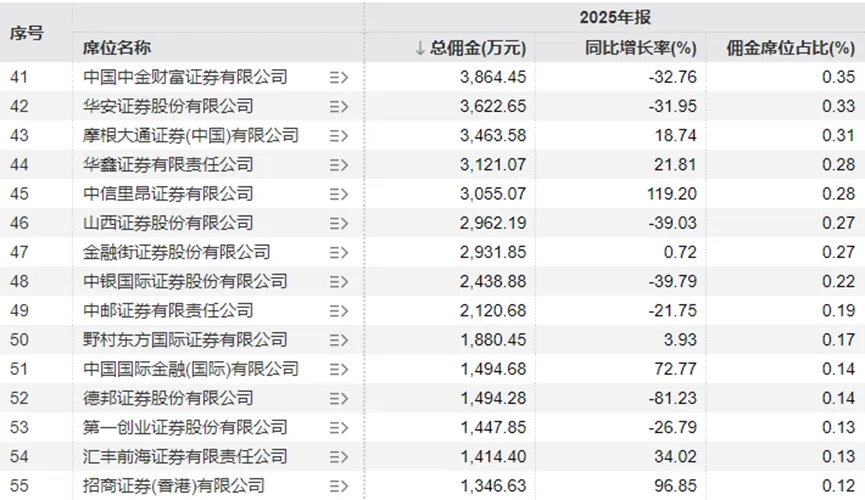
Starting from 41st place, the competition for commission rates became quite exciting. The most notable example was CLSA, which broke through with a strong year-on-year increase of 119.20%.
Among foreign sell-side institutions, UBS Securities (154.40%) and Citigroup Global Markets (73.69%) saw explosive growth, completely shattering the stereotype that foreign capital is "unsuited to local conditions." This demonstrates that foreign giants are rapidly seizing high-value existing markets during industry reshuffling by leveraging their global perspective and professional services. Even Goldman Sachs (China) Securities Co., Ltd. recorded a steady growth of 5.35%, further confirming the risk resistance capabilities of leading foreign institutions.
However, the other side of prosperity is brutal elimination. The divergence among small and medium-sized securities firms is even more pronounced, with Debon Securities leading the decline with a 50% drop of -81.23%, followed by Guodu Securities (-61.96%), Pacific Securities (-62.02%), Guorong Securities (-44.06%), Dongxing Securities (-38.32%), and Guoxin Securities (-26.64%), all of which also recorded sharp declines.
Among the "Hong Kong branches" of Chinese securities firms, the divergence in performance constitutes the most brutal comparative experiment. CLSA broke through with an astonishing growth rate of 119.20%, becoming the fastest-growing "dark horse" in the long-tail group, with its performance almost doubling, demonstrating extremely strong explosive power in cross-border business development.
Following closely behind is China International Capital Corporation (International), which maintained a high growth rate of 72.77%, firmly holding its position in the second tier. Both demonstrate that leading Chinese institutions, through their internationally-oriented positioning, are fully capable of carving out high-value niches in a competitive market. In contrast, Haitong International Securities served as the "control group," recording only RMB 7.5424 million in commissions and a negative growth of -26.64%, ranking 70th.
This stark contrast between "same origin, different fate" profoundly reveals that the logic of Chinese companies going global has changed: simple geographical advantages are no longer effective, and even those located at the forefront of opening up in the Yangtze River Delta or the Greater Bay Area are not immune to the survival crisis of marginalization in the industry reshuffle.
Overall, the dramatic fluctuations in commission rates reflect intensified competition within the industry. Small and medium-sized securities firms lacking core research strengths or with weak client bases are facing a survival crisis of marginalization.