


Author:Wall Street CN
The continued rise in yields on Japanese long-term government bonds is triggering a cross-border liquidity contraction.As unrealized losses at Japanese financial institutions continue to widen...Pressure to repatriate capital led to a sell-off of risky assets.
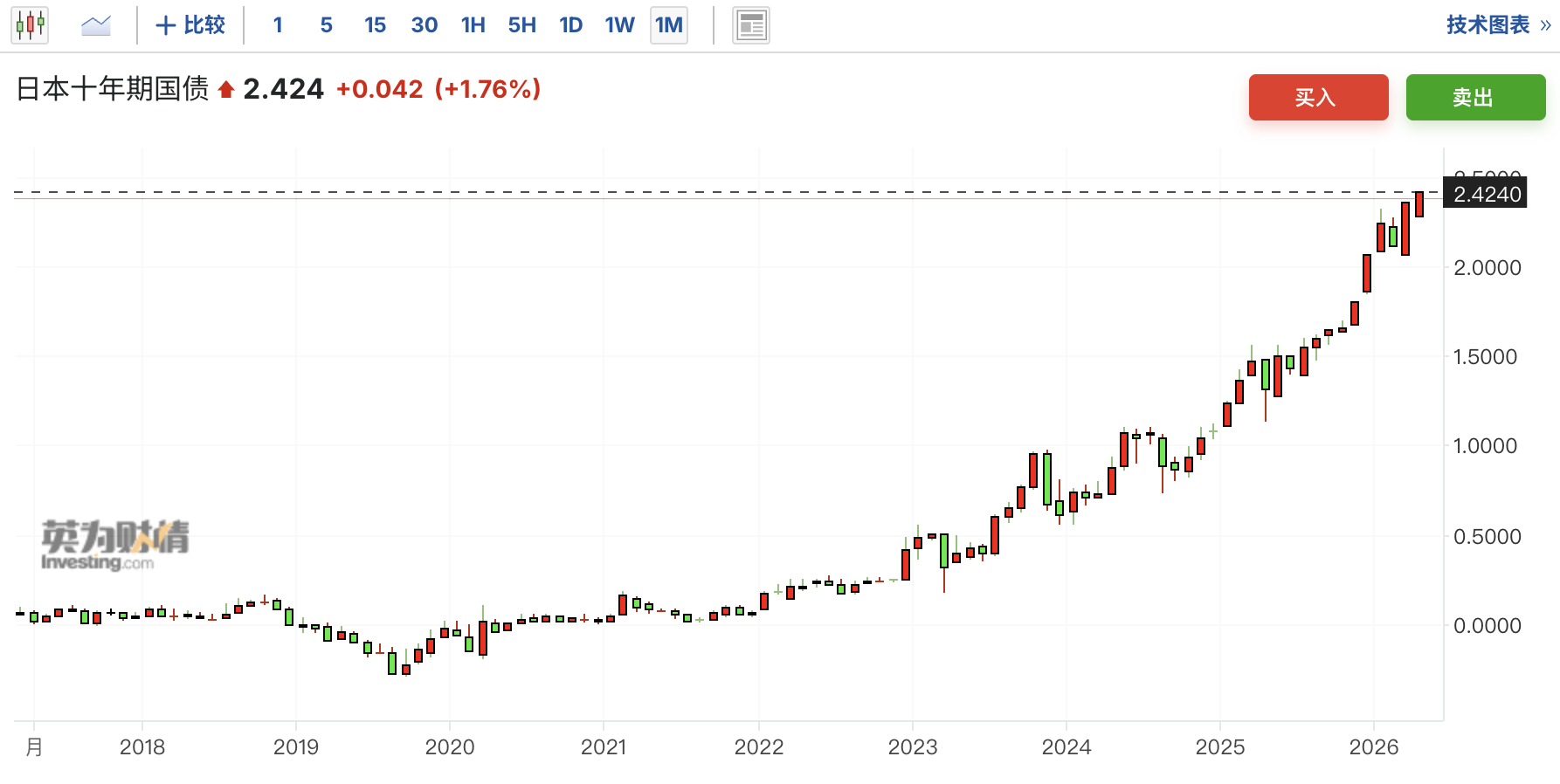
The yield on Japan's 10-year government bond rose 4 basis points (bps) to 2.424% on Monday, a 27-year high.The reason is that last Friday's non-farm payroll data weakened expectations of a Fed rate cut, coupled with the continued inflationary pressure from the US-Iran conflict and concerns about Japan's fiscal expansion.
Japanese banks, life insurance companies, and pension funds collectively hold approximately 390 trillion yen (about 2.4 trillion US dollars) in Japanese government bonds. Theoretically, every 1 percentage point increase in yield would result in valuation losses amounting to tens of trillions of yen.
To offset losses and maintain a healthy balance sheet, these institutions accelerated the sale of overseas risky assets and repatriated funds. Market data shows that foreign credit denominated in yen (including overseas loans and investments) has turned into a year-on-year decline, confirming that Japanese-origin funds are withdrawing from global markets.
Rising yields triggered valuation losses, forcing institutions to sell off foreign risk assets.
The upward trend in Japanese government bond yields is not a temporary fluctuation, but a structural change driven by expectations of a policy shift, inflationary pressures, and fiscal concerns. Overseas asset allocations accumulated over a long period during the low-interest-rate era are now facing systemic adjustment pressures as the interest rate environment reverses.
The yield on Japan's 10-year government bond rose 4 basis points (bps) to 2.424% on Monday, a 27-year high. The yield on Japan's 40-year government bond rose 9.5 basis points to 3.965%.
Japan is one of the world's largest net holders of foreign assets, and the scale of overseas assets held by its financial institutions is significant.
As losses on government bond valuations continue to widen, institutions are forced to liquidate overseas risky assets to replenish liquidity and repair their balance sheets. This chain of events unfolds as follows:Rising yields → falling bond valuations → widening unrealized losses → selling foreign risky assets → repatriation of funds to Japan → contraction of global market liquidity.
The year-on-year negative growth in foreign credit denominated in yen is direct data evidence of this mechanism, indicating that the outflow of funds originating from Japan has become a trend.
Exchange rate linkages amplify pressure, putting pressure on dollar-denominated assets.
The foreign exchange market is another crucial link in this transmission chain. Rising interest rates in Japan have increased the relative attractiveness of the yen, creating upward pressure on the yen.
This could trigger further capital outflows from dollar-denominated assets, putting additional pressure on overseas risk assets through exchange rate channels.
Changes in Japan's monetary policy and government bond market are no longer merely internal issues for one country. Against the backdrop of its vast foreign assets, the chain reaction triggered by interest rate fluctuations in Tokyo is quietly but undeniably altering the global market environment for risky assets.