
Key Changes to Aster Multi-Asset Mode Interest Rates
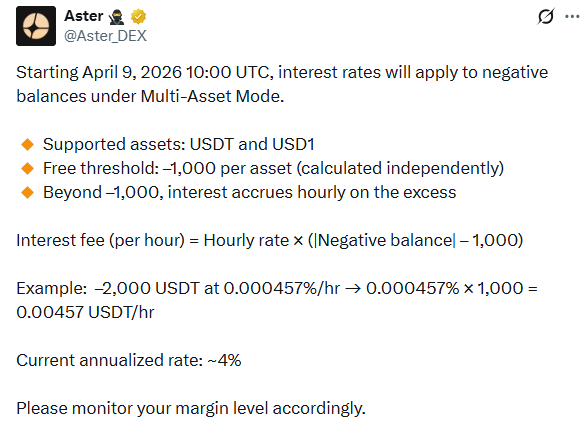
What happens when a trading platform starts charging for negative balances? That is the question many traders may now ask after Aster's announcement a new rule for Aster Multi-Asset Mode. In a post on X, the platform said interest will apply to negative balances in USDT and USD1 starting April 9, 2026, at 10:00 UTC. The update adds a clear cost for users who keep borrowed margin balances below the allowed free level. In a market where leverage, collateral, and margin management shape daily trading decisions, even a small hourly fee can change behavior.
 Source: X(formerly Twitter)
Aster Multi-Asset Mode Starts New Interest Rule
Under the new rule, Aster Multi-Asset Mode will apply interest only after a balance drops below minus 1,000 in USDT or USD1. The limit is counted separately for each asset. That means a trader could be below the threshold in one asset without affecting the other. Once the negative balance moves past minus 1,000, interest starts to build every hour on the excess amount.
They also shared a simple example. If a user has a minus 2,000 USDT balance and the hourly rate is 0.000457%, the fee applies only to the extra 1,000 USDT below the free threshold. In that case, the hourly charge would be 0.00457 USDT. The platform said the current annualized rate is about 4%, though hourly charges will be the number traders watch most closely.
How Aster Multi-Asset Mode Works for Margin
The change matters because Aster Multi-Asset Mode is built to let traders use shared collateral across positions. Instead of treating each trade alone, the system looks at the account more like one portfolio. Gains, losses, and collateral work together under a cross-margin setup. That can help active traders use capital more efficiently, but it also means negative balances can stay open as part of normal trading activity.
This is why the new fee stands out. It turns negative balances into a direct carrying cost. For traders who use leverage often, that cost may become part of daily risk control. For smaller users, the free threshold may reduce the impact. Still, anyone who leaves a negative balance open for too long may now need to think more carefully about how much that position costs over time.
Why the Aster's Update Matters to Traders
The update does not look dramatic at first glance, but it could shape how traders act inside Aster Multi-Asset Mode. Some may rebalance faster. Some may move collateral sooner. Others may cut leverage earlier to avoid steady hourly charges. This is especially important for accounts that use USDT and USD1 as working margin assets.
The announcement also shows a broader trend in crypto derivatives. Trading platforms are becoming more precise about how they price risk. Instead of only relying on liquidation rules or collateral discounts, exchanges and decentralized trading venues are adding smaller, ongoing costs that push users toward tighter margin discipline. In that sense, the move fits a wider market shift.
Market Context and Future Outlook
For now, there is no sign that the announcement caused a major market shock. The bigger effect is likely to be on trader behavior, not headline prices. Aster Multi-Asset Mode now gives users a clearer signal: negative balances are possible, but deeper deficits will come with a cost. That may support stronger risk control during volatile trading periods.
As crypto trading platforms refine leverage tools, rules like this may become more common. Interest on negative balances, collateral value ratios, and account-level risk checks are all part of a maturing derivatives market. For traders, the main takeaway is simple. Aster Multi-Asset Mode still offers shared collateral and flexible margin use, but from April 9, keeping a deep negative balance in USDT or USD1 will no longer be cost-free.
YMYL Disclaimer: This article is for informational purposes only. It is not financial, investment, legal, or trading advice. Crypto and margin trading carry risk, and readers should review official platform updates before making decisions.