

Author:TechFlow
Author: Deep Tide TechFlow
Deep Tide Guide:The Fellowship of Tether, a crypto super PAC that has been established for seven months and claims to have raised over $100 million without spending a single penny, announced on Wednesday the appointment of Jesse Spiro, Vice President of Regulatory Affairs at Tether US, as its chairman. This marks the first official public connection between Tether and the PAC. Meanwhile, another major crypto PAC, Fairshake, already boasts a $193 million treasury. The two PACs combined have nearly $300 million in political funds aimed at the November midterm elections, while the legislative battle in Congress over stablecoin yields remains unresolved.
The political arms race in the crypto industry is escalating.
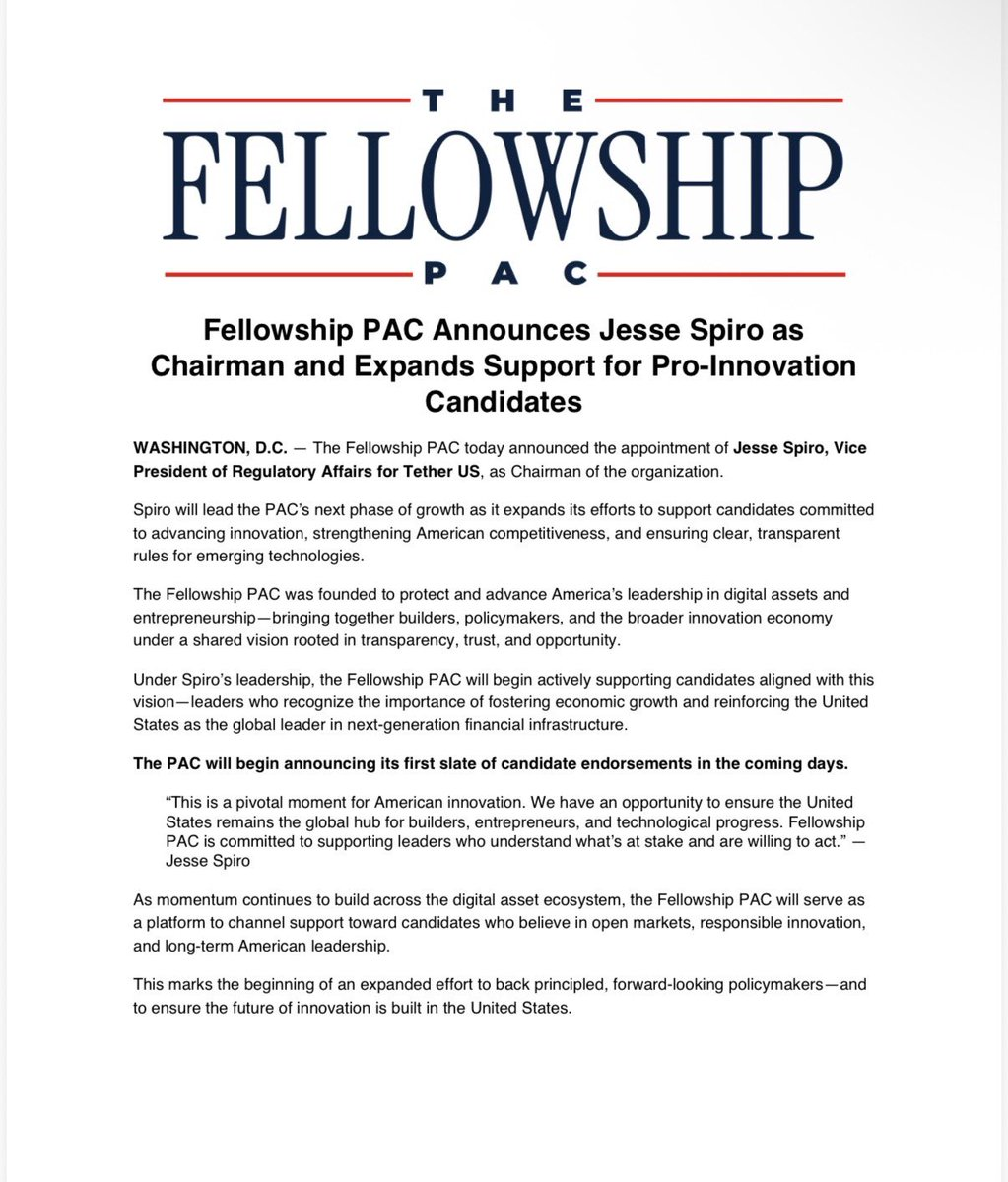
According to a Cointelegraph report on April 1, the Fellowship PAC announced on Wednesday that Jesse Spiro, Vice President of Regulatory Affairs at Tether US, will serve as the organization's chairman, leading its next phase of expansion. The first list of endorsers will be released in the coming days. Fellowship is a super PAC founded in August 2025, and last September announced it had raised "more than $100 million" from unnamed donors aligned with the crypto industry.
In a statement, Spiro said, "This is a pivotal moment for American innovation. We have an opportunity to ensure that America continues to be a global hub for builders, entrepreneurs, and technological advancement. Fellowship PAC is committed to supporting leaders who understand the stakes and are willing to take action."
From "denying any connection" to "executives overseeing the process," the relationship between Tether and the Fellowship has come to light.
Since its high-profile debut last September, the identity of the financial backer behind Fellowship PAC has been one of the biggest mysteries in the industry.
The PAC was established without disclosing any administrators, donors, or key employees. Early reports listed Tether as a potential backer, but Tether International subsequently officially denied any affiliation with the PAC. According to a CoinDesk report in February of this year, a Tether International spokesperson explicitly stated that "Tether International has no affiliation with Fellowship."
But the FEC records tell a different story. Mitchell Nobel, the registered financial officer of the Fellowship, was an executive at Cantor Fitzgerald, the custodian firm managing billions of dollars in reserves for Tether. The PAC is registered in Bethesda, Maryland.
Now, a current Tether US executive has officially assumed the position of Chairman of the PAC, finally putting all the previous rumors into public record. According to BeInCrypto, this marks the first formal and public connection between the Fellowship PAC and Tether.
Spiro joined Tether in 2024 as Head of Government Affairs. Prior to that, he was responsible for blockchain and digital asset regulatory relations at PayPal, and before that, he held a leadership position in government affairs at on-chain analytics company Chainalysis.
The $100 million "ammunition depot" has yet to fire a single round; FEC records show zero expenditure.
Despite Fellowship's claim of having $100 million in funding, FEC records show that as of December 31st of last year, the PAC had not reported any donation income or expenditure. Since its launch last September, Fellowship has only issued three public statements on the X platform, operating almost "invisibly."
This discrepancy has sparked widespread skepticism. A February 25 investigative report by CoinDesk pointed out that Fellowship had "never shown up" in the seven months since its inception, and its promised $100 million in funding was nowhere to be found in the Federal Election Commission's disclosures.
Spiro's appointment is seen as a sign that Fellowship is returning to the public eye after a period of dormancy. The PAC has stated that it will announce the first batch of candidate endorsements in the coming days, with more than seven months to go before the November midterm elections.
Bo Hines, executive director of the White House Advisory Council on Digital Assets, expressed his support for the appointment on the X platform, stating, "The fight for American innovation needs serious advocates. I look forward to seeing a leader who truly understands the stakes elected."
Cryptocurrency PAC Arms Race: Fairshake, with $193 million in assets, has already spent $8.6 million in Illinois.
Fellowships aren't the only political funding machine in the crypto industry. Fairshake PAC, backed by Coinbase, Ripple, and a16z, and its affiliates reported holding $193 million in cash as of January, making it the largest super PAC in the crypto industry in terms of cash reserves.
Fairshake has already begun its campaign. According to Cointelegraph, the PAC and its affiliates have spent approximately $8.6 million on the Illinois congressional race, six times its planned spending in the state in 2024. While some of Fairshake-backed candidates failed to win the Illinois primary in March, there is still a seven-month window before the midterm elections.
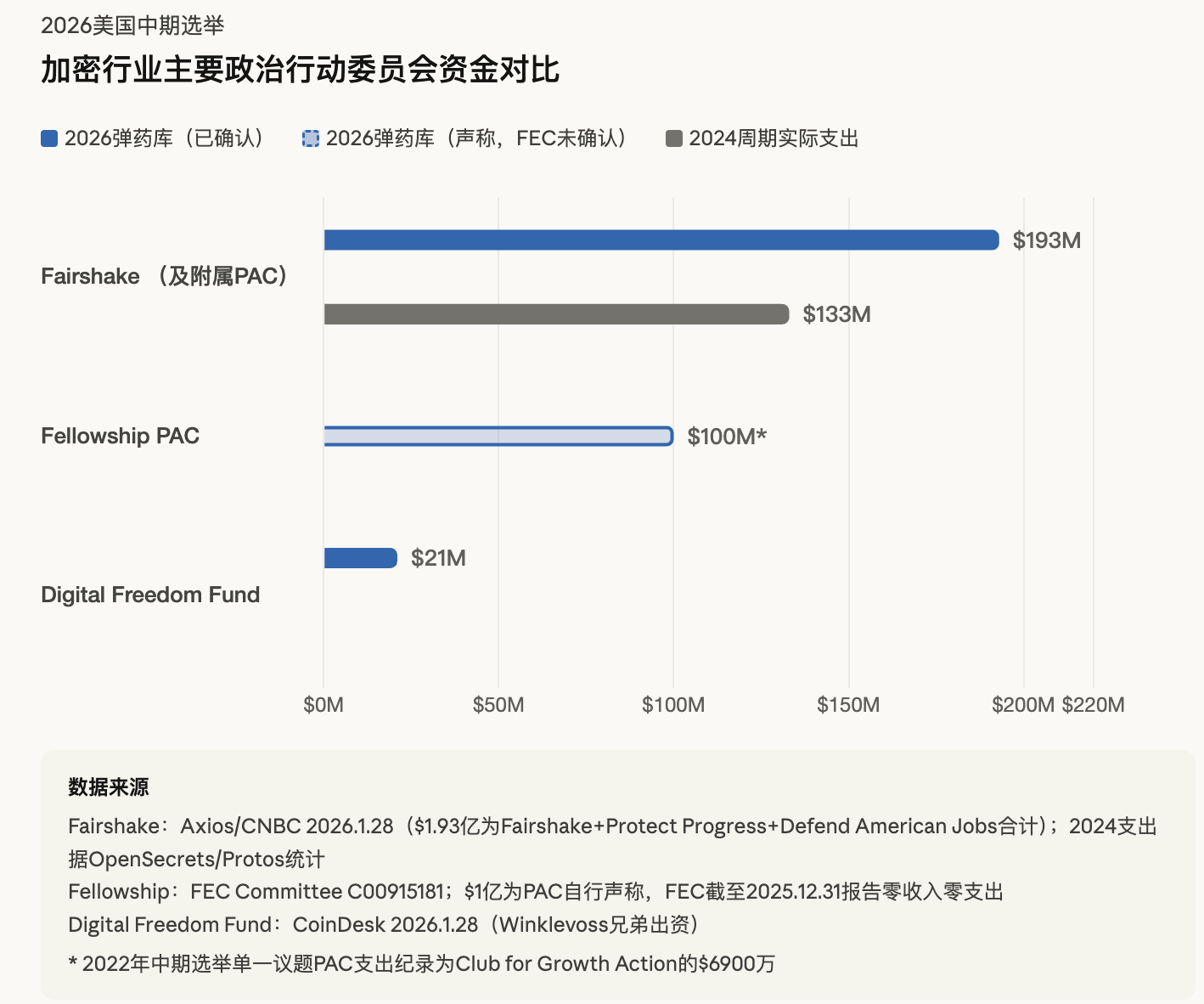
In the 2024 election cycle, Fairshake spent over $130 million on media spending, and most of the more than 50 candidates it supported were elected. According to statistics from the non-profit watchdog organization Public Citizen, nearly half of the corporate funding flowing into the 2024 election came from the crypto industry.
With the combined $300 million treasury of Fellowship and Fairshake, plus other political donations from the crypto industry, the 2026 midterm elections are poised to set a new record for political spending in the sector.
Legislative Battle: Stablecoin Yield Dispute Stalls Clarity Act, Tether's Interests are Stake
Spiro's appointment is not accidental. The CLARITY Act, a core legislative priority for the crypto industry, is stuck in the Senate deadlock, and one of the focal points of the dispute is stablecoin yields, which directly impacts Tether's business model.
The Clarity Act passed the House of Representatives in July 2025 with a vote of 294 to 134, and passed the Senate Agriculture Committee in January of this year. However, at the Senate Banking Committee level, the banking industry and the crypto industry are engaged in fierce debate over whether stablecoins can pay users yields.
On March 20, Senators Thom Tillis and Angela Alsobrooks reached a compromise in principle on stablecoin yields: prohibiting passive yield payments based on held balances, but allowing reward programs based on trading activity. According to CoinDesk, crypto industry representatives reviewed the latest draft in a closed-door meeting on Capitol Hill on March 23, deeming the language too narrow and vague. Coinbase has twice stated its opposition to the current draft.
The Senate Banking Committee's markup is currently scheduled for late April after the Easter recess. Senator Bernie Moreno warned that if the bill fails to move forward before May, crypto legislation may not receive serious consideration during the midterm election cycle.
To make matters worse, David Sacks, the White House's AI and crypto czar, confirmed on March 26 that his 130-day term had expired and that the government would not appoint a successor. The most crucial legislative sprint for the crypto industry will proceed without its White House chief advocate.
USDT, issued by Tether, is the world's largest stablecoin with a market capitalization of approximately $184 billion, but it is not available to US residents. Last year, Tether launched USAT, a compliant stablecoin targeting the US market. The final outcome of the stablecoin's yield terms will directly determine the operational space for Tether and its competitors in the US market.
Against this backdrop, Tether has moved its political influence from behind the scenes to the forefront by appointing executives as chairmen of the PAC, sending a clear signal: during this critical window of legislative maneuvering, it is using political funds to protect the interests of the industry.