Buying the Dip in US Stocks: Three Dos and Three Don'ts
Buying the dip in US stocks means "buy small dips, buy big dips, and don't buy if there's no dip."
When a buying opportunity arises in US stocks, you must understand two questions:
1. Under normal circumstances, how much will a US stock market correction last?
2. What if a black swan event occurs, and the decline continues indefinitely?
01. How Deep is a US Stock Market Correction?
First, let's define what a "correction" is.
Corrections are generally divided into three levels: daily, weekly, and monthly. A decline must meet one of two conditions: magnitude and duration (everyone's definition may differ; this article only represents my standard).
Daily Level: A drop of more than 5% from the highest point, or a duration of more than two weeks (referring to the time span from the highest to the lowest point);
Weekly Level: A drop of more than 10% from the highest point, or a duration of more than four weeks;
Monthly Level: A drop of more than 15% from the highest point, or a duration of more than four months.
Meeting either of these two conditions is sufficient. Some adjustments are not deep but take a long time, while others are the opposite.
Once the definition is clear, bottom-fishing essentially has two objectives:
Objective 1: Buy the position you want.
Objective 2: Buy as cheaply as possible.
Market trends always become clearer in hindsight. When things are unclear at the time, and a correction is underway, we can only be certain of two things—how much has it fallen from the previous high, and how many days has it been falling? It might continue to fall, consolidate, or resume its upward trend.
Therefore, there is a contradiction between these two objectives. Buying too quickly may achieve Objective 1 but at a relatively high price; however, if you focus solely on buying cheaply, you might miss the opportunity and the price will rise.
This requires us to have some probabilistic understanding of the magnitude of corrections in historical US stock market trends in order to set a reasonable objective.
Taking the S&P 500 index as an example, in the 20 years from 2004 to the present, there have only been 7 monthly-level corrections. The reasons for these are as follows:
January-October 2022: The most intense interest rate hike cycle in 40 years
February-March 2020: Global public health event
September-December 2018: Trade war coupled with interest rate hikes
July 2015-February 2016: Central economic recession coupled with expectations of interest rate hikes
April-September 2011: Deepening European debt crisis
April-June 2010: European debt crisis and Goldman Sachs fraud scandal
October 2007-March 2009: Subprime mortgage crisis
Therefore, monthly-level corrections in the US stock market are very rare, averaging once every 3 years, each time with macroeconomic fundamentals as the reason. In fact, there were no such corrections in the 44 months from September 2011 to July 2015, making it a truly long bull market.
Weekly corrections are more frequent, occurring 2-3 times a year. They don't require fundamental reasons; once a stock has risen significantly, a correction is likely.
Therefore, bottom-fishing first requires determining whether the current correction is a weekly or monthly correction.
However, stock price movements are influenced by various new news, making accurate prediction difficult. The Federal Reserve isn't your personal financier, and negative or positive news won't arrive according to your plan—fortunately, you can still determine your target.
You need to consider this question: imagine you're haggling with a vendor. If you can only choose between "buying" and "buying cheap," what would you choose?
If it's the former, then you should assume the correction is weekly and plan accordingly. This way, even if a monthly correction actually occurs, you can still achieve your first goal. Similarly, if your goal is "buying cheap," then you should prepare a bottom-fishing plan for a monthly correction in the relevant sector.
However, generally speaking, I suggest prioritizing "buying" as your primary goal, especially if you have spare cash. Firstly, monthly corrections only occur once every three years, making the probability quite low. Secondly, if you have spare cash but can't buy US stocks, you're likely to invest in other high-risk products.
With a goal in mind, the plan becomes much simpler.
02. Time and Position Planning
The first question for bottom-fishing in US stocks: When to start the plan?
Taking bottom-fishing during a weekly correction as an example, if there are no new highs for two weeks, a daily correction is already underway, and you should prepare a bottom-fishing plan for this cyclical correction.
The core of bottom-fishing in US stocks is two words—phased buying.
There are two types of phased buying plans:
One is time-based phased buying, where you buy at regular intervals.
The other is position-based phased buying, where you buy when the price drops to a certain level.
Based on the trends of the past 20 years, the average time from the high to the low in a weekly correction (excluding monthly corrections) is 10 weeks. Therefore, time-based phased buying can be divided into three phases, buying every three weeks from the high, with longer intervals between the first and second purchases.
Position-based phased buying can also be divided into three phases, buying one batch when the price drops 3% from the high. If the price drops by a maximum of 10%, the entire bottom-fishing plan can be achieved.
The probability of success for these two plans is different. Time-based plans are generally successful unless it's just a daily correction that quickly rebounds to a new high. Even then, it's not a loss, as you've at least captured a daily correction opportunity to increase your position.
However, position-based phased buying plans are not guaranteed to succeed. Many weekly corrections in the US stock market have been lengthy but have not reached a magnitude of 10%.
If the primary goal of a weekly-level correction is to "complete the bottom-fishing," then a phased bottom-fishing plan should be prioritized. Even if the price drop hasn't reached its target, once the correction period is complete, the phased bottom-fishing plan should be executed.
Now let's look at a bottom-fishing plan targeting a monthly-level correction. The average time to reach the bottom is 6.5 months, but this varies greatly. Therefore, one should accept the assumption that "it's highly unlikely to complete the bottom-fishing," and only buy as much as possible.
Position sizing doesn't need to be even; instead, it should be higher at the beginning and lower at the end, with the three batches representing 1/2, 1/3, and 1/6 of the total plan, respectively.
The time plan can be phased as: the first month, the third month, and the sixth month.
The price target can be phased as: a 3% drop, an 8% drop, and a 15% drop.
Thus, often, if you target a "monthly-level" correction, you might end up completing a weekly-level correction bottom-fishing plan, but the volume might not reach the target.Therefore, I initially recommended focusing on weekly chart adjustments as much as possible.
Buying the dip in US stocks can be summarized as three dos and three don'ts:
1. Plan in batches; avoid random decisions and impulsive trading during trading hours.
2. Prioritize "buying enough," with "buying cheap" as a secondary strategy.
3. Prioritize "buying in batches by time," with "buying in batches by price level" as a secondary strategy.
Buying the dip in US stocks is a very mechanical plan, and the long-term upward trend and relatively low volatility of US stocks are prerequisites for this plan. However, the stock market is ultimately a game of human nature, and economic operations themselves are unpredictable; black swan events can happen at any time, and are inevitable.
What should you do if the adjustment time or depth exceeds the plan? What should you do if a black swan event occurs?
03, Black Swan Events
The above adjustments are divided into monthly and weekly charts. The advantage is that the standards are relatively clear, but even among monthly-level adjustments, there are significant differences. The 2008 and 2020 adjustments were actually economic crises, not stock market adjustments.
Therefore, market corrections can be categorized into three types based on their causes:
1. Natural corrections caused by excessive cumulative gains, but with generally positive macroeconomic fundamentals—this applies to most daily and weekly corrections.
2. Corrections caused by overvaluation coupled with economic recession or a bearish interest rate policy—this applies to a few weekly corrections and most monthly corrections.
3. Economic crises or major recessions caused by systemic risks—this applies to a few monthly corrections or long-term bear markets.
In the past 20 years, the 2008 subprime mortgage crisis and the 2020 public health crisis both fall into the third category. The former saw a 58% drop in just over a year, and the latter a 35% drop in two months. Therefore, the third scenario exceeds our bottom-fishing plan and requires separate analysis.
However, crises and corrections are initially indistinguishable. When the US stock market first began to decline in 2007, the market perceived it as an economic recession. After the Federal Reserve began cutting interest rates, the stock market rebounded, and by early 2008, investors had already begun large-scale bottom-fishing.
Therefore, during the bottom-fishing process, it's crucial to continuously observe whether anything that didn't occur in the early stages of the decline has happened, or whether the initial factors contributing to the decline have worsened.
Take recent deep market declines as examples:
A standard bear market like the one in 2022, with a 27% drop in a year, is actually the easiest to identify. It's driven by standard macroeconomic logic; everyone is discussing interest rate hikes, all prices are soaring, and every month there's data showing that this month is worse than last month. Bottom-fishing might result in losses at the initial confirmation, but the consequences will become clear later. This is a protracted battle, requiring a longer bottom-fishing period.
A sudden, unprecedented plunge like the 36% drop in a month during the 2020 public health crisis is caused by a black swan event, not a non-economic factor. While it causes short-term panic, the decline is over eventually, and in this case, one can only endure it.
The most difficult scenario is the 58% drop during the 2008 financial crisis. This is actually a combination of the two scenarios mentioned above. In a normal recession, a crisis event triggers a deep bear market, which is unpredictable; one can only respond.
Going back further, the dot-com bubble burst in 2000 was a rare example of a crash caused by overvaluation, which in turn dragged down the economy. However, valuation levels at that time were indeed far higher than they are now. It was a predictable "gray rhino" event, but nobody wanted to be the first to "get off the train."
Considering the similarities between these US stock market declines, you'll find that the most important thing is not to predict a US stock market decline in advance, but to face reality and respond after it happens. The sky won't fall.
Of course, not making predictions and taking timely and correct actions after they occur requires you to pay attention to the market. You can't just allocate assets without managing them like you would with wealth management. You still need to assess whether the decline could potentially turn into a crisis after it reaches a certain stage.
One of the most important functions of continuously tracking the market is that a person typically only experiences investment losses two or three times in their lifetime. Avoiding each one...
483
0
0
23
Token Terminal 📊
1h ago
Follow
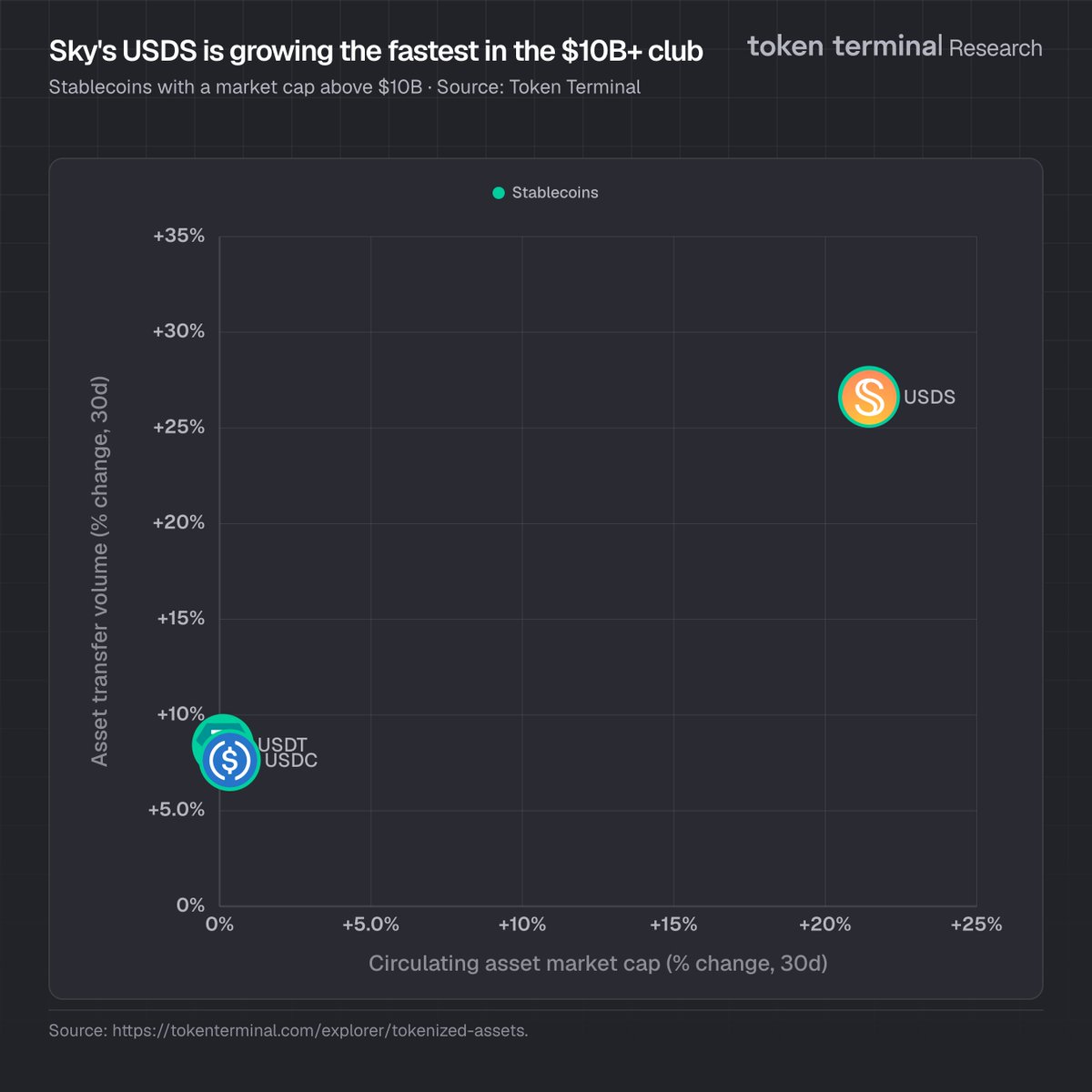
Sky Sports' USDS derivatives trading volume saw the fastest growth among trades with a market capitalization exceeding $10 billion.
Key competitive developments to watch 👇
402
0
0
33
0x East City Prefect
2h ago
Follow
Tonight at 8:30 PM, the Non-Farm Payrolls report will be a bombshell! Will the crypto market be wiped out this weekend?
Don't think everything's fine just because the US stock market is closed. Tonight's March Non-Farm Payrolls report at 8:30 PM is the real catalyst for market volatility!
The market expects 60,000 new jobs, breaking out of the previous "negative growth" vortex. But the problem is: good data means no chance of a Fed rate cut, and the crypto market will continue to be under pressure; bad data will fuel rate cut expectations, but Middle East geopolitical conflicts and soaring oil prices will push inflation expectations sky-high, creating another dilemma.
What's worse, with US stocks, gold, silver, and oil markets all closed today, the data won't be reacted to immediately. All the emotions and expectations will be released all at once when the market opens next Monday.
The crypto market is already being crushed by high oil prices and strong job growth. BTC is teetering around 66,500, and ETH has fallen below 2,100. Whether tonight's Non-Farm Payrolls report exceeds or falls short of expectations, it's planting a huge landmine for Monday's market.
A reminder to all crypto traders:
1. Do not heavily invest in directional betting before or after tonight's Non-Farm Payrolls report. Liquidity is zero, and volatility is entirely driven by sentiment.
2. Monday's opening will likely see a gap down, either a sharp rise or a sharp fall. Manage your risk in advance and don't get swept away by one-sided market movements.
3. The core issue remains the Fed's interest rate cut expectations and Middle East geopolitics. The Non-Farm Payrolls report is merely an amplifier, not the fundamental factor.
Remember, before the data is released, all predictions are guesswork. Preserving your capital and waiting for the market to become clearer before taking action is always the right approach.
353
0
0
48
KK.aWSB
13h ago
Follow
How special is Holy Week in Spain?
The streets are packed with people under the night sky as processions, dressed in robes and wearing pointed hats, slowly carry enormous statues of Jesus and the Virgin Mary. The sound of drums, candlelight, and solemn atmosphere create this annual Catholic tradition.
361
0
0
49
TiaBTC
18h ago
Follow
*Fortune Telling Affects Fighting Spirit*
Fortune telling really can affect a person's fighting spirit.
This is absolutely true.
Take myself for example. I've long been satisfied and content with my life, especially compared to those around me.
For a while, I was thinking about developing some hobbies to pass the time, like long hikes or calligraphy.
But one day, I happened to read a sentence, seemingly about my life after forty, from the Ming Dynasty's *Complete Collection of Zi Wei Dou Shu*: "When the sun is at noon, it is called 'the sun shines brightly in the sky,' indicating power and wealth comparable to a nation."
It means that the sun at noon is like the midday sun radiating its light. The last two sentences are truly exaggerated. "The powerful and wealthy" implies real power, and "wealth comparable to a nation" is even more flattering, suggesting wealth that rivals that of a country…
I understand these are merely rough conclusions drawn by the ancients based on statistics, using exaggerated language. But who doesn't like to hear compliments?
I noticed that from then on, my fighting spirit seemed to have shifted slightly.
Before, I felt satisfied with my early hardships, but later, I was fortunate enough to reap some rewards, and I planned to live a contented life. But after reading these sentences, I began to doubt—maybe life hasn't even begun yet? Maybe the best is yet to come?
If that's the case, shouldn't I start preparing now? Otherwise, when the opportunity arrives and the curtain rises, will I be disappointed?
I was living a pretty good life, and I seemed to have some fighting spirit, though only at an average level. But after doing some calculations, I realized I definitely had a bit more fighting spirit.
I've seen people say that "fortune telling can affect a person's fighting spirit," and because I've experienced that firsthand, I completely agree.
386
0
0
24
Welfare Duck
04-02 21:02
Follow
Damn, the sky is falling!
477
0
0
30
Snowball (Catch the Golden Dog Edition) 🔶 BNB ETHGas ⛽️ 🤖Botte🦅
04-01 12:52
Follow
Many people have no idea what 10,000 yuan can actually do.
They think 10,000 yuan can only buy a phone, a gym membership, a few nice meals, and then they go back to their desks complaining about not having enough money or opportunities.
But the truth is: 10,000 yuan is enough to change a person's life.
Step 1: Redeem yourself.
Have you ever done the math?
Rent 1,500, food 1,500, miscellaneous expenses 500. In cities with low cost of living, 4,000 yuan is enough to live on for a month. 10,000 yuan is just enough for two and a half to three months.
Don't save this money, and don't spend it recklessly. Treat it as your "redemption money."
Your current job is draining you, hindering your growth, and making every day feel like a funeral. You're afraid to quit not because you desperately need the salary, but because you're afraid of running out of income. Use 10,000 yuan to redeem yourself and buy three months of freedom.
For three months, you'll owe no one anything, no clocking in, no dealing with grudges—you'll be the master of your own time.
This courage alone is worth 10,000 yuan.
Step Two: Go to the Trading Scene
Quitting your job isn't about giving up.
Take the remaining money, buy a train ticket, and go to Yiwu, or any wholesale market, industrial zone, or supply chain base where you can experience real trading.
Not for tourism, but to immerse yourself in it.
Squat beside the stalls, watch how the owners quote prices to customers, how the packers prepare and ship goods, and how foreigners haggle. Don't rush to stock up, don't pretend to be a buyer. Just be an observer, use the most basic method to experience the scene.
You'll discover a shocking truth:
So this is how money flows, so this is how deals are made, so these uncles in slippers might be making millions a month!
Your previous imagination of making money was all about office PPTs and KPIs. Once you're actually standing in the midst of a transaction, you'll understand the essence of business: satisfying needs and profiting from the price difference—it's that simple.
This step shatters the filter of a respectable job in your mind. Once you've seen the real world, you can never go back to the days of pretending to be busy in your cubicle.
Step Three: Write down what you see by hand.
Every night, no matter how tired you are, force yourself to write it down.
What did you see today? What did you hear? What moved you? What detail made you realize something? Don't just type a few words in your phone's notes app; grab paper and pen, fill a page.
What is the significance of this action?
It's about using your own eyes to cleanse yourself of the secondhand knowledge you've been fed over the past thirty years. You're not just reciting theories from books; you're recording truths you've witnessed firsthand.
By the end, you'll find your anxiety has lessened and your confidence has grown.
Because the fear-mongering script of "what if I fail?" in your head has been replaced by the real experiences you've had over the past three months. You know the sky won't fall, you know that as long as you're hardworking and quick-witted, you'll always have food to eat, and you know that those people in suits and ties aren't much smarter than you.
Three months later, you might not have made a fortune yet... Even though you've almost spent all that 10,000 yuan,
you return to reality with a completely new cognitive framework, a worldly-wise mind, and a confidence that has grown from real-world experience. You're no longer willing to go back to that suffocating workstation.
You begin to see every opportunity around you from the perspective of a boss.
You realize that you weren't lacking money before, but rather a proper understanding of it.
This is the true logic behind how 10,000 yuan can change your destiny.
It doesn't just leverage wealth; it leverages your power to value yourself.
Money isn't spent; it's gained. That 10,000 yuan buys you a life free from being a puppet on a string.
425
0
0
46
Nancy
04-01 04:24
Follow
Long post, proceed with caution!!
Long, long ago,
There was a king.
He ruled his kingdom very well.
The kingdom was small,
but the people were well-fed and clothed,
living in peace and prosperity,
and very happy.
The king had three beautiful and lovely princesses.
From birth, the three princesses possessed a magical power.
When they cried,
their tears would turn into sparkling diamonds,
priceless indeed.
One day,
The king realized he was growing old,
and there was no one to entrust his kingdom to,
and no one to care for his princesses.
So the king proclaimed to the world:
"As everyone knows, I have three princesses, each possessing unparalleled beauty,
and their tears can transform into precious diamonds. In a month, I will gather all the finest men for them, allowing them to choose their own husbands—the chosen ones will have the opportunity to inherit my kingdom and wealth!"
A month later,
the king's castle was filled with princes,
knights, and sons of the wealthy from all over the world.
Each one was handsome and distinguished.
They confidently surrounded the palace,
awaiting the princesses' arrival.
At noon,
the king arrived at the palace with his three princesses.
To welcome the guests from afar,
the eldest princess sang a song for everyone, her voice clear and heavenly;
the second princess danced for everyone, her steps light and her figure graceful.
The youngest princess smiled faintly at the crowd,
then hid behind the king, refusing to come out.
The king awkwardly explained,
Please don't mind,
the little princess has never spoken since birth and is very shy around strangers.
To win the princesses' favor,
everyone displayed their talents. Some wrote poems and painted pictures for the eldest princess on the spot,
some demonstrated swordsmanship and horsemanship for the second princess,
and some presented the youngest princess with rare and precious treasures.
The eldest and second princesses were very happy,
and gradually made their own decisions,
only the youngest princess remained quietly hidden behind the king.
In the end, the eldest princess chose a prince,
who promised her that
he would conquer the world for her,
and carve her name on every castle. The second princess ultimately chose the son of a wealthy man.
The clever boy promised her,
He would earn a lot of money,
and build her the most magnificent palace in the world,
filled with beautiful and rare treasures.
The little princess calmly looked at the crowd and shook her head.
Just as the king was about to announce the result,
a young shepherd stepped out from the crowd,
he went straight to the little princess and whispered something in her ear.
The little princess suddenly smiled brightly,
and without hesitation, she took the shepherd's hand.
And so, all three princesses found their partners.
Five years passed.
The eldest princess's husband used diamonds formed from his tears to recruit soldiers and horses,
conquering far and wide, winning every battle.
On every castle he conquered, the eldest princess's name was indeed engraved.
The eldest princess's name became known to all. She felt very happy.
The second princess's husband used diamonds formed from his tears as capital,
and his business grew exponentially.
Of course, once the business was large enough, the diamonds were no longer needed.
He was truly the son of a merchant,
a born businessman.
He quickly amassed a vast fortune.
Although he hadn't yet built the most luxurious palace in the world,
the second princess was already very content.
She felt very happy.
Since the day she left the king's castle with the shepherd,
the little princess began traveling the world.
Later, they found a beautiful, secluded paradise,
and settled there.
The shepherd spent half a month
building a large house out of wood and straw,
and making a lot of furniture.
They planted many vegetables behind the house,
and built a fence around the vegetable garden by hand.
The little princess transplanted all the pretty flowers she saw,
to her little garden.
Although she didn't know the names of these wildflowers,
she was happy every day just seeing them.
In the evenings,
they would sit by the lake fishing,
or counting stars.
They were always poor,
but they lived very happily.
The little princess gradually began to speak,
she only spoke to the shepherd,
talking about everything,
the clouds in the sky,
the fish in the river,
the birds' nests in the trees,
the butterflies in her hair—chattering away all day long.
The shepherd often sat by the lake,
listening quietly to her stories,
until the little princess,
fell asleep from exhaustion,
and he carried her back to her room.
The king fell critically ill,
and sent men to find the three princesses and their husbands.
He was surprised to find that
the princess and her husband wore clean, tidy clothes, but they were covered in patches.
He wondered why they were so poor.
You see,
a single tear from the little princess could buy a clothing store.
The shepherd said,
"Because I never let her cry."
The king immediately decided,
to pass the throne to the shepherd.
Perhaps everyone has their own understanding of happiness,
the answer is never unique.
But only the shepherd understood what it meant to cherish.
The king asked the little princess,
"What did the shepherd say to you back then?"
The little princess said, "He whispered in my ear, 'Even if your tears could turn into the most expensive diamonds,
I would rather live a life of poverty than let you cry.'"
The most precious tears,
are not those that can turn into diamonds,
but those that never fall,
because those who cherish you,
will not let you cry.
The king passed away,
and the shepherd immediately inherited the throne.
After the coronation ceremony,
the shepherd, wearing the crown, returned to the palace.
The little princess helped him remove the crown,
and took off his court robes.
She wrapped her legs around his waist,
and gently licked the shepherd's ear, saying:
"Now you can make me cry."
461
0
0
46
Snowball (Catch the Golden Dog Edition) 🔶 BNB ETHGas ⛽️ 🤖Botte🦅
03-31 22:05
Follow
Why are retail investors always trapped?
Please note the following facts:
1. Pension insurance cannot lose money; it must be profitable.
2. Major insurance companies cannot lose money; they must be profitable.
3. Brokerages cannot lose money; otherwise, the platform will collapse, and how can the casino operate without funds?
4. Company listings drain over one trillion yuan annually in recent years. A 100% increase in the secondary market adds another trillion yuan, half of which will no longer be invested.
5. Annual stamp duty of 200 billion yuan.
6. Private equity, public funds, and QFII funds generate a total profit of 200 billion yuan.
7. Retail investors (possibly less than 10%) are used as bait, generating 10 billion yuan annually.
This is the drain.
The inflows are as follows:
1. Social security fund surplus. Decreasing.
2. Life insurance surplus, also decreasing.
3. Retail investor participation. The largest source. However, the 80s and 90s generation are drained, while their parents still have savings for medical expenses that cannot be touched.
In short, the future of the stock market is becoming like the Hong Kong stock market. There are countless penny stocks that no one wants. Leading companies, on the other hand, are driving the index sky-high.
421
0
0
48
KK.aWSB
03-31 20:10
Follow
Fun Fact: Some people's lives are bound by a "life-or-death pact" with Halley's Comet.
Mark Twain was born in 1835, the same year Halley's Comet passed by Earth.
In 1909, in his later years, Mark Twain uttered a remarkably eerie yet precise statement to a friend: "I came with Halley's Comet in 1835, and it will come again next year. I expect to go with it. If I don't go with it, it will be the greatest regret of my life."
As it turned out, on April 20, 1910, Halley's Comet reached its perihelion, its light streaking across the sky; the very next day, Mark Twain breathed his last. This 75-year interstellar synchronization was so punctual that even death seemed remarkably punctual.