

Edited by Wu Shuo Blockchain
This episode features a Chinese AMA co-hosted by WuShuo and Mask Network on January 23rd. Guests included Ethereum co-founder Vitalik Buterin, Mask founder Suji Yan, WuShuo editor-in-chief Colin Wu, and other community representatives. The discussion primarily focused on the chain reaction triggered by Twitter's concentrated ban on "talking platforms," delving into the real-world challenges and new opportunities of decentralized social networking.
Vitalik analyzed the fundamental reasons for the failure of most decentralized social products from the perspectives of the difficulty in overcoming network effects, misaligned incentive mechanisms, and excessive financialization. He emphasized that products should be redesigned starting from "problems inherent in social interaction" rather than "the overlay of crypto-finance." Suji, using case studies of products like Lens and Farcaster, pointed out that user migration is a slow, phased process requiring the coexistence and collaborative advancement of centralized and decentralized models. The discussion also extended to the potential integration of social protocols with wallets, prediction markets, and AI with community governance, arguing that decentralized social networking still holds long-term exploration value if the goal is to "improve the quality of discussion and approach facts and consensus."
The opinions expressed by the guests do not represent the views of Wu Shuo and do not constitute any investment advice. Please strictly abide by local laws and regulations.
The audio transcription was done by GPT and may contain errors. Please listen to the full podcast on platforms such as Xiaoyuzhou and YouTube.
The Real-World Context and Two Main Reasons for Vitalik's Refocus on Decentralized Social Networking
Colin: Twitter's recent crackdown on "talking platforms" has reignited discussions about decentralized social networking. Vitalik, what are your thoughts on this event and the overall trend?
Vitalik: I've been following decentralized social networking for many years, and I used Farcaster quite a bit from 2023 to 2025. Recently, I've refocused more clearly on this direction, mainly for two reasons.
First, Twitter's problems are becoming increasingly apparent. Whether it's encryption, politics, or public issues, the overall quality of discussion continues to decline, making it no longer suitable as a center for global public discourse. However, the biggest challenge for new social media platforms remains the network effect; even the best product cannot succeed without users.
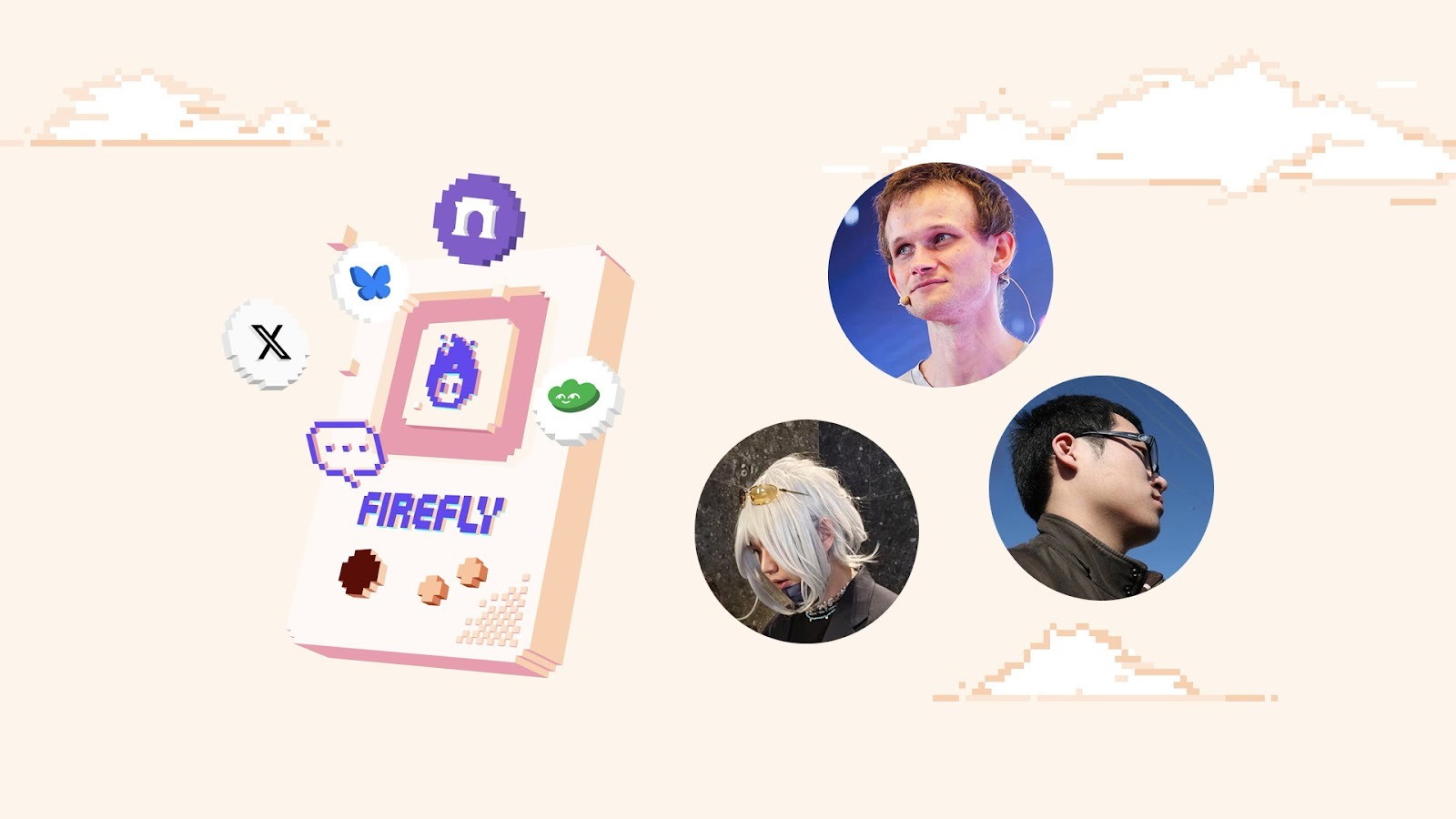
Currently, there are two relatively feasible paths in decentralized social networking: one is protocol layer splitting, placing accounts and content on a shared protocol, with different teams developing clients, so new users can see the complete network upon entry; the other is the aggregation model like Firefly, which puts Twitter, Farcaster, Lens, etc., in the same interface, gradually guiding users to migrate without leaving Twitter. Both of these approaches essentially aim to mitigate the network effect problem.
The second reason is the maturity of the technology. Over the past three years, user experience has significantly improved, whether it's Firefly, Farcaster, or the broader encryption infrastructure, privacy technologies, and communication tools.
Given these combined factors, coupled with a series of recent events such as the Kaito ban and changes to Farcaster and Lens, I think now is a time to re-evaluate decentralized social networking and take a serious look at it again.
Suji recounts his early collaboration with Twitter and the differences in centralized platform governance.
Colin: Suji, what do you think of Twitter's recent crackdown on "mouth masturbation platforms"?
Suji: Our collaboration with Twitter dates back to 2018, when Jack Dorsey was in charge. Twitter was very open to crypto experiments, including crypto tweets, on-chain transactions, and later turning the first tweet into an NFT and auctioning it. These all reflect Twitter's early, more gradual, rules-oriented governance style.
The changes after Elon took over were very noticeable. While he still emphasized freedom of speech, his approach was more enforcement-oriented, and this difference in governance was directly reflected in the products and censorship strategies. Based on this assessment, I wasn't surprised that products like Kaito were blocked during Elon's era.
Projects like Lens and Farcaster initially adopted a strategy of "directly confronting Twitter." Personally, I prefer Jack's approach: don't rush to replace them, but patiently and gradually migrate user behavior and traffic.
I've also noticed that exchanges have been trying to develop social products in recent years, such as Binance Square and OKX Orbit, but they are very cautious about deeply integrating Twitter, which also illustrates the uncontrollability of centralized platforms themselves.
Therefore, I am more optimistic about decentralized social networking as an integration layer, but this will definitely be a long-term process. A more realistic path is to transition from centralized platforms to a "semi-centralized" social networking model, and then gradually move towards complete decentralization. This path is very similar to the evolution of DeFi and prediction markets. The current simultaneous occurrence of multiple events in a short period of time is essentially a phased release after long-term accumulation.
The core problem that has hindered the long-term success of decentralized social networking
Colin: There's a strong demand for decentralized social networking, but in recent years, whether it's Friend.tech or more recently Kaito and Farcaster, it's been difficult to achieve Proof-of-Function (PMF). Why is this direction so difficult to succeed in?
Vitalik: I think there are two main reasons.
First, the network effect is too strong. In the past decade, almost no new social media platforms have truly grown large; Twitter remains one of the core platforms, indicating that the social media sector itself has extremely high barriers to entry.
Secondly, many projects have misunderstood the problem, treating "crypto finance" as a solution for social interaction, jumping straight into SocialFi, adding tokens, and transaction layers. But from the perspective of social interaction itself, the truly crucial issue is often creator incentives: how to ensure that newcomers and high-quality content receive sustained rewards.
This type of mechanism has been tested in the crypto space for over a decade (Steemit, Bihu, various Creator Tokens), and many have failed because the incentives actually reward existing influence and speculative demand, rather than content quality. In contrast, Substack allows high-quality creators to earn income in the long term, while the top performers on many tokenized platforms are often just "existing social capital" figures such as KOLs and exchange founders.
Therefore, to create a good decentralized social network, the starting point should be to figure out which social problems need to be solved, rather than thinking about how to add a financial layer.
Early experiences and regrets of Chinese-language social products: migration, governance, and patience
Colin: The Chinese community has actually tried combining social networking and crypto quite early on, such as Bihu and Mirror. Bihu once gathered a large number of creators, but eventually shut down; Mirror once replaced WeChat Official Accounts and Medium, with many organizations and authors writing for a long time, but it stopped due to team issues. These all show that the demand has always existed, but a true PMF (Professional Mobility Factor) has never emerged. Suji, what are your thoughts on this?
Suji: If we only look at the Chinese-speaking community, migration has actually been happening all along, just very slowly. In the early days, people mainly used Weibo and WeChat. Despite the real-name registration system and security risks, few people left because of habit. It wasn't until a batch of encrypted accounts and media accounts were cleaned up that people migrated to Twitter on a large scale, and WeChat groups also switched to Telegram.
Twitter itself is not decentralized, but mechanisms like Community Notes allow the community to correct the mistakes of authoritative figures, embodying a certain spirit of decentralized governance, which is very attractive to many people. However, it was later discovered that Twitter still accidentally punishes creators and lacks transparency in communication. As a result, some people began to try more advanced alternatives such as Firefly, rather than leaving Twitter entirely immediately.
Historically, from Weibo to Twitter, from WeChat to Telegram, regulation and product experience have always been driving forces behind development. Today, decentralized social networking hasn't reached a similar tipping point yet and can only continue to advance patiently.
Furthermore, neutrality is crucial. For example, Farcaster's early growth largely stemmed from Coinbase's support, but if it were perceived as serving only one company or a small circle, it would deter other participants. Truly sustainable social infrastructure must attract participation from diverse camps.
I think this is a point in time to pay attention to. A series of events have occurred in quick succession, indicating that the migration has begun, but it may take several more years to be truly completed.
Lens's multi-platform collaboration strategy and social opportunities in the forecasting market
Colin: Suji, what is the specific situation of your current collaboration with Lens?
Suji: We've been shareholders of Lens for a long time. Later, I became more and more certain of one thing: neither Lens nor Farcaster needs to go it alone or stick to just one ecosystem. The crypto social market is still small, and it must be open enough—to cooperate with all wallets, all chains, and even to some extent, to access Twitter's data and social relationships—in order to grow big.
We talked with Stanley for a long time and finally decided to officially step in and become Lens's new management. I don't really want to describe it as an "acquisition"; it's more like an alliance, not a takeover. Around that time, a series of events happened, such as Kaito and Farcaster, but those were just coincidences. I actually hope that everyone doesn't focus on competition; this market is too small, and collaboration is the most important thing.
Colin: So what will Lens do next?
Suji: First, I hope all wallets can directly post using Lens, regardless of the blockchain or exchange. Second, I think "prediction markets + social" is severely underestimated. In places like Polymarket, many betting activities themselves generate discussion, banter, and interaction, but the current comment section experience is very rough; almost no one is making it a true social product. This is an opportunity.
Broader in scope, this extends beyond prediction markets. It connects trading activity, comment sections, content incentive mechanisms, and even Memecoin's "social expression"—for example, transferring coins and saying "lunch money" is essentially like a WeChat red envelope. Our approach is to take a step-by-step approach, starting with wallets, then moving to prediction markets and trading comment sections, gradually connecting these real-world social behaviors, and continuing this strategy long-term.
The potential of AI + community annotation to improve the quality of discussions
Colin: Besides decentralized social networking itself, have you noticed any new or interesting trends this year, Vitalik? For example, could combining it with prediction markets be a direction to explore?
Vitalik: I think this is a very promising direction. One relatively positive change on Twitter this year was the introduction of Grok. Now, when someone posts a clearly inaccurate or even extreme opinion, people directly ask Grok, which often points out what is wrong and what is right, thus improving the quality of the discussion to some extent.
Of course, Grok isn't perfect. Twitter also has Community Notes, but the biggest problem is the slow feedback; notes often take a long time to appear. I've been thinking about how to make "error correction" faster, and currently, prediction markets seem like a viable tool.
For example, when someone makes an extreme judgment, a prediction market can be launched directly. By looking at the probabilities provided by the market, it can be quickly seen how low the likelihood of such a statement occurring is. In many cases, this can effectively alleviate emotional and irrational discussions.
However, some prediction markets are now deviating from their original purpose, emphasizing sports betting or hype rather than "helping to get closer to the truth." Therefore, I believe that combining AI, mechanisms similar to Community Notes, prediction markets, and search into a single interface, with the explicit goal of "improving the quality of discussion," would be a worthwhile direction to explore.
Furthermore, concepts like Glen Weyl's "secondary prediction market," which combines prediction markets with secondary voting, identity, and governance, are also well-suited for experimentation on social platforms. Overall, as long as the goal is clear and centered on "helping people better understand reality and the future," the combination of AI, prediction markets, and social media will remain valuable in the long run.
The rationale for the coexistence of prediction markets in different cultural contexts
Forrest: In prediction markets, human perspectives and judgments are an essential component of price discovery, not just capital and liquidity. The future may require more than just one prediction market. The West already has polymarkets; should the Chinese context also need a prediction market that represents local culture and user structure? Even for the same event, prices and judgments formed under different cultural backgrounds may differ, and these differences are valuable and worth discussing.
Vitalik: This is an open question. The key question is whether there are truly fundamental differences in the needs of prediction markets across different cultural communities. There's no definitive answer yet. But one thing I'm very certain of is that this field needs more competition and experimentation. Different market models, different application scenarios, or combining prediction markets with predictive governance (futarchy) are all worth exploring in parallel. Nobody knows which model will ultimately prevail, and that's precisely why we need to try different approaches.
Interoperability issues in combining social protocols with wallets
0xLuo: Social protocols and wallets are increasingly being integrated, whether it's decentralized social platforms or centralized platforms like Twitter, all are adding trading and financial functions. Firefly is also integrating wallet and prediction market features. What are your thoughts on this trend of "social products becoming wallet-like, and wallet products becoming social"?
Vitalik: The key premise is that the underlying protocol of social networking should remain as simple and neutral as possible. If the underlying layer is over-customized and crammed with too many features, it will weaken the network effect and hinder collaboration between different products. I don't want to see every wallet develop an incompatible social network.
One of Ethereum's key success factors is "wallet interchangeability": users can freely switch wallets and migrate their private keys. This openness is equally important when social networking and wallets are combined, and interoperability must be a priority.
Wallet functionality will inevitably continue to expand, especially given the increasing importance of privacy. Wallets protect not only assets but also data. Integrating social and financial functions at the interface level is reasonable, such as tipping, simple decision-making, and ENS. However, it's important to note that many social users are not native on-chain users.
Therefore, a more realistic design is to first provide a built-in wallet to lower the barrier to entry, while ensuring that users can migrate their accounts and assets at any time. This "low-barrier entry + free migration" model is the key to the long-term success of combining social networking with wallets.
Further exploration of the integration of social networking, prediction markets, and DAO governance
Instant Pig: I've been following the integration of Community Notes, social graphs, social identity, and prediction markets, and I'm also working on oracles related to prediction markets. I'd like to ask a question: Will we see a future scenario where, while browsing a news feed, content is directly linked to a prediction market, allowing users to participate instantly? If Firefly does this, what advantages will it have over Twitter?
Vitalik: This deeper integration is very interesting, and there are many forms we can try. For example, instead of just liking and retweeting, we could add a "I agree/I disagree" prediction market to the comments section of a post, allowing everyone to see a probability given by the prediction market. These kinds of experiments centered around the discussion itself are well worth continuing to explore.
Instant Pig: If this mechanism is extended to DAO governance, such as initiating predictions or betting within a small scope based on identity to assist decision-making, would this type of predictive governance (Futarchy) be more suitable for implementation on a decentralized platform?
Vitalik: Currently, there isn't a social platform truly designed for DAO or protocol governance. Many governance discussions take place on Twitter or in private groups, which is problematic in itself. If the social interface is designed from the outset with the goal of "serving governance discussions," combining on-chain decision-making behaviors such as discussion, prediction, and voting, this would be a direction worth exploring in depth for decentralized social networking.
Neutral assessment of centralized companies' self-built social platforms
Colin: Vitalik, what do you think of products like Binance Square? Some people even joke that it might be one of the most active social products in the crypto world right now, though it's certainly not decentralized. I feel the content mainly revolves around cryptocurrency trading, and the users are mostly "grassroots"—many people might not use Twitter or Telegram, but they'll communicate directly on Binance. However, there's also the possibility of price manipulation, sentiment manipulation, and even scams. What's your opinion on exchanges venturing into social networking?
Vitalik: I have indeed looked at Binance Square a little and know it exists, but I haven't used it extensively, so it's difficult for me to give a specific evaluation of the content quality. In principle, I don't think there's anything wrong with companies creating their own social media platforms. In fact, having everyone in the world concentrated on one social media platform is inherently an unhealthy situation.
If we can evolve from "one centralized social platform" to "many centralized social platforms," with each platform better suited to the needs and usage scenarios of its respective community, that would already be progress. Going a step further, it would be even more ideal if these platforms could be interconnected to some extent, for example, based on a common protocol, allowing users on different platforms to still see each other's content and find more suitable communities.
I've been thinking that if a high-quality, decentralized, and sufficiently neutral social platform truly emerges in the future, even my own blog comment section might be directly hosted on such a system. In other words, if decentralized social networking succeeds, it's likely that it won't ultimately be "a unified product," but rather a multitude of companies, communities, and individuals, each building upon the same underlying layer, creating completely different interfaces and products for entirely different purposes.
Suji: So do you hope that the social features of exchanges like Binance, OKX, Coinbase, and Bitfinex can be interconnected in the future, just like Ethereum transfers? So that each of them doesn't have to build a completely incompatible system.
Vitalik: This question actually requires more detailed consideration. I don't believe that social interaction necessarily needs to achieve completely "frictionless" interoperability. Sometimes, if a community wants to maintain its own boundaries, setting certain thresholds can actually be meaningful.
However, interoperability itself remains very important. The key is not "whether to interoperate," but "at what level and to what extent." This may require finding a more suitable balance between openness and community differences.
How can we attract talent to participate in building the blockchain industry again?
Jocy: We've been discussing recently why blockchain applications like social networking and gaming haven't truly succeeded. With the advent of the AI cycle, the scale of internet applications has expanded rapidly, user attention has become more fragmented, and many have begun to question whether decentralized social networking is a false proposition.
In the current environment, our assessment is that directly creating an application to compete head-on with mainstream internet products has a very low probability of success. A more realistic approach is to first develop a niche product targeting crypto users, validate it within a small community, and then consider expansion, such as the Polymarket model. However, it is essentially still geared towards finance, and it's currently difficult to succeed with broader user-facing products like social networking and games.
Another viable path is B2B, which involves creating products that are genuinely in demand, have product value (PMF), and can generate revenue. In the AI field, many B2B companies are actually more likely to succeed.
I would like to ask Vitalik: In this market environment, what kind of founders are more likely to create decentralized applications? And how can we encourage more outstanding builders and talents to stay in this industry?
Vitalik: I think the reason why blockchain social networking and blockchain games repeatedly fail is that too many projects start from "we are Crypto, we can add finance", rather than from the application itself.
The real questions we should be asking are: What application are we creating? What is this application truly lacking right now? Can these problems be solved with existing technology? Many projects that seemed successful in 2021 rapidly lost users during the bear market, essentially because users weren't drawn to the product itself, but rather to the prospect of making money. The same logic applies to social products.
Therefore, the next generation of founders with a greater chance of success are those who truly understand social interaction and user needs. Even someone who "understands social interaction but not blockchain" might be more suitable than someone who "only understands blockchain." The same applies to blockchain games; understanding games is more important than understanding blockchain itself.
As blockchain gradually becomes infrastructure, it should play a more back-end role rather than becoming the product itself. Decentralization is not about "on-chain + token issuance + speculation," but about using blockchain as a reliable foundation for data and collaboration. Starting with specific use cases, rather than focusing on technology or tokens, is more likely to create products that people will want to use in the long run.
Crypto Culture Differences Between China and the US and Advice for Chinese Developers
Jocy: I'd like to ask your perspective on the differences between crypto culture in China and the US. The US has a stronger culture of protocols and developers, while China leans more towards an exchange culture, with relatively fewer large-scale protocols and infrastructure. With the advent of the AI era, the rate at which Chinese talent leaves the crypto space is noticeably faster. What advice do you have for Chinese developers? How can we encourage more people to continue participating in decentralized development?
Vitalik: I've always believed that the biggest advantage of Chinese developers lies in product and user experience, especially front-end capabilities. They excel at creating high-quality experiences for a large user base. This is a strength globally.
Compared to ten years ago, the underlying infrastructure is now very mature, and it's no longer necessary for every team to build L1 or underlying systems from scratch. Furthermore, AI has lowered the development threshold, so I don't recommend that Chinese developers continue to develop complex, asset-heavy underlying protocols.
A more realistic approach is to treat blockchain as infrastructure in the background, focusing on making good use of existing protocols and innovating at the application and user experience layers. You don't necessarily need to create a new protocol; you can still create excellent clients or applications. Ultimately, what determines the success or failure of a product is user experience and the ability to be implemented, which is precisely where Chinese developers have the greatest advantage.