


Author:Wall Street CN
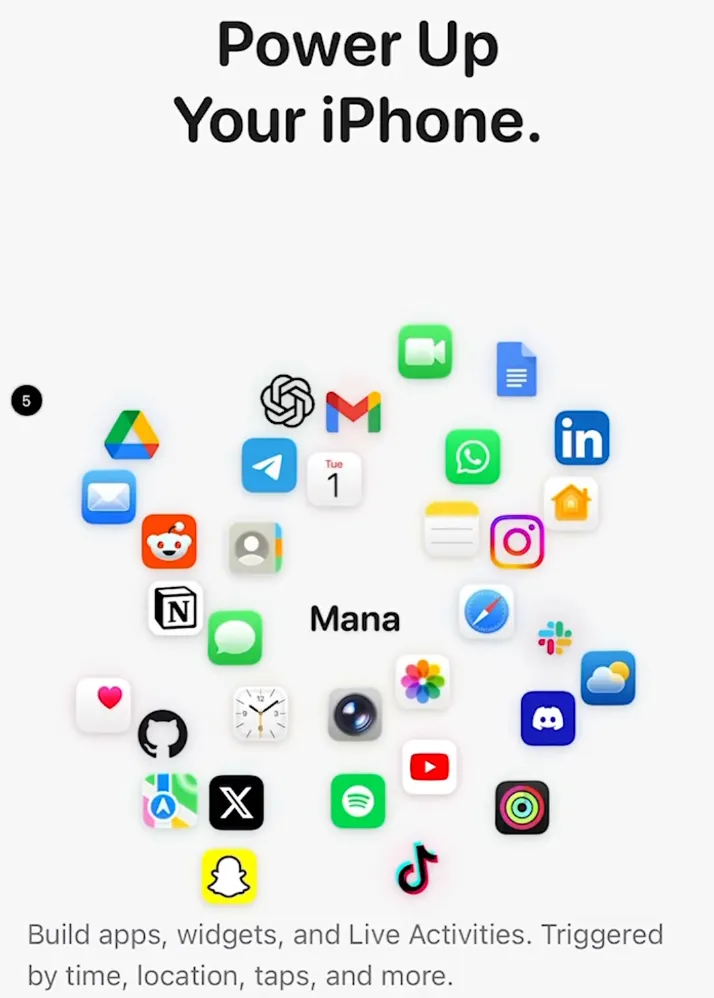
In January of this year, a team called Mana did something really cool: generating iOS shortcuts using natural language. By simply speaking a sentence, they can connect over 590 native functions such as alarms, health, and calendars—essentially the n8n of mobile devices, allowing users to program with their voice.
They were excited for about a week. Then they discovered that shortcuts couldn't run persistently in the foreground; complex processes would be killed by the system halfway through. While iOS technically implemented a 30-second timeout for background execution, it wouldn't work in the product.
So they shifted to a second direction: creating mini-apps. Users would say a sentence, and AI would directly generate a complete mini-application that would run on their phones. The product was ready, the promotional copy was written, and they were ready to launch it.
Then Apple simply took action.
Apple even removed it from the App Store.
On March 18, media outlets discovered that Apple was blocking multiple Vibe Coding apps from releasing App Store updates. Replit, valued at $9 billion, along with Vibecode, Rork, and a0.dev, were among those affected. Rork ceased operations on iOS, and a0.dev completely abandoned the Apple platform.
Apple cited App Store Review Guideline 2.5.2, which states that apps must not download, install, or execute code that alters their functionality. Apple argues that this rule has always existed and enforcement is not specifically targeting Vibe Coding. Apple's compromise terms are also specific: Replit can change the generated app preview to open in an external browser, while Vibecode needs to remove its ability to generate software for Apple devices.

Original text of the review guidelines
It's important to clarify that Apple is cracking down on a very specific practice: generating code within an app and running it directly, allowing the app to bypass review and become a completely different application. Using Cursor or Claude Code to write iOS apps and then submitting them to the App Store for review is a different route and not included in this crackdown. However, the surge in app submissions due to Vibe coding has slowed down the review process, with many developers reporting that waiting times have increased from less than a day to a week.
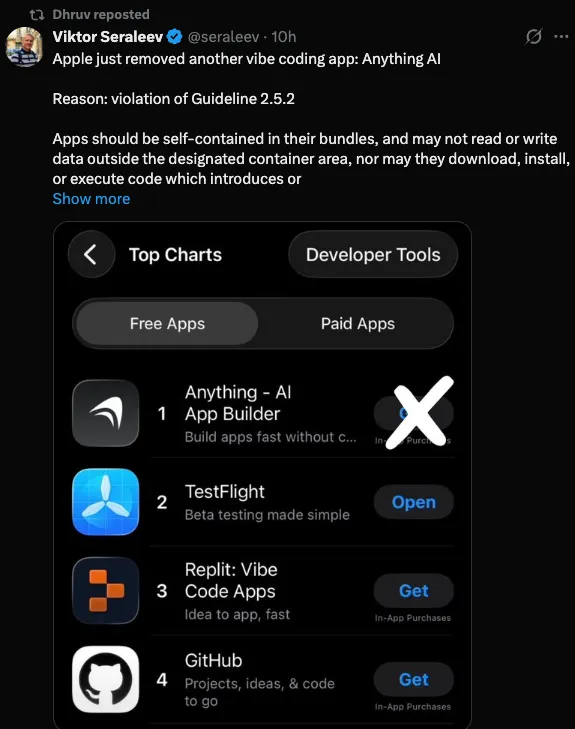
Two weeks later, the situation escalated. A vibe coding app called Anything was removed from the App Store by Apple. This product had just secured $11 million in funding last September, valuing the company at $100 million, and users had already published thousands of App Store apps through it. Anything's developers had proactively submitted a compliance update, changing the app preview to open in a browser in an attempt to meet the requirements of version 2.5.2, but Apple rejected the update and subsequently removed the entire app.
Apple is leaving no room for compromise. Replit, which has been unable to be updated since January, has seen its iOS app drop from first to third place in the free developer tools charts.
The New Destructive Power of an Old Rule
This rule has been in place for many years, but it was rarely triggered before because few people could "generate an app within an app." AI has changed that. Vibe coding allows anyone to create working software on a phone, and a dormant old rule has suddenly gained a completely new scope for application. The rule itself hasn't changed; what has changed is that technology has allowed more people to cross that line, and the interpretation of when and to whom it is enforced rests entirely with Apple.
This isn't the first time Apple has used similar logic to restrict third-party innovation. WeChat Mini Programs serve as a cautionary tale. Mini Programs allowed third-party functions to run within WeChat, bypassing the App Store's review and revenue-sharing system. Apple blocked WeChat updates for years because of this, eventually reaching an agreement whereby Apple would take a 15% commission from in-mini program payments. The situation Vibe Coding faces today shares a similar underlying logic with WeChat's experience back then.
At the same time, the surge in app submissions brought about by Vibe Coding is also impacting Apple's review system.
Data shows that the number of iOS app releases in the US increased by 56% year-on-year in December last year and by another 54.8% in January this year, the fastest growth rate in four years. Forrester analysts believe that Apple cannot solve this problem by rejecting apps; as AI accelerates the speed of app creation, Apple needs to evolve from manual review to large-scale curation.
Your own tools are called innovation; other people's tools are called violations.
What makes the whole thing particularly glaring is Apple's own actions.
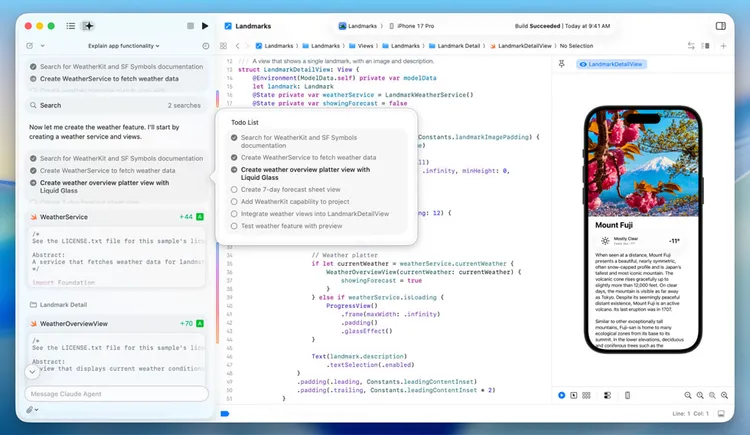
In the same week that Apple cracked down on third-party Vibe Coding apps, it built OpenAI and Anthropic's AI programming agents into Xcode 26.3. Developers can use Apple's tools to generate code using natural language, build apps, run tests, and then submit them through the standard App Store review process.
In his post-mortem analysis, the founder of Mana wrote, "Vibe coding is called 'innovation' in Apple's own tools, but it's called 'violation' in third-party applications." Rabbit founder Lu Cheng put it more directly on the Silicon Star podcast, stating that Apple is particularly opposed to others creating "apps that generate apps." His judgment is that it's dangerous to not have control over the narrative. No matter how well you do, you might become someone else's appendage. For example, Apple has no reason to allow a product smarter than Siri to replace its own Siri.
The logic of the rules is actually quite clear: you can build on iOS, but you can't run what you build on iOS. Or to put it more bluntly, you can write code using AI, but you must use Apple's tools, go through Apple's review process, and pay Apple a fee.
The developer community is divided on this issue, but opposition to Apple is significantly stronger. Some side with Apple, arguing that "an app that can be mass-produced internally is essentially a sideloading backdoor in disguise," and that allowing unapproved code to run on user devices does pose a security risk. However, many developers believe that software is becoming increasingly user-unfriendly, and that allowing ordinary people to describe their needs and receive a customized tool should be the direction of technological progress.
Apple's security concerns are real, as are its commercial motives; both point in the same direction. It's worth noting that the same Vibe Coding app runs perfectly on Android, while Rork and Replit haven't encountered any similar restrictions on Google Play.
Detour to survive
After being blocked by Apple, many entrepreneurs began to turn to other options.
The Mana team has cut everything tied to the iOS system. Its founder told Silicon Star that the current plan is to follow a web app route similar to Replit. He described the mindset behind this shift as, "Forcing the wrong things to be right would be even more terrible."
Some developers told Silicon Star that they have switched to the PWA route, moving their products into the browser and completely bypassing the App Store. Others are taking another compliant route, directly embedding the client-side model into the app, making AI capabilities built into the application itself rather than dynamically generated code. This method is currently getting approved smoothly.
Replit compromised, agreeing to open the generated application in an external browser. But Anything's experience shows that compromise doesn't always work.
Currently,Apple's red line is drawn on the point of "whether the generated code runs within the app".
Tools that help users write code but don't execute it within the app (like Vercel's v0) are currently safe, while those that generate content and run it directly within an app's embedded web view will be penalized. However, this line isn't clear. In the Chinese market, Ant Financial's "Flash App" and Macaron AI's mini-app, which also generate and run interactive content within the app, are currently unrestricted. Some analysts point out that apps like Canva, which can create interactive content using AI, may also face similar scrutiny in the future. Apple itself may not yet be clear on where this red line will be drawn.
Life is not in your own hands
Mana's founder told Silicon Star that Vibe Coding's future on mobile is basically set, "That's it, there probably won't be any changes." He believes that the field will split into two ends in the future: entertainment games and everyday gadgets. As for the short, quick, and immediate needs in between, system-level AI assistants like Xiao Ai can already cover most of them, and it's only a matter of time before Apple takes over.
However, there are variables. The EU's Digital Markets Act (DMA) has already forced Apple to open its app store and allow third-party downloads in Europe, and game emulators were previously allowed to operate under regulatory pressure. If the developers of the Vibe Coding app choose to pressure regulators, the story may not end there.
Three months, three directions, each time successful, each time killed by platform rules. Mana's experience is not an isolated case. Whether it's an early team of three people or an industry giant valued at 9 billion, their situation is no different in the face of Apple's rules. Mana's founder's own summary is the most accurate: "Both times we succeeded, and then realized that our fate was not in our own hands."
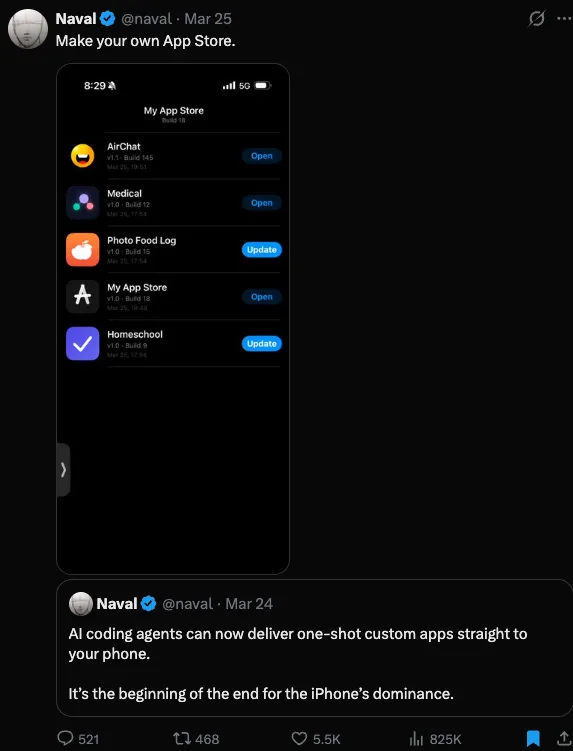
A few days ago, Naval Ravikant, a well-known Silicon Valley investor, posted a screenshot of his AI-powered one-screen app on X, accompanied by the single sentence, "Make your own App Store." He went even further in another post."AI programming agents can now deliver customized apps to your phone in one step, marking the beginning of the end of iPhone's dominance."
Vibe Coding promises a future where ordinary people can create software. This future is coming, but on Apple's turf, it needs a license first.In Apple's own favorite parlance, this is something only Apple can do.
This article is sourced from: