

Author:Wall Street CN
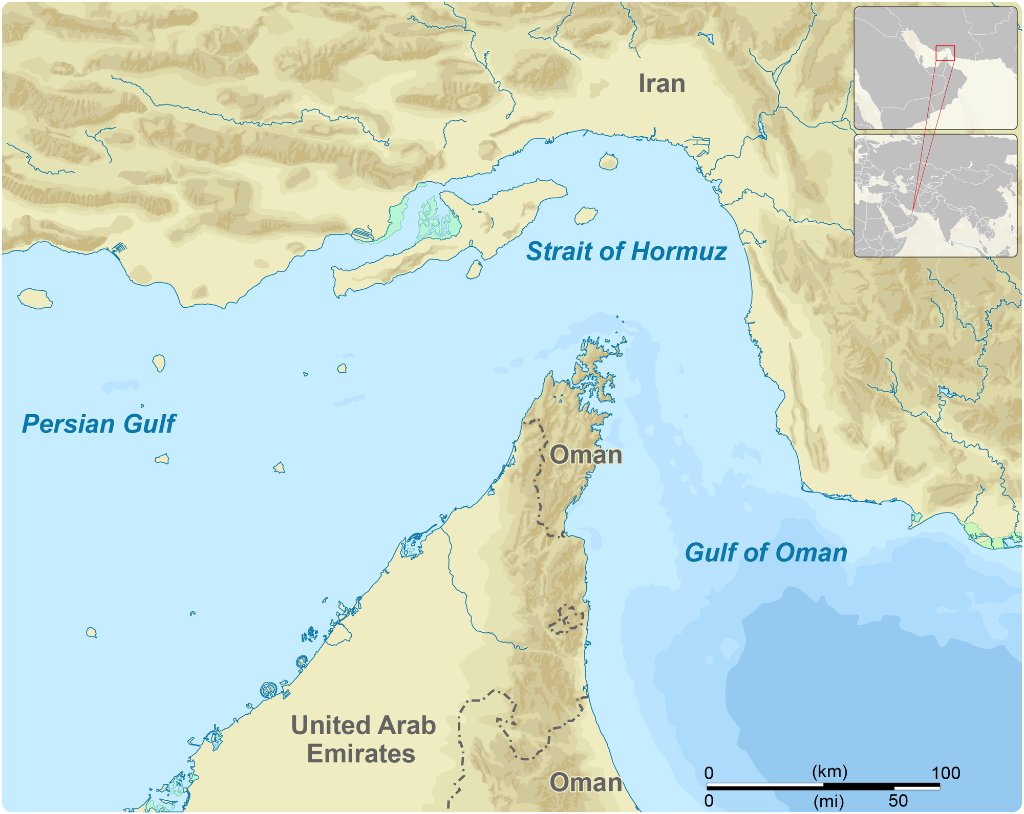
On April 3, multiple foreign media outlets reported that Amazon's data center in Bahrain was once again attacked by Iranian missiles. This is the second such attack this year.
No matter how robust a ground-based data center is built, it can't withstand missiles. This suddenly brings a topic that was previously considered science fiction into reality: if we move data centers into space, could we mitigate this ground-based threat to some extent?
In fact, quite a few tech companies are already doing this.
Google CEO Sundar Pichai declared that space-based data centers will become the "new normal" within a decade, and the company plans to launch two prototype satellites in 2027 to verify key technologies for orbital computing power operation, high-speed inter-satellite communication, and long-term system stability.
Bezos' Blue Origin submitted an application to regulators in March of this year, planning to launch 50,000 solar-powered data center satellites.
Another US space computing startup, Starcloud, completed a key validation in December 2025: it trained a small AI model on an orbiting satellite for the first time, proving for the first time that AI training can be achieved in space.
A race to develop “orbital computing power” is heating up.
Supporters claim this is the only way to solve AI's power shortage. Opponents argue it's simply not worth the investment. Some have even raised more pressing concerns: moving computing power into orbit means exposing the most critical digital infrastructure to predictable and vulnerable spatial coordinates. In the event of an escalation of conflict, could these high-value targets become easy prey for adversaries?
The more critical question is: when your computing power is floating in an orbit that other people's missiles can reach, who will pay for its security?
01
Google's "Suncatcher Project": Small Satellites, Laser Interconnection, and TPU in Space
Google's "Suncatcher Project" is the one with the most detailed information disclosed so far.
Google's solution involves a constellation of small satellites, each equipped with Google's proprietary TPU chip, interconnected via free-space optical links. The orbits are chosen in a dawn-dusk sun-synchronous near-Earth orbit, ensuring the satellites are almost constantly exposed to sunlight.
The biggest technical challenge lies in communication between satellites. In terrestrial data centers, data transmission between chips uses fiber optics, offering high bandwidth and low latency. However, in space, satellites rely on wireless connections. Google's calculations indicate that to achieve data center-level performance, inter-satellite links need to support transmission rates of tens of terabits per second.
They have already achieved a bidirectional transmission rate of 1.6 terabits in the lab using a pair of transceivers. The key is that the satellite has to fly very close, within a few kilometers, or even only a few hundred meters.
Google's orbital dynamics model shows that at an altitude of 650 kilometers, the constellation of 81 satellites has only about 100 to 200 meters between adjacent satellites. Fortunately, maintaining this formation, in Google's words, only requires "moderate positioning maneuvering," meaning occasional adjustments to position.
Another major issue is radiation. High-energy particles in space bombard chips, causing data errors (bit flips) or even damaging them. Google bombarded their v6e Cloud TPUs with a 67 megaelectron volt proton beam and found the chips to be more robust than expected. High-bandwidth memory was the most sensitive component, but it only started showing abnormalities after a cumulative dose of 2 kirads (krad).
A rad is a unit of absorbed radiation dose; 2,000 rads is roughly equivalent to several thousand times the dose of a full-body CT scan. Google estimated the radiation dose for its five-year mission at 750 rads, meaning its actual tolerance is about three times that amount. No hard failures were observed in a single chip up to 15,000 rads.
Google stated that the SunCatcher project can only succeed if the TPU can operate for at least five years, which corresponds to a radiation exposure of 750 rads.
02
Not just Google, Musk, Bezos, and others are all vying for a position.
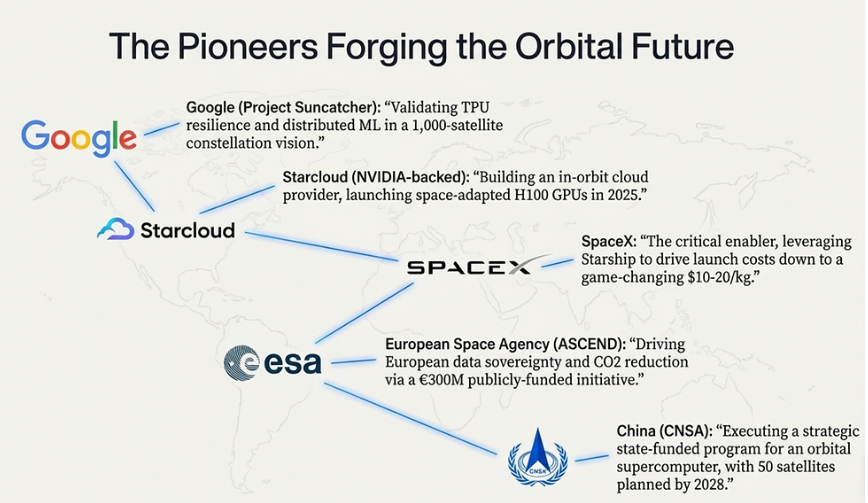 Caption: From Google to SpaceX, from startups to national space agencies, a new infrastructure race surrounding "orbital computing power" is unfolding in space.
Google is not the only one.
In late January of this year, SpaceX applied to the U.S. Federal Communications Commission for permission to launch up to one million satellites. According to the document, this is part of a larger goal: to establish a network of solar-powered satellites to “meet the explosive growth in data demand driven by AI.”
In December 2025, Starcloud, powered by Y Combinator and NVIDIA, launched its first AI-equipped satellite. CEO Philip Johnston predicted that even including launch emissions, extraterrestrial data centers would generate 10 times less carbon emissions than terrestrial data centers.
In March of this year, Blue Origin requested federal permission to launch a network of 50,000 solar-powered data center satellites into orbit. In their application, they wrote that moving data centers into space would help alleviate the pressure that energy and "water-intensive computing" places on American communities and natural resources.
Nvidia is also taking action, having already released hardware for space data centers. CEO Jensen Huang stated in February that the economics of space data centers "will improve over time."
Investors are equally enthusiastic. Nebula's valuation reached $1.1 billion after a $170 million Series A funding round led by Benchmark and EQT Ventures. Robinhood co-founder Baiju Bhatt, who has been investing in space data centers since 2024, is raising a new round of funding for his space-based solar energy company, Aetherflux, at a valuation of $2 billion.
03
There are many people who oppose space data centers, and their reasons are quite valid.
Matthew Buckley, an associate professor of physics and astronomy and a theoretical physicist at Rutgers University, estimates that each space data center would require solar panels the size of 450 football fields to power it. That alone would cost $10 billion, plus another $10 billion to launch it into space. And that doesn't even include maintenance costs.
Barkley added, "You can put data centers in space. It's not physically impossible. I just don't understand why anyone would do that."
OpenAI CEO Sam Altman was even more blunt, saying the idea was "absurd."
“This is a really crazy idea,” said Kathleen Curlee, an analyst at Georgetown University’s Center for Security and Emerging Technologies. She pointed out that space data centers are designed for a short lifespan, possibly only five years at most. “Ultimately, the cost of sending a data center into space is simply unreasonable. This is a long-term goal packaged as something that can be achieved within a few years.”
Quentin A. Parker, director of the Space Research Laboratory at the University of Hong Kong, believes: "A serious cost-benefit analysis will show that it simply doesn't hold up to scrutiny. Ground-based options are still available, and are likely much cheaper than sending anything into space. Sending data centers into space has all sorts of problems."
Launch cost is the biggest variable. Google's analysis of historical and projected launch pricing data suggests that by around 2035, the price of space launches could fall below $200 per kilogram. At this price, the operating cost of a space-based data center (per kilowatt per year) would be roughly the same as the electricity cost of a terrestrial data center.
However, a CNN report points out that Lonestar Data Holdings signed a $120 million contract with Sidus, a U.S. commercial satellite design, manufacturing, launch and data services company, to build six data storage satellites, each launched on a SpaceX Falcon rocket, with each launch costing approximately $10 million. The storage capacity of these satellites is only a fraction of that of ground-based data centers.
There is an even greater risk: an AI bubble. A McKinsey report in April 2025 warned that over-investment in data centers could lead to stranded assets, while under-investment would mean falling behind. In 2025, Alphabet, Amazon, Oracle, Meta, and Microsoft issued $121 billion in new debt, compared to only $40 billion in 2020.
04
Is it easy to become a missile target?
He wrote that tracking and targeting satellites in low Earth orbit is remarkably simple, and many countries have already demonstrated anti-satellite missile capabilities. The defense protection, physical security, and covert deterrence enjoyed by ground-based data centers operating within national borders do not exist in space. Their orbits are fixed, making defense virtually impossible.
"Those who advocate for space-based data centers had better come up with a security plan that doesn't require taxpayers to spend hundreds of billions or trillions of dollars to replicate the same level of protection for their businesses in space."
Other concerns have been raised. Space debris is a real threat; even a coin-sized fragment can damage a satellite's core components. Space weather events such as solar flares can disrupt services. Reportedly, some countries are developing "counter-space technologies," such as jamming systems that can target satellites.
In a 2024 statement, Golestan Radwan, Chief Digital Officer of the United Nations Environment Programme, said: “There are still many unknowns about the long-term environmental impact of AI, but some of the existing data is already disturbing. He called for a comprehensive assessment before large-scale deployment of AI technology: whether its positive effects on the planet can outweigh its negative effects.”
Conclusion
Reviewing these latest developments reveals an interesting disagreement.
On one side are tech companies. Google, Starcloud, Aetherflux—their logic is straightforward: the power bottleneck for AI is there, and space has unlimited solar energy, so why not use it? Musk wrote on the SpaceX website, "There's a reason space is called 'space,'" followed by a laughing-crying emoji.
On the other side are security experts. They don't deny the appeal of space-based solar energy, but they see a different picture: satellites in orbit fly along fixed paths at constant speeds, and their time and position can be precisely predicted, making them easy targets.
The two groups are thinking on completely different levels. Tech companies are calculating the cost per kilowatt-hour of electricity, while security experts are calculating the probability of each satellite being shot down.
One possible consensus lies in the level of data sensitivity. If it's just edge computing, handling tasks that don't matter much if interrupted, the logic of the space-based solution might hold true. But for running critical missions, the question becomes unavoidable: who will protect these servers floating in orbit?
It is worth noting that two technological approaches are being pursued in parallel:
One is sending computing power into space, while the other is preparing for a possible conflict.
In the next decade, we may see not only computing power in the sky, but also the attack and defense of computing power in the sky.
This article is sourced from:Tencent Technology