

Author:Wall Street CN
The explosive growth in demand for AI computing power is pushing TSMC's advanced process capacity to an unprecedented state of strain.
According to the trading platform, JPMorgan Chase released a research report on April 2, 2026, raising its target price for TSMC from NT$2,250 to NT$2,400. It expects TSMC's gross margin to reach 66.8% in its upcoming first-quarter financial report, higher than the company's own guidance of 63% to 65%.
The core logic driving the upward adjustment is:The capacity of advanced process technologies, represented by the N3 process, has been booked until 2027, and the supply-demand imbalance has further intensified in the past two to three months.
The robust growth of Agentic AI workloads has led to an exponential increase in computing power consumption, while the demand for various products such as GPUs, CPUs and AI interconnects has risen simultaneously, causing TSMC's advanced process utilization rate to continue to exceed 100%.
This supply and demand dynamic will support TSMC's gross margin to continue rising in the first half of 2026 and drive the company's cumulative capital expenditure to approximately US$190 billion over the three years from 2026 to 2028.
Demand for AI computing power has surged, and N3 production capacity is already booked until 2027.
Over the past two to three months, the demand for AI computing power has accelerated significantly.The explosion of agentic AI workloads—The surge in token consumption following the launch of similar products from Claude Code, OpenClaw, and other AI labs — is the main driver behind this unexpectedly high demand.
At the same time, the demand for server AI interconnect products (including network chips, DSPs, retimers, etc.) is increasing in tandem with the expansion of computing power.Demand for server CPUs such as Google Axion, Nvidia Grace, AWS Graviton, and Microsoft Cobalt has also rebounded significantly.
The demand for advanced process wafers has tightened significantly.The N3 and N2 capacity has been booked until 2027 for most HPC customers.
Major AI accelerators such as NVIDIA Rubin, AWS Trainium 3, and Meta MTIA are migrating to the N3 process in 2026. Coupled with the continued mass production of Google TPUs (Ironwood and v8 series) and AMD MI series, the supply and demand imbalance of N3 will be further exacerbated.
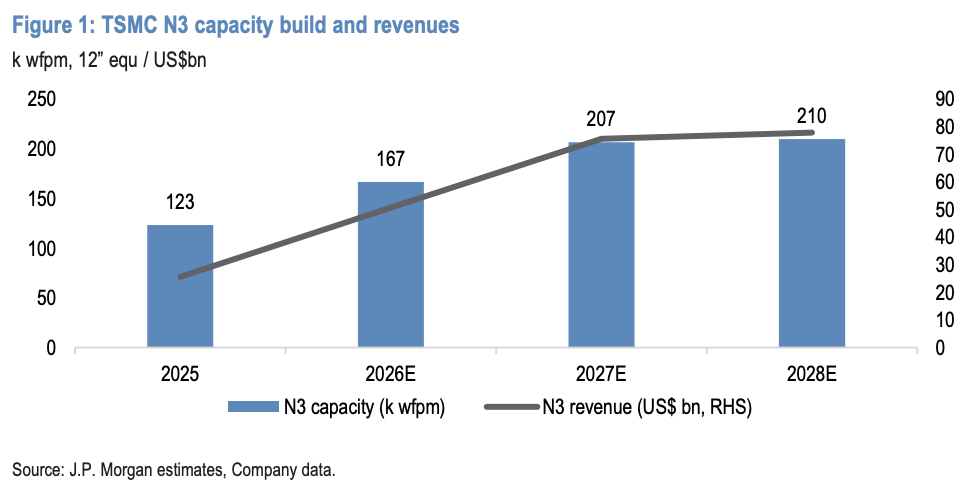
Despite TSMC's efforts to expand capacity by the end of 2026, N3 capacity utilization will remain above 120% and 110% in 2026 and 2027, respectively. N3 revenue is expected to roughly double in 2026, accounting for more than 30% of TSMC's total revenue, with HPC demand accounting for about two-thirds of total N3 demand.
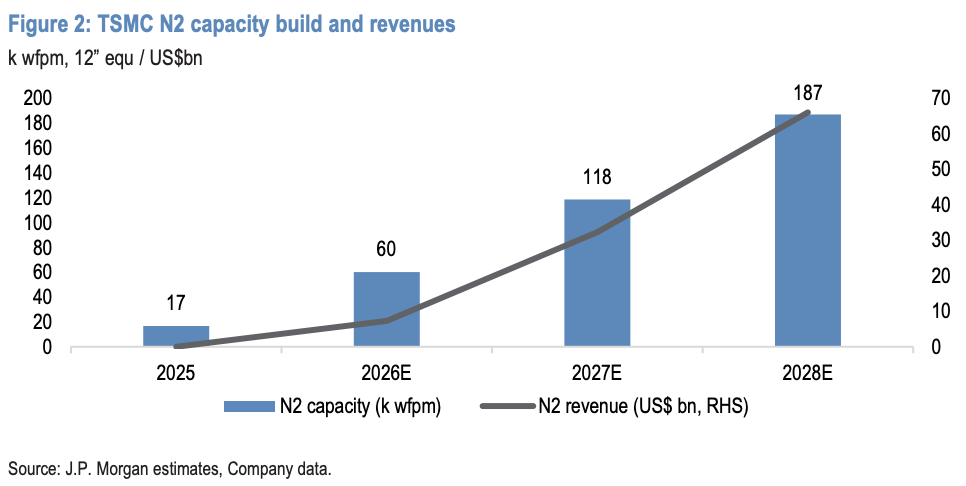
Regarding N2, Apple's entire iPhone lineup (A20/A20 Pro), AMD Venice and MI450, as well as MediaTek and Qualcomm's flagship SoCs will all adopt the N2 process in 2026. The revenue share of N2 is expected to grow from about 4% in 2026 to 15% and 26% in 2027 and 2028, respectively.
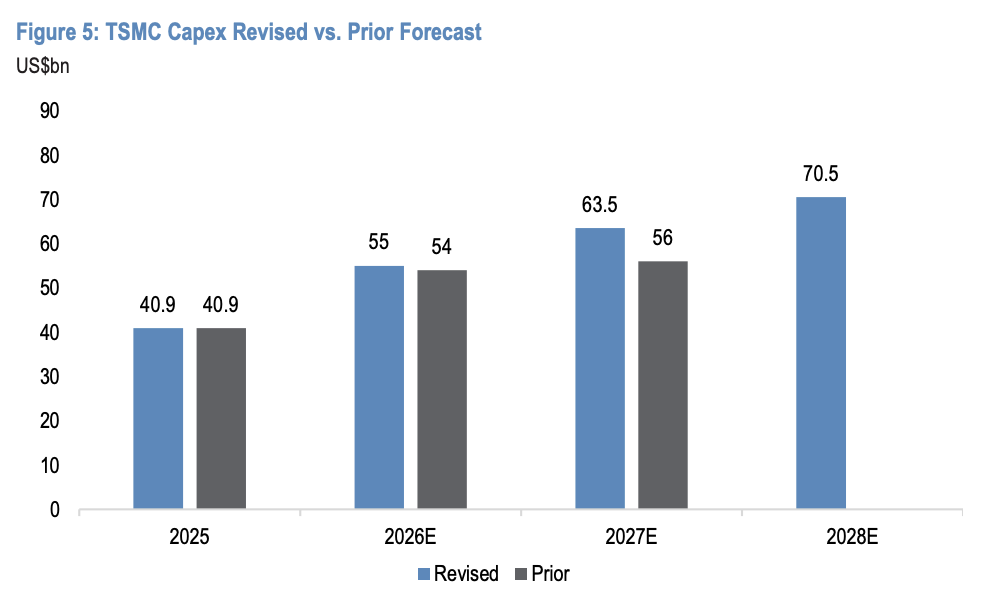
With aggressive capacity expansion, capital expenditures are expected to reach US$190 billion between 2026 and 2028.
TSMC has revised its capital expenditure forecasts for 2027 and 2028 to US$63.5 billion and US$70.5 billion, respectively. It is estimated that TSMC's cumulative capital expenditure from 2026 to 2028 will reach approximately US$190 billion, almost double the approximately US$101 billion from 2023 to 2025.
This large-scale expenditure reflects TSMC's strategic commitment to fully support the expansion of AI computing power, driven by the rapid growth of its customers' client revenue and the exponential expansion of token usage.Advanced process technology (N7 and below nodes) capacity is expected to achieve a CAGR of 16% between 2025 and 2028.
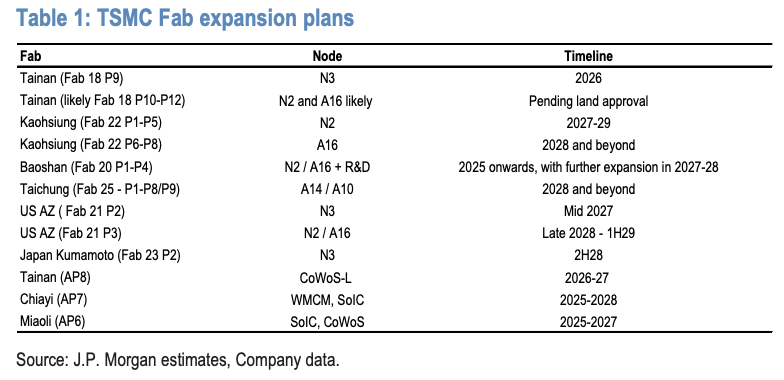
Global production capacity is expanding at an accelerated pace.
In Taiwan, TSMC is advancing the expansion of N3 capacity at Fab 18 P9 in Tainan, the construction of N2 and A16 capacity at Fab 22 P1 to P5 in Kaohsiung, and the construction of P1 to P4 at Fab 20 in Baoshan.
In terms of long-term planning, Taichung Fab 25 will be set up with A14/A10 nodes, and Fab 18 is also expected to add P10 to P12 stages (subject to land approval). Tainan also has early planning for another eight-stage new wafer fab targeting A10/A7 nodes.
Overseas, the second phase of N3 production at Fab 21 in Arizona, USA, is expected to begin in mid-2027, while the third phase of N2 production capacity may start from the end of 2028 to the first half of 2029; the second phase of N3 production capacity at Fab 23 in Kumamoto, Japan, is expected to begin in the second half of 2028.
In terms of advanced packaging, CoWoS capacity is expected to reach 115,000 and 145,000 wafers/month by the end of 2026 and 2027, respectively. SoIC will enter a large-scale investment phase from 2027 to 2028. Multiple N2 accelerators, such as NVIDIA Feynman, Google TPU v9, Trainium 4, and OpenAI Titan 2, are expected to adopt the SoIC architecture.
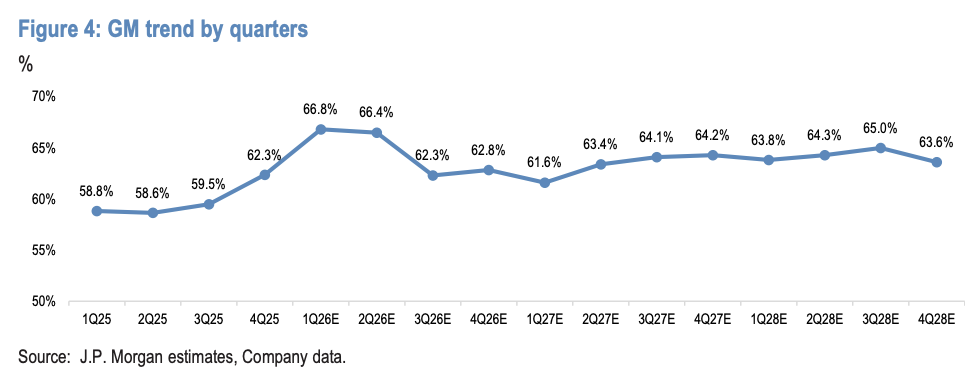
Gross margin exceeded expectations; first half of the year may see record high.
TSMC's gross margin is expected to reach 66.8% in the first quarter, exceeding the upper limit of the company's guidance by about 180 basis points, and will remain at a high level of 66.4% in the second quarter, a jump of more than 550 basis points compared to the second half of 2025.
The report listed five key factors that supported the better-than-expected gross margin:
Firstly, the utilization rates of N5 and N3 have consistently exceeded 100%.
Secondly, cross-Fab operations have improved the utilization rate of N7 and 28nm capacity and reduced the cost of idle equipment.
Third, HPC customers are increasing their "expedited" and "super-expedited" wafer orders (hot run/super-hot run), which can earn a premium of 50% to 100%.
Fourth, the price increase of approximately 6% to 10% for similar products using advanced processes in 2026 has been fully implemented since January;
Fifth, the Taiwan dollar has depreciated by more than 1.5% against the US dollar in the past two months, and each 1% depreciation can bring about a 0.4 percentage point increase in gross profit margin.
Conservative estimates suggest that gross margin will decline by approximately 400 basis points sequentially in the second half of 2026, primarily reflecting the dilution effect of the N2 process yield ramp-up, the upfront amortization of overseas wafer fabs (especially the rapid expansion of the US plant), and the potential impact of rising electricity prices.
Pre-earnings market expectations: Q1 exceeded expectations, full-year guidance remains unchanged.
TSMC expects its Q1 revenue to grow 7% quarter-over-quarter, higher than the upper end of the company’s guidance range (3% to 6% quarter-over-quarter growth, corresponding to US$33.5 billion to US$35.8 billion); Q2 guidance is expected to be 6% to 8% quarter-over-quarter growth (estimated at 8%), with a gross margin guidance range of 64% to 66%.
Despite continued strong demand, the report anticipates that TSMC will not adjust its full-year guidance during this earnings call, and management is expected to maintain the following three guidelines unchanged:
Full-year 2026 USD revenue growth is "close to 30%" (forecast is 35%).
The compound annual growth rate of AI revenue from 2024 to 2029 is "medium to high 50%";
And the company's long-term compound annual growth rate of USD revenue is approximately 25% from 2024 to 2029.
Management is expected to convey the following signals during this conference call:
Optimism regarding the demand for AI will be strengthened.
The statements regarding the capacity expansion plan for 2027-2028 are more positive;
The emphasis is placed on the strong demand from Apple's supply chain.
The accelerated expansion of N3 and N2 processes in the United States;
And maintain full confidence in the competitive landscape, including Tesla's TeraFab, Samsung's and Intel's foundry businesses.
The report uses a 12-month forward P/E ratio of approximately 20 as the valuation benchmark, corresponding to a target price of NT$2,400, which is higher than TSMC's five-year historical average P/E ratio, reflecting JPMorgan Chase's strong recognition of its structural growth logic.