


Author:Encryption Tracker
The Bitcoin long-term holder supply change has flipped positive over the past 30 days, indicating that investors have chosen not to sell.
Bitcoin faces renewed selling pressure after failing to hold above the $70,000 level on April 6. Despite this weak price performance, data highlighted by CryptoQuant analyst Darkfost shows that the change of Bitcoin long-term holder (LTH) supply has turned positive over the past 30 days.
Key Points
- Bitcoin climbed above $70,000 on April 6 but failed to hold this level, falling to $68,000.
- Long-term holder supply increased over the past 30 days, flipping from -674,000 BTC to about +308,000 BTC.
- The rise in long-term holder supply comes from coins aging past six months and slipping into the LTH category rather than new accumulation.
- Currently, 29% of long-term holder supply is in loss, still below past cycle bottom levels of 44%-53%.
- Despite solid spot demand, Bitcoin may hit new yearly lows in Q2 2026.
Bitcoin Long-Term Holder Supply Change Turns Positive
Darkfost’s recent analysis confirmed geopolitical tensions and their economic effects continue to create pressure, especially on risk assets, but some investors remain focused on the long term.
According to him, the supply held by long-term holders is gradually increasing, which is a positive sign. Even though demand remains relatively weak, more Bitcoin is now staying in wallets long enough to be classified as long-term holdings than is being sold by these investors.
Darkfost also clarified that this data comes from UTXO-based analysis. This means it does not necessarily show active buying. Instead, it comes from Bitcoin that was moved six months ago and has remained untouched, naturally shifting from short-term to long-term holder status. This trend shows that more investors are choosing to hold rather than sell.
Data Shows Change in Investor Behavior
Data from the chart indicates a change in the metric. After dropping to -674,000 BTC (30-day moving average) at the end of November 2025, the metric has now turned positive. On average, about +308,000 BTC has been added back into long-term holder supply.
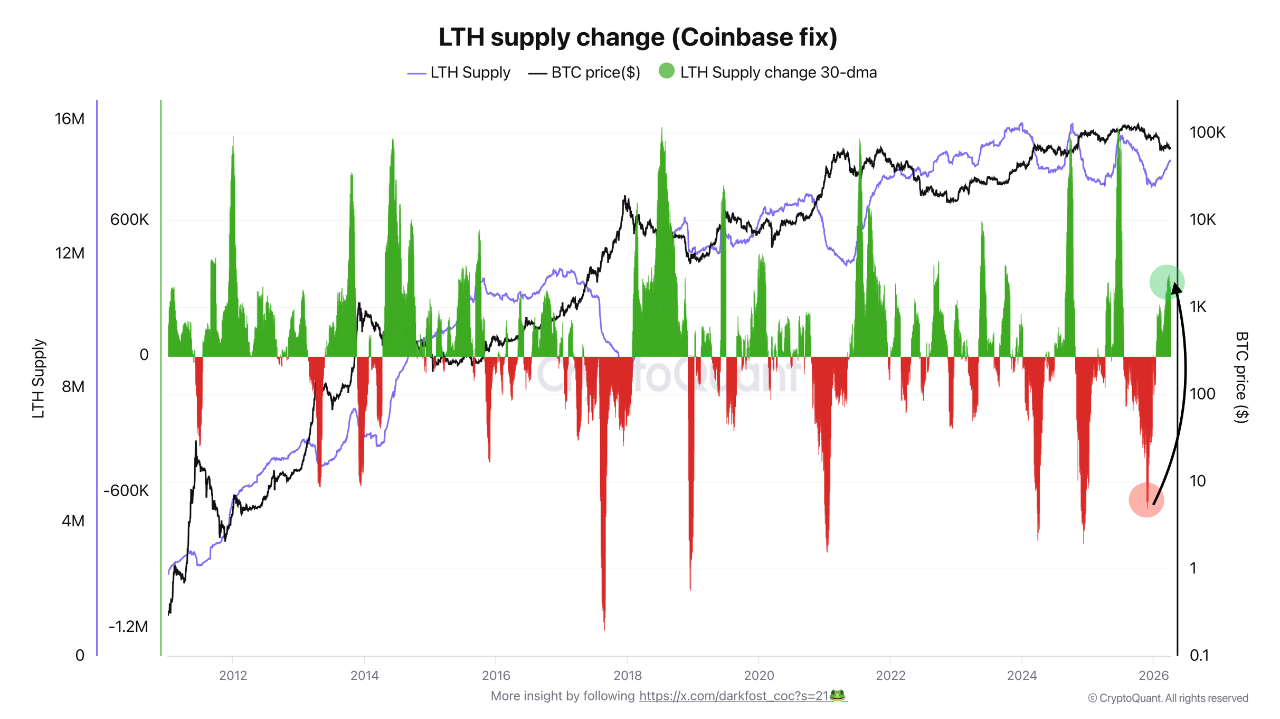
Darkfost called this a change in behavior, where holding now outweighs selling, despite Bitcoin persistently trading within a range. In the past, similar changes have often come before price increases. However, he warned that it is too early to be certain.
According to him, in bear markets, this kind of change can happen without leading to a strong and lasting trend. For now, the market analyst suggested that investors watch closely. If the increase in long-term holder supply continues, it could become a stronger signal for the market.
Analysts Warn of Possible Deeper Downside
Elsewhere, another analyst, Ardi, explained that during past market bottoms, 53% of long-term holder supply was in loss in 2015, 45% in 2018, and 44% in 2022. Each of these extreme levels matched the market bottom.
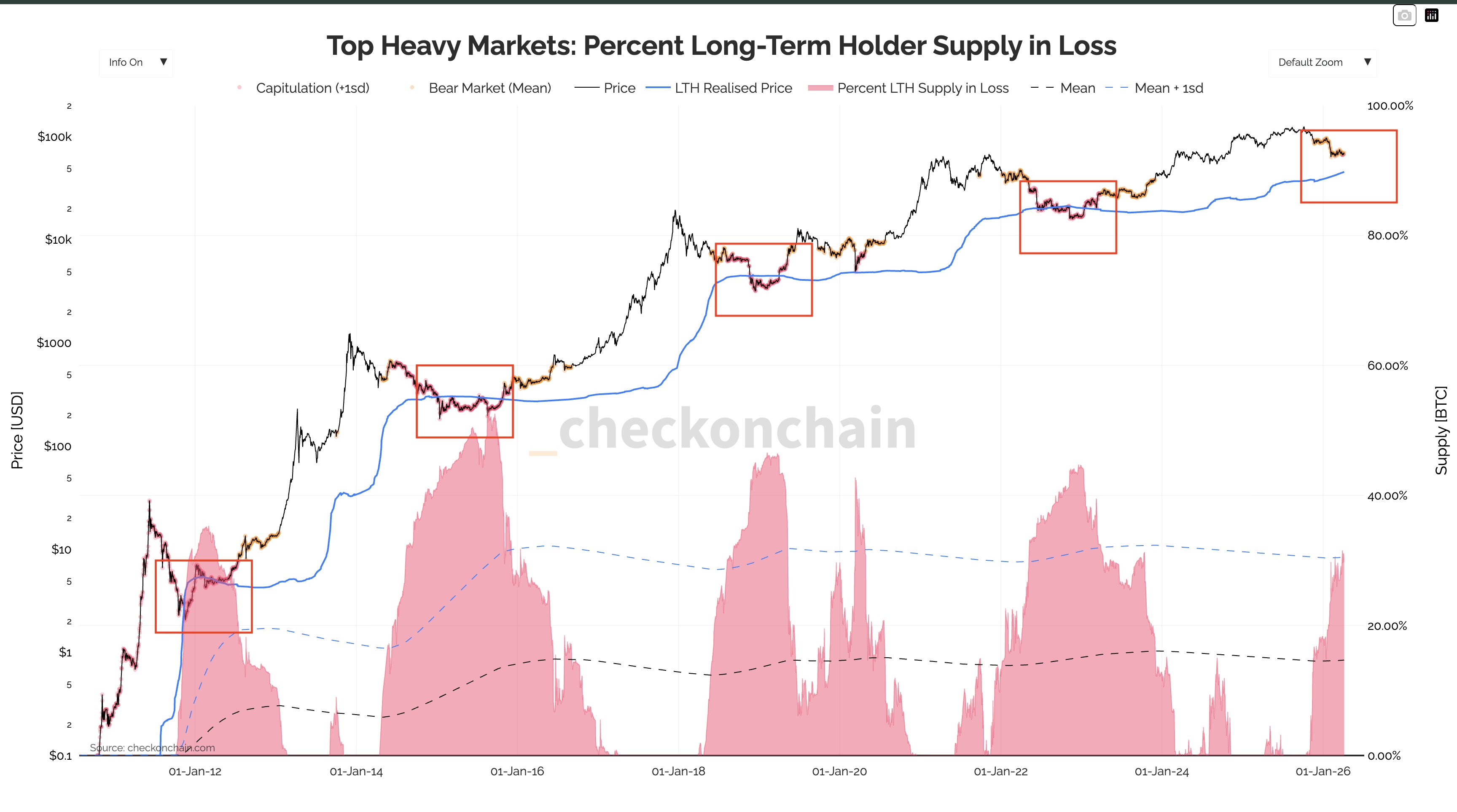
Right now, the figure stands at 29% and is still rising, suggesting that the market has not reached its lowest point yet but may be moving in that direction.
Meanwhile, market analyst Ted Pillows pointed out that Bitcoin recently tested the $69,000-$70,000 resistance zone but failed to break through. He said that while spot demand remains solid, any short-term rise may not last. To him, Bitcoin could fall to new yearly lows in Q2 2026.
$BTC tapped the $69,000-$70,000 resistance zone and got rejected.
Spot demand is still good, so there's a chance of another upward move.
But that won't last long.
IMO, BTC is going to new yearly lows in Q2 2026. pic.twitter.com/OKdiRTWLKk
— Ted (@TedPillows) April 7, 2026