When DeFi discovered RWA, most protocols opted for obvious assets:
Treasury bills.
Real estate.
Tokenized funds.
These assets have legal packaging, institutional endorsement, and predictable demand: easy to issue and easy to explain, but not truly integral to the financial system that drives global commerce.
The main operational layers of global finance reside in:
- Trade finance
- Payments finance
- Cross-border settlement liquidity
These markets exceed $10 trillion, but are largely ignored by the cryptocurrency space due to their complexity and operational intensity.
Before RWA, Kelp was one of the larger restaking protocols:
- Total Value Locked (TVL) exceeding $2.2 billion
- rsETH as a leading Liquidity Re-Token (LRT)
- Integration with over 10 blockchains and major DeFi ecosystems
Kelp discovered from restaking that infrastructure typically only records usage, not the full value layer. Therefore, Kelp's focus is no longer on adding new re-collateralized products, but rather on moving upstream to tokenize the underlying economic activities.
Global trade relies on a nearly invisible credit layer. Cross-border freight companies pre-fund payment accounts, finance invoices, and manage settlement liquidity, resulting in:
- Approximately $20-25 trillion in idle pre-funded accounts
- A global trade finance gap exceeding $2.5 trillion
These funds are effectively locked within the trade system. Banks have historically dominated this area, but the Basel Accords, smaller invoice sizes, and fragmented supply chains have led to significant inefficiencies.
KUSD aims to address this issue by tokenizing the financing layer of global trade (rather than the traded assets).
Most DeFi yields face scalability issues. With the growth of stablecoins:
- Decreased lending demand
- Decreased interest rates
- Funds flowing into Treasury bills
Therefore, yields tend to decline.
KUSD's yield structure is based on actual credit repayments linked to trade flows and business activities, rather than on a feedback loop based on issuance or leverage.
Historically, trade finance has generated annualized yields of approximately 8% to 12% over the long term, with the majority of these yields held within institutional networks. KUSD offers a tokenized way to access these yields.
This means yields that:
- grow with global trade volume
- have low correlation with cryptocurrency market cycles
- can theoretically support pools of billions of dollars without experiencing the same interest rate compression dynamics
Operating a heavily staking protocol with over $2 billion in Total Value Locked (TVL) allows Kelp to understand how (or fails to) value accumulates within the crypto infrastructure. KUSD integrates value capture mechanisms from the outset and is supported by:
- Large-scale institutional payment partners
- Trade finance strategies with a long track record of zero defaults
- Chainlink Proof-of-Reserves (PoE)
- Multi-layered security and risk framework
Its goal is not to create a purely speculative risk-weighted asset (RWA) system, but rather a system that can interface with real capital markets.
The surrounding environment has also changed:
- Stablecoin supply is approaching $300 billion or more.
- Activity is gradually shifting from transaction channels to payment and settlement infrastructure.
- Governments are introducing regulatory frameworks, such as the GENIUS Act.
- Institutional investor interest is no longer limited to simple Treasury-backed risk-weighted assets (RWAs).
Meanwhile, entities like Tether generate substantial annual revenue, demonstrating the economic benefits of stablecoin infrastructure. A logical next step is for stablecoin yields to derive from real economic activity, rather than purely on-chain mechanisms.
In this architecture, KUSD serves as a credit-pegged stablecoin, Kelp provides the infrastructure layer, and $KERNEL is positioned as the primary value-accumulating token in the system. As KUSD is deployed in global commerce and payment channels, yields and activity will propagate through the protocol, with related value flowing into the token layer.
If KUSD can enter a market exceeding $10 trillion with a funding gap of trillions of dollars, even a small fraction of it would be enough to have a significant impact. $KERNEL's behavior may differ from typical DeFi governance or incentive tokens, reflecting its connection to the real-world credit system.
While many RWA protocols focus on tokenizing existing assets, KUSD targets the trade and payments finance sector, historically inaccessible to retail customers and, in many cases, to non-specialized institutions.
Under conservative assumptions, a $10 billion TVL base and a 1% fee would translate to approximately $100 million in annualized revenue for the protocol layer. In this context, $KERNEL represents a value layer associated with this new financial system.
377
0
0
31
High mountain to look up to.eth
03-14 03:49
Follow
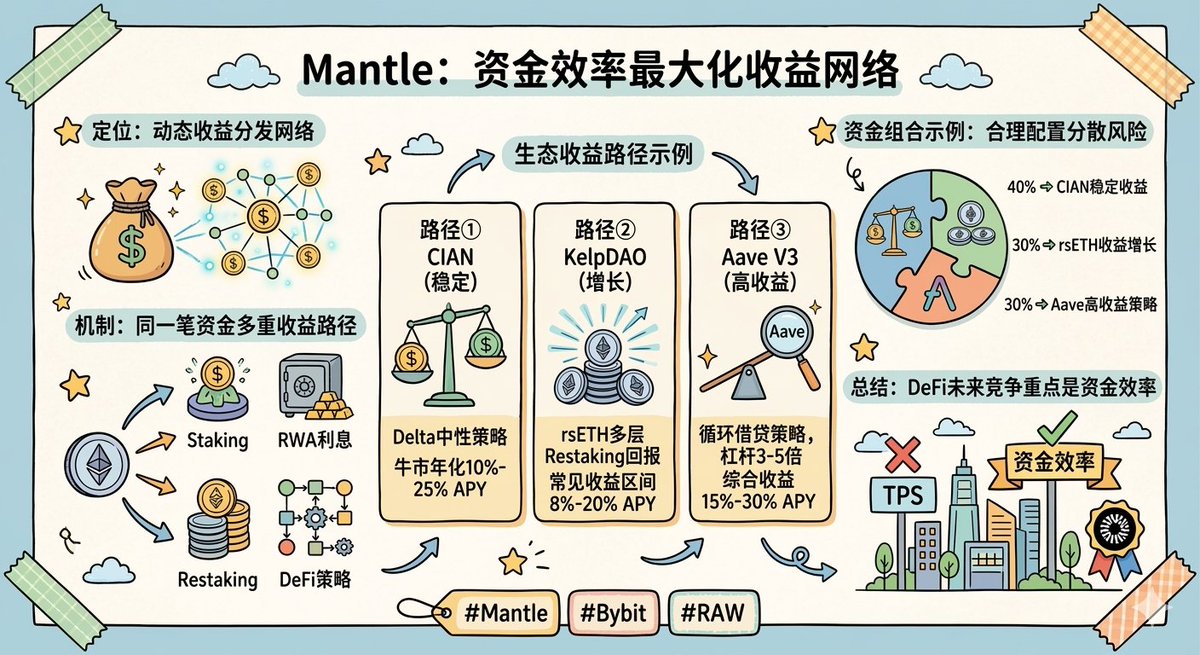
Mantle is maximizing on-chain capital efficiency.
If we still use traditional metrics like TPS and Gas to measure @Mantle_Official, its core value is easily underestimated.
Unlike many public chains that simply pursue TVL (Total Value Limit), Mantle is building itself into a dynamic "on-chain yield distribution network."
Its core logic isn't about passively storing bridged funds, but about enabling each investment to continuously generate multiple yields on-chain through higher capital efficiency.
🌟 How can funds be made more efficient on Mantle?
The same investment can participate in multiple yield paths simultaneously, such as:
🔸Staking
🔸RWA Interest
🔸Restaking
🔸DeFi Strategies
🌟 What are the yield paths in the Mantle ecosystem?
* For example, CIAN offers relatively stable returns through a delta-neutral strategy, achieving an annualized APY of 10%–25% in a bull market.
* KelpDAO extends ETH returns to multi-tiered restaking rewards through rsETH, typically offering 8%–20% APY.
* Aave V3's revolving lending strategy allows users to leverage their funds 3–5 times to pursue a combined APY of 15%–30%.
A Common Fund Portfolio
By strategically allocating different strategies, risks can be diversified while generating returns. For example:
40% ➜ CIAN stable returns
30% ➜ rsETH return growth
30% ➜ Aave high-yield strategy
From a longer-term perspective, the future competition in DeFi may not only focus on TPS, but also on capital efficiency.
@0xMantleCN This yield network model, which focuses on improving the efficiency of on-chain capital utilization, is likely to have increasingly apparent competitive advantages.
#Mantle #Bybit #RAW
303
0
0
31
Stephen | DeFi Dojo
2025-12-31 02:21
Follow
Who's still holding Ethereum?
Here's some yield information for those who have held on.
🚨Top 5 Ethereum Yields at Year-End🚨
1) Veteran @aave
Ethereum (14.23x Leverage):
weETH: 15% Annualized Yield
wstETH: 10% Annualized Yield
Plasma's yields are occasionally higher, but in terms of net annualized yield and liquidity, the Ethereum mainnet still currently wins.
2) @Morpho
Morpho cycles are especially effective when @merkl_xyz provides incentives (e.g., @monad), but for now, regular cycles on the mainnet remain the best option.
Ethereum:
weETH (14x): 17.7%
wstETH (20x): 19.41%
On Mondays, you can borrow AUSD to earn yield on wstETH, allowing you to implement leveraged long and short strategies as needed.
3) Relatively low-key, @KelpDAO's hgETH
It's considered low-key because Kelp hasn't been in the public eye for a while.
However, the hgETH vault has averaged around 10% yield over the past three months and over 8% in the past seven days.
It has a fairly sophisticated underlying strategy (primarily circulating wstETH, tETH, and rsETH across different chains like Aave and Morpho), but it also interestingly utilizes off-exchange lending to increase exposure.
4) Similarly, @ipor_io's wstETH vault
I explained this last night, but basically it's a leveraged wstETH loop, which I call lending aggregation.
It borrows from the place with the best interest rates and swaps debt when appropriate. Therefore, the leverage ratio doesn't constantly change, but the money market for borrowing adjusts according to interest rates.
This is a pretty good strategy. And you also earn Fusion credits.
5) @monad Incentivizes @Uniswap LP
It's that simple.
wstETH/WETH: Average 9.67%
Bonus Reward: @GearboxProtocol
➢ ETH+: 29%
➢ ETH+/WETH LP: 25%
➢ PT DETH: 15%
In fact, there are tens of millions of dollars available for lending in the market on @makinafi.
Thanks to @deepcryptodive for the reminder.
354
0
0
22
Dune | We Are Hiring!
2025-12-11 01:35
Follow
Since the beginning of December, the total market capitalization of WETH, rsETH, and ezETH on the @arbitrum platform has increased by approximately 30%.
The combined market capitalization of these three Ethereum assets currently stands at $1.1 billion.
446
0
0
47
The Data Nerd
2025-11-03 20:18
Follow
The DeFi protocol @Balancer appears to have been hacked.
Approximately $100 million in assets were stolen, including:
- 7,838 $WETH
- 6,851 $osETH
- 5,431 $wstETH
- 2,443 $frxETH
- 1,224 $rsETH
- 1,037 $rETH...
Address:
474
0
0
45
Dune | We Are Hiring!
2025-10-02 23:04
Follow
Week four of the @arbitrum DRIP incentive program has concluded. Here are the highlights:
1. Overall Ecosystem Highlights:
• Total market capitalization of yield-earning USD-eligible assets reached a new high of $497 million (up $67 million / 16% month-over-month)
• Despite the launch of Plasma, Arbitrum's lending DeFi Total Value Locked (TVL) grew by ~5% month-over-month to a new high of $1.8 billion
• USDC borrowing volume on Arbitrum's lending market grew by 10% month-over-month to $542 million
• DEX liquidity for USD-eligible assets grew by $12 million to $96 million (up 15% month-over-month)
• Total protocol fees grew month-over-month:
- @0xFluid grew by 22% month-over-month (up 84% month-over-month)
- @eulerfinance grew by 23% month-over-month (up 167.5% month-over-month)
- @SiloFinance: 36% (up 20% month-over-month)
2. Protocol Highlights:
• @MorphoLabs: Market size reached a new high of $300 million. Growth was primarily driven by USDC lending.
• Euler: Market size reached a new high of $177 million (up 65% month-over-month). USDC market size (and lending) and PT-USDai supply were the primary contributors to this week's growth.
• Silo: Recycling market size reached a new high of $100 million (up 8% month-over-month). Silo continues to show strong signs of USDC and WETH circulation, across rsETH/weETH/PT-sUSDai deposits and USDC/WETH lending.
3. Asset Highlights:
• thBILL currently has the largest market capitalization of all eligible USD assets at $82 million, followed by USDai at $69 million and syrupUSDC at $60 million. • While $250M USDai has been minted on Plasma, 67% of it has flowed back to Arbitrum.
493
0
0
24
Bankless
2025-09-15 22:06
Follow
Giza, a DeFi platform, launched two major products last week:
On Monday, it launched Swarms, an incentivized validation layer. On Wednesday, it launched Pulse, an autonomous agent in partnership with Pendle Finance, with its $3 million cap sold out in just three hours.
Learn everything you need to know in 5 minutes 👇
~~Analysis by @davewardonline~~
How Giza Works
@gizatechxyz is a decentralized network that deploys autonomous agents to generate high yields. It transforms passive deposits into active capital, with AI agents proactively seeking the best returns.
Giza's flagship agent, ARMA, offers a 15% yield on USDC, exceeding standard DeFi yields. With $20 million in proxy assets and a 20% deposit rate, users are reinvesting their returns, demonstrating their satisfaction.
The network operates through three core layers:
➢ Semantic Layer - Converts DeFi protocol operations into agent-readable data for evaluating investment opportunities.
➢ Smart Authorization Layer—Serves as an autonomous custodial hub for deposits, interactions, and token authorization.
➢ Decentralized Execution Layer—Executes user instructions, enabling agents to implement strategies on-chain.
The new Swarms layer verifies advertised yields through live testing, ensuring agents deliver verified results.
The $GIZA token derives value through protocol fees, token buyback funding, liquidity growth, and pool development. The network is open to developers, allowing anyone to launch an agent.
Pulse Launches: Fixed Yield Simplified
Pulse launched on Wednesday in partnership with @pendle_fi, targeting Principal Token (PT) portfolios, offering fixed-yield exposure. Pendle divides assets into PT (guaranteed principal at maturity) and Yield Tokens (yields). Pulse simplifies this process by managing expiration dates, rebalancing, and optimizing allocations.
Pulse launched an ETH-PT market on Arbitrum, offering a 13% annualized interest rate and reaching its $3 million cap within three hours. Giza has expanded its partnerships through @KelpDAO to include assets like PT-rsETH. It plans to expand to more blockchains and increase capacity.
Pulse addresses DeFi pain points such as user churn and complexity, potentially simplifying other protocols and expanding DeFi adoption.
Swarms: Ensuring Honest Yields
Swarms launched last Monday to address the issue of unverified DeFi yield claims. It introduces a standardized annual percentage rate (sAPR) through proxy testing to ensure accurate yield metrics. The protocol publishes an incentive scheme, proxies test their performance, and the sAPR reflects verified results (for example, an 8% base yield plus a 5% reward equals a 13% sAPR).
This helps the protocol receive measurable inflows, providing users with competitive yields and enabling efficient capital allocation. Swarms also creates a revenue stream, as protocols pay to access Giza proxies and support $GIZA holders through buybacks and fund growth.
Swarms acts as quality control for DeFi, prioritizing proven performance over promises.
Future Outlook
Giza's vision is to create a suite of intelligent agents optimized for specific areas. Pulse and Swarms, which enable higher returns with less investment, demonstrate the potential of DeFi when AI-powered agents streamline operations. Pulse's rapid sales demonstrate user enthusiasm, and as Giza's capacity continues to expand, DeFAI is also growing.
437
0
0
49
Stani.eth
2025-09-11 00:58
Follow
The renaissance continues... 🌱
Borrow WETH on the @aave v3 Arbitrum market, using rsETH as collateral, to unlock:
✦ Daily rewards: $74,700 worth of ARB rewards
✦ Double Kernel Points
Join @arbitrum's DeFi renaissance and amplify your rewards ✨
Arbitrum is everywhere. Kelp is everywhere.
⚓ https://t.co/rb4vFe0s5q
475
0
0
36
Euler Labs
2025-07-14 23:34
Follow
Upshift aims to give users access to yield opportunities that are usually only available to institutional funds.
hgETH is the collection token for Upshift's high-growth ETH vault, built by @KelpDAO, which distributes rsETH across 12 DeFi protocols.
For more information, visit:
https://t.co/YnxrHknjSF