


Author:Coin Encyclopedia
Author: Zhou, ChainCatcher
Since the end of last year, listed mining companies have launched a wave of collective share reductions.
Cango sold approximately 60% of its holdings, totaling 4,451 bitcoins, in February; Bitdeer liquidated its entire bitcoin inventory in January; and Riot Platforms sold multiple bitcoins in December.,First quartersellAlready3778 BTCCore ScientificPreviouslyThey also plan to sell approximately 2,500 bitcoins in the first quarter.
Recently, leading mining company MARA announced that in just three weeks, from March 4th to 25th, it sold 15,133 bitcoins, cashing out over $1 billion. Simultaneously, the company announced it would lay off approximately 15% of its workforce.,As part of a strategic transformation into an energy and digital infrastructure company.
In fact, miners selling Bitcoin is nothing new. During the bear markets of 2018 and 2022, mining companies also experienced large-scale liquidation and surrender, leaving behind only the more efficient players. This time, however, it's not just the drop in Bitcoin price that triggered the sell-off; they also have a new destination—AI data centers.
I. Three Motives Behind the Sell-Off
On the surface it is amining companiesofA mass sell-off, but breaking it down more closely...themThe underlying motivations are not uniform and can be roughly divided into three different selling logics.
Mining itself has already fallen into losses.
The first, and most direct, reason is cost pressure.
CoinShares Latest Mining ReportThe data shows that the weighted average cash cost for listed mining companies to mine one BTC is approximately $79,995, while the market price of BTC hovers between $68,000 and $70,000. The average loss per BTC is close to $19,000, resulting in an overall loss of about 21%.
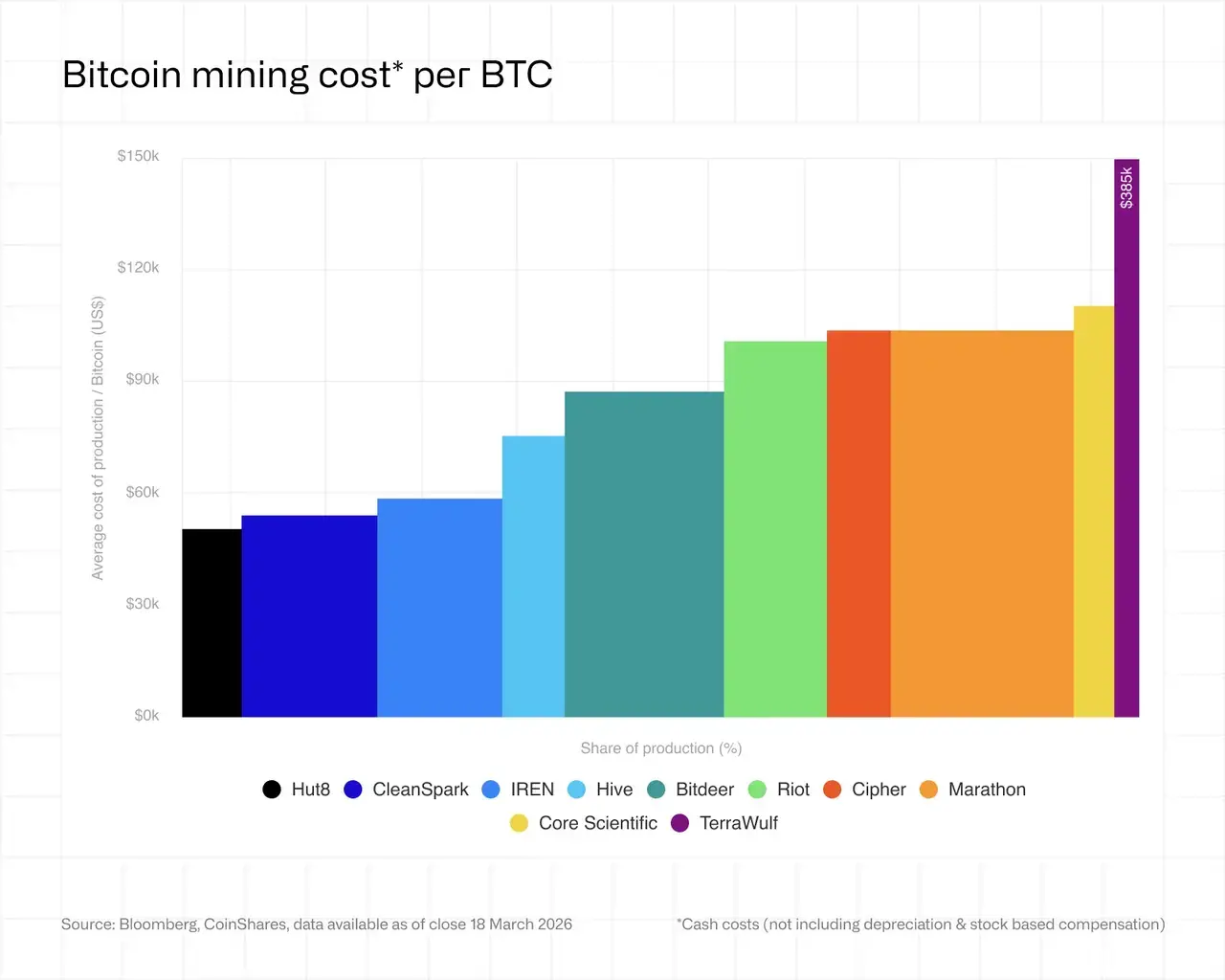
This is no longer a problem of narrowing profit margins, but a problem of whether cash flow can sustain the business if it continues to be exploited.
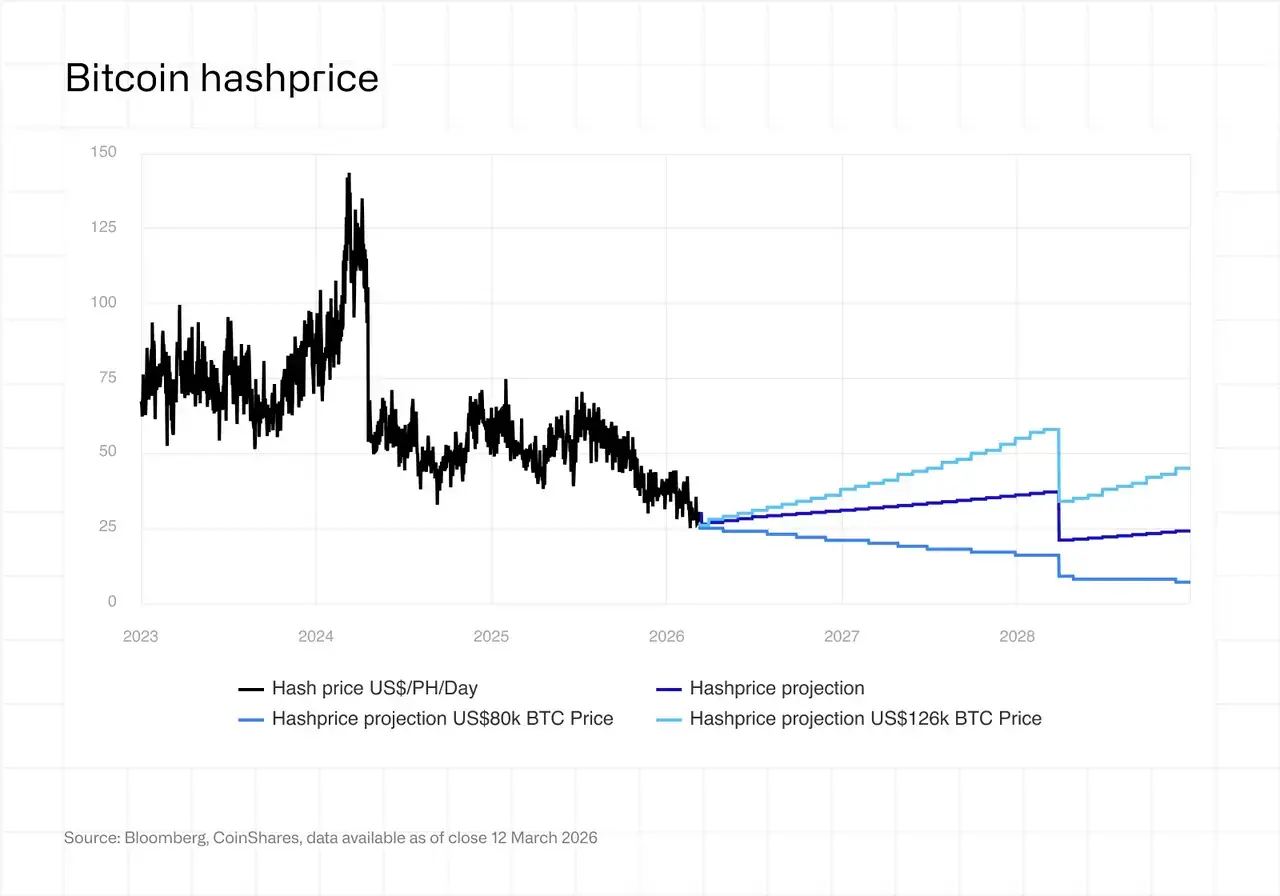
ReportreturnThe data shows that computing power prices in March...earlyIt once fell to $28 to $30 per pence per day, hitting a new low since the halving.At this level, most active mining rigs would need to keep electricity prices below $0.05 per kilowatt-hour in order to maintain cash profitability.at present,Approximately 15% to 20% of all mining machines on the network are already on the verge of breaking even.
At the same time, geopolitical tensions in the Middle East are pushing up energy prices and putting continued pressure on electricity costs, which are external variables that mining companies have little control over.
The QCP Group report points out that with Bitcoin prices significantly lower than average mining costs, mining companies are under considerable pressure, and liquidity has become a priority over hoarding strategies.
Against this backdrop,partFor mining companies, selling Bitcoin is a practical necessity to maintain operations.
AI provides a more stable revenue model
The second motivation, which is more strategic, is the part most worthy of in-depth investigation in this round of sell-offs.
Bloomberg analysis points out that, unlike previous sell-offs aimed at covering costs, the funds from this round of sell-offs are being reallocated to the field of artificial intelligence.
Behind thisofThe business logic is clear: mining revenue is highly dependent on the price of the cryptocurrency, the hash rate, and the electricity price, making it extremely volatile.In comparison,AI infrastructure is closer to long-term leases, with a CoinShares report indicating that its profit margins can reach 80% to 90%, and its revenue has long-term predictability.
More importantly, mining companies already have readily available resources—cheap electricity contracts, established data centers, sophisticated cooling systems, and mature operation and maintenance teams.
Some analysts point out that the construction cost of Bitcoin mining infrastructure is about $700,000 to $1 million per megawatt, while AI infrastructure costs as much as $8 million to $15 million per megawatt. This huge cost difference is being monetized on a large scale by mining companies.
It is worth noting that behind this transformation stands a group of unexpected driving forces—tech giants and traditional financial institutions.
Previously,Google has disclosed over $5 billion in credit support by providing credit guarantees for the lease obligations of its AI cloud platform Fluidstack, and has provided guarantees for the AI transformation of mining companies such as TeraWulf, Cipher Mining, and Hut 8 in exchange for corresponding equity; Microsoft signed a five-year, $9.7 billion AI cloud service contract with mining company IREN; and Morgan Stanley provided a $500 million loan to Core Scientific, with a potential total amount of $1 billion.
themofEntry, formining companiesofThis transformation has provided a much stronger capital backing than imagined.
at the same time,Core Scientific, TeraWulf, Hut 8, Cipher, and other mining companies have signed large AI/HPC contracts, totaling over $70 billion. (CoinShares)ReportMentionMining companies with AI/HPC contracts are valued at about twice that of pure mining companies, and the market is rewarding those companies that have completed the transformation first with valuation premiums.
Even the most financially stable and least leveraged mining companies, such as HIVE, have proactively scaled back their mining operations and shifted their focus to expanding into AI data centers. This indicates that the pressure to transform is no longer unique to highly leveraged mining companies, but rather a directional choice facing the entire industry.
Actively use BTC as a financial tool
The third logic is relatively shrewd and also the most proactive.
Some mining companies are choosing to sell BTC not out of operational pressure, but as a tool to optimize their balance sheets.,likeMARAThe specific operation involves using the proceeds from the sale of convertible bonds to repurchase previously issued convertible bonds at a discount to their face value. This reduces both the debt size and the potential risk of equity dilution.
For these mining companies, the role of BTC on their balance sheets has quietly changed from a long-term holding symbolizing faith to a strategic asset that can be flexibly allocated.
In addition, a relatively rare type of seller has emerged in this round of sell-offs: sovereign states.
On-chain data showsThe Bhutanese royal government's BTC holdings have decreased by about 66% from their peak at the end of 2024, with single transactions in March reaching between $35 million and $45 million, and the pace of selling continuing to accelerate.
Unlike most countries that accumulate BTC through market purchases, Bhutan's holdings come from its domestic hydropower mining operations. This large-scale reduction may be related to the funding needs of its national development projects. This is also one of the largest government-led Bitcoin reductions on record.
With three factors converging—mining losses, AI transformation, and debt optimization—plus selling pressure at the sovereign level, the market is facing structural supply pressures from multiple directions and of varying natures. Mining companies' faith in Bitcoin is being reshaped by more pragmatic business logic.
two,After leaving, they went their separate ways.
certainly,Selling off is not the same as liquidating inventory; the remaining holdings and subsequent strategies of various mining companies are showing a stark divergence.
Three paths, three choices
The first road,Stick to mining.
Represented by CleanSpark and HIVE, these companies do not chase the AI transformation narrative, avoid accumulating debt, and rely on a combination of low electricity prices, next-generation mining machines, and low leverage to seek victory during the industry shakeout. Their logic is that as high-cost production capacity gradually exits the market, the revenue per unit of computing power for the remaining mining companies will increase accordingly.
CleanSpark has publicly stated that continuing to invest heavily in Bitcoin mining at the current price level of computing power is "no longer economically reasonable," but the company still chooses to stick to its core business, betting that the cycle will eventually reverse.
famousencryptionKOLBlue FoxIt is pointed out that historically, almost every halving has resulted in miners surrendering, while those who remain are often the more efficient players who gain a larger share in the next rebound.
For these mining companies, sticking to mining is not stubbornness, but rather a trust in the cyclical patterns.
The second way,Walking on two legs.
Examples include MARA, IREN, and Riot. They maintain a significant amount of BTC holdings while simultaneously investing in AI/HPC, using the relatively stable revenue from AI businesses to hedge against the cyclical fluctuations in mining revenue.
These companies are essentially solving an asset allocation problem. The answer varies from company to company, but the core logic is that the two business lines support each other and diversify the risk of a single business.
The third way,Fully shift to AI.
Companies like Core Scientific, TeraWulf, and Cipher exemplify this trend. BTC holdings have fallen out of favor as a core asset, and mining has gradually become a secondary component of data center operations.
CoinShares predicts that by the end of 2026, AI revenue may account for as much as 70% of some mining companies' total revenue, while mining revenue may decline from about 85% in early 2025 to less than 20%. These companies are still nominally mining companies, but in reality they are becoming AI infrastructure operators that started with mining.
This road has potentialofriskyes,A shift towards heavy asset investment means a huge debt burden, and both ends of the business will be under pressure if the demand for AI cools down.
alsohaveOpinionPoint outGoogle's credit guarantee structure through Fluidstack actually creates a highly concentrated counterparty risk—the entire cash flow chain relies on Fluidstack as an intermediary, and this structure will become a single point of failure should there be significant changes in the AI lease market.
BTC priceDecidetheyofdestiny
Regardless of which path you choose, it ultimately points to the same variable: the price trend of BTC.
CoinShares provides three scenarios:
●If BTC recovers to $100,000 by the end of 2026, the hashrate price will recover to about $37/PH/day, mining profits will recover, and the overall pressure on the industry will ease.
●If the price remains below $80,000, high-cost miners will be forced out of the market more quickly, and the traditional model of mining, hoarding coins, and waiting for a bull market will become increasingly unsustainable.
●If the historical high is broken, the price of computing power may soar to $59/PH/day, and the industry will enter a new round of expansion cycle.
Conclusion
In generalMining companies face only two possible outcomes: either the price of cryptocurrency recovers, allowing them to return to their core business, and everything they're experiencing now is merely a cyclical historical event; or the price...continuedIn the midst of a downturn, more and more mining companies are transforming into AI data centers, and the business model of mining, hoarding coins, and waiting for a bull market is becoming increasingly rare in this industry.
but,There's another issue beyond the business logic that deserves further investigation in this transformation. Mining companies aren't ordinary publicly traded companies; their continuous investment in computing power is itself part of the Bitcoin network's security budget.
Sazmining CEO Kent Halliburton everThe statement bluntly states that these companies "hold power contracts, land, and infrastructure, yet they hand these resources over to Microsoft and Google in exchange for rent checks, transforming themselves from protecting the Bitcoin network into storing rack space for hyperscale cloud providers."
When mining no longer generates sufficient economic returns, a rational business decision would naturally be to shift resources; however, if this trend continues to spread, the question of who will bear the long-term costs of maintaining the Bitcoin network will become an issue that cannot be ignored.
History may have provided the answer to this question.
The Bitcoin network has undergone several large-scale miner cleansings, and each time it has operated at a higher efficiency.
But this time, the miners who left did more than just shut down the machines.
Times have changed.