

Author:Wall Street CN
Oracle's sudden layoffs in the early hours of the morning were not an April Fool's joke.
CNBC has confirmed that Oracle has initiated a new round of layoffs, affecting thousands of employees.
At the same time, it is investing tens of billions of dollars in building AI infrastructure.
Multiple industry media outlets have reported that Oracle plans to increase its annual capital expenditure to approximately $50 billion, primarily for data center and AI infrastructure development.
This investment has already begun to erode the company's cash flow: TheStreet data shows that Oracle's free cash flow turned negative from approximately $11.8 billion in 2024 and is projected to reach -$23 billion in 2026. Furthermore, Oracle's stock price has fallen by about 25% this year, a decline exceeding that of all other tech giants.
On one hand, there is continuous expansion of AI investment, and on the other hand, there is layoffs and cost control. This combination is not common in traditional software companies, but it is becoming a typical state for infrastructure companies in the AI era.
If you work for an infrastructure company, you should be wary now: the hotter AI becomes, the more likely you are to be "optimized out."
Oracle bone script is just the latest example.
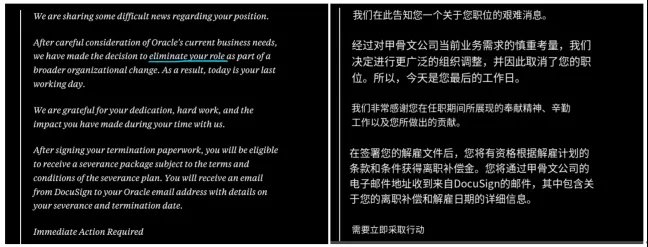
Oracle's layoffs are not an isolated case.
Similar things are happening across the entire AI infrastructure chain.
Between 2025 and 2026, several companies in this chain announced large-scale layoffs:
Intel announced in 2025 that it would lay off approximately 25,000 employees as part of its manufacturing and cost restructuring.
Amazon plans to lay off approximately 16,000 employees by early 2026.
Microsoft plans to lay off approximately 9,000 employees by mid-2025.
Block laid off more than 4,000 employees in early 2026.
These companies are spread across different sub-sectors, including semiconductors, cloud computing, enterprise software, and payment infrastructure. Their layoffs certainly have their own specific reasons, but they also share a clear commonality: they are all "assisting" AI.
These companies are not peripheral participants in the AI wave; on the contrary, they were among the first to capitalize on the growing demand for AI. For example, cloud providers handled model inference workloads, chip manufacturers provided computing power, and enterprise software companies took on data and process management functions. As AI demand grew, they generally received more orders and higher usage—in other words, they "made a lot of money" from AI.
However, pressure also followed, with order growth and changes in cost structure occurring simultaneously.
Unlike the asset-light logic of traditional software, AI infrastructure construction has distinctly asset-heavy characteristics: data centers have long construction cycles and high capital intensity, and the procurement prices of core hardware such as GPUs remain consistently high. A single high-end computing card can cost tens of thousands of dollars, while large-scale training or inference deployments typically require tens of thousands of cards.
The cost of an AI data center is no longer a matter of "hundreds of millions of dollars", but rather an investment of billions or even tens of billions of dollars.
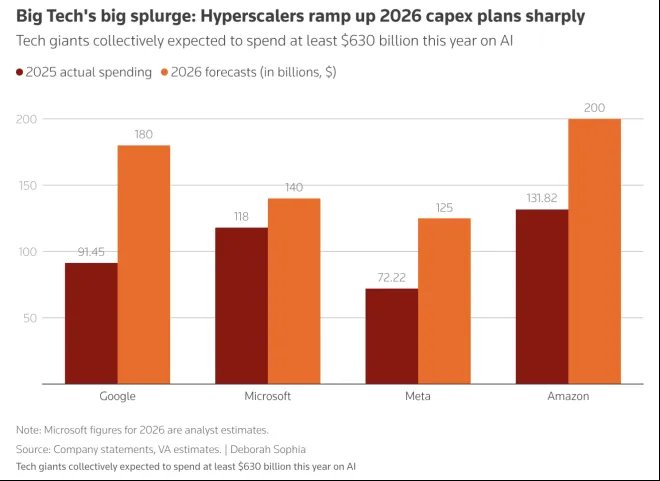
The sharp rise in capital expenditures has forced these infrastructure companies to find a new balance in their financial structures. In the face of AI investment, people have become the most easily adjusted cost.
A simple and direct choice begins to emerge:
Trading human resource costs for computing power costs.
The AI dividend is being "redistributed".
To understand this change, we need to go back to the value structure of the AI industry.
In the past, value in the software industry was often distributed across multiple layers: including the application layer, platform layer, middleware, and underlying infrastructure. Each layer could gain a certain degree of pricing power through differentiated capabilities.
However, in the current AI cycle, this distribution is gradually becoming more concentrated. The value of tokens in the AI era can be roughly categorized into two types: one is generation capability, which is the ability of the model itself to produce tokens; the other is consumption capability, which is the amount of tokens continuously generated and used by users during the inference phase.
In the simplest terms: the benefits of AI are concentrated on models and tokens.
Companies with modeling capabilities, such as OpenAI, Google DeepMind, and Anthropic, can directly define product form and pricing structure; platforms with large-scale user access can generate continuous revenue through token consumption.
Traditional infrastructure components remain important, but they are increasingly like "electricity" and "bandwidth"—essential, but difficult to determine in terms of price.
A clear pattern is emerging: the closer you are to the token generation and consumption stage, the higher the profit margin; the further you are from this core, the more competition tends to focus on cost reduction.
In other words, in the AI wave, those who control tokens control pricing power; those who stay away from tokens only lose money.
For most infrastructure companies, they possess neither modeling capabilities nor user access points. They act as "support systems," such as storing data, scheduling resources, providing runtime environments, or building toolchains.
As technology moves from non-standard to standard, and then from standard to automation, the demand for human resources will naturally decrease.
In the early stages of technological development, a large number of engineers and maintenance personnel are necessary because the system is complex and lacks standardization. However, as model capabilities improve, automation tools become more widespread, and platform capabilities are enhanced, tasks that originally required manual work begin to be replaced by the system.
In this context, when companies need to both reduce costs and improve efficiency, layoffs are almost inevitable—after all, people are a continuous cost, while computing power is an initial investment. Once the system is running stably, the size of the workforce will be reassessed.
Hiring aggressively in the early stages of a technology cycle, followed by massive layoffs once the technology matures, has almost become the fate of infrastructure companies.
This process is not unique to the AI era: in the early days of cloud computing, enterprises also experienced a shift from rapid expansion to efficiency optimization. However, the pace of AI development is significantly faster.
The simultaneous evolution of model capabilities, tool ecosystems, and hardware capabilities in a short period of time has directly compressed the process of efficiency improvement. Cloud computing took about ten years to complete standardization and scaling, while AI may only need three years.
Another option is emerging.
For infrastructure companies that are investing heavily in AI, replacing some of their manpower with computing power may seem cold-blooded, but it is a reasonable choice.
However, looking at a broader perspective, the positions did not disappear entirely, but rather migrated between different levels.
Over the past few years, a large number of jobs have revolved around infrastructure, including system maintenance, data processing, process management, and tool development. With the advent of AI, some of these jobs are beginning to be automated.
At the same time, the demand for positions that directly involve model development, application construction, or product innovation is constantly increasing.
Amid these changes, some practitioners face uncertainty, while others see opportunities and are ready to "pick up the pieces."
For example, WHOOP, a company focused on health and wearable devices, is expanding its team against the trend and plans to hire about 600 people.
WHOOP CEO Ahmed bluntly stated, "This is probably one of the best talent markets in history, with many talented people currently unemployed or working in companies that are constantly talking about being replaced by AI."
“Great teams use great tools to build great products. We see a huge ocean of opportunity in health, fitness, balance, and medical functions. Instead of saying, ‘Oh, how we can become so efficient in the next 12 months,’ we’re saying, ‘How we can shorten our 3 to 5-year research roadmap to 12 to 24 months.’ So, this makes us more ambitious, and I think that’s the most exciting part right now.”
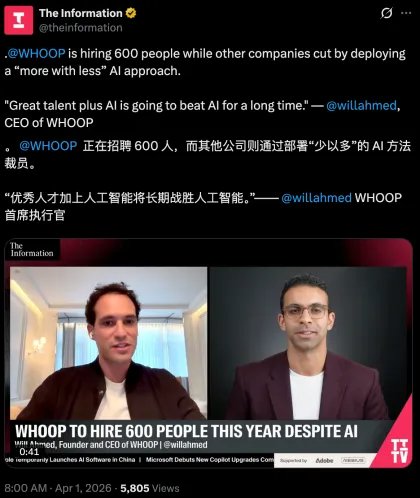
This judgment represents a completely different line of thinking from that of infrastructure companies that are currently laying off employees.
For companies focused on products and applications, AI is not about saving money (although that's part of it), but about improving efficiency: it allows the same team to create in a shorter time what would otherwise take years, enabling faster product launches and continuous iterations.
In this scenario, the role of humans is not replaced, but rather amplified by AI—the same people can do more, faster, and more complex things.
Therefore, you will see that AI brings drastically different results depending on the approach taken: for some companies, AI means reducing costs and improving efficiency; for others, it means accelerating innovation and expanding boundaries.
For practitioners, this change also has a real impact.
In the AI system, work can be broadly divided into three categories: directly creating content and capabilities (models, algorithms, agents); amplifying and applying capabilities (products, application layers); and providing support and infrastructure (systems, tools, operations and maintenance).
As AI capabilities improve, the substitutability of the third type of work is increasing. This does not mean that these jobs have no value, but rather that their value is more difficult to translate into a premium.
For practitioners, the key issue is no longer limited to the technology itself, but rather to their position in the industry—what determines your stability is not your ability, but how close you are to the core value of AI.
The distance between a job position and value creation directly affects job stability and career development opportunities.
As technology cycles accelerate, organizational and job structures change accordingly. Layoffs and hiring occur simultaneously, becoming two facets of the same era.
When faced with the question of whether AI will replace human labor, we might as well think about whether this company is using AI to save money or to make money.
AI won't directly decide whether you'll be replaced, but it will decide whether your current position is worth retaining.
This article is sourced from: