


Author:Wall Street CN
The Middle East energy crisis is quietly rewriting the demand logic for electric vehicles.
According to information from the trading platform, UBS stated in a report on March 30 that the Strait of Hormuz blockade has blocked approximately 12% of the world's oil supply. To fully fill this gap, approximately 770 million gasoline-powered vehicles would need to be replaced with electric vehicles—almost double the historical cumulative number of electric vehicles in the world.
Sustained high oil prices will systematically improve the total cost of ownership (TCO) of electric vehicles (EVs and PHEVs) relative to gasoline vehicles, thereby triggering a structural surge in demand that exceeds previous market expectations. For lithium and other battery raw materials, this means that a potential medium- to long-term demand inflection point is building.
Historical Lessons: How the 1973 Oil Price Shock Reshaped the Automotive Landscape
The UBS research report first cited a historical precedent from 1973. In October of that year, the Organization of Arab Oil Exporting Countries (OAPEC) announced a comprehensive oil embargo against countries that supported Israel. Although the embargo lasted only about six months, oil prices surged by nearly 300%, triggering a profound structural reshaping of the energy and automotive supply chains.
Policy level: Governments around the world have successively introduced fuel efficiency standards, established strategic petroleum reserves, and introduced incentive policies to reduce dependence on oil.
At the OEM level: Automakers that previously disregarded fuel economy were forced to transform rapidly, resulting in fundamental changes to vehicle design and model strategies;
From the consumer perspective: The sharp rise in gasoline prices has profoundly changed car-buying decisions, with fuel efficiency becoming a core consideration.
UBS emphasizes that these changes have proven to be persistent, continuing even after the embargo was lifted. This provides a highly valuable historical framework for understanding the current energy crisis.
Math problem: How many electric cars are needed?
UBS has constructed an intuitive yet alarming quantitative framework. Given the current situation:
The obstruction of the Strait of Hormuz has resulted in a disruption of approximately 13 million barrels per day (13 Mbpd) of global oil supply, accounting for about 12% of the total global supply.
According to data from the International Energy Agency (IEA), the global passenger vehicle fleet accounts for approximately 25% of global oil demand, or about 27 million barrels per day (27 Mbpd).
Assuming that approximately 94% of the world's 1.6 billion vehicles are gasoline-powered (ICE) vehicles, then about 770 million gasoline-powered vehicles would need to be converted to electric vehicles in order to fully fill the current oil supply gap.
This is clearly a purely theoretical assumption, and in reality, multiple constraints such as demand elasticity, supply bottlenecks, and substitution effects make it impossible to achieve.
But even if only 50% of the gap is filled, it would require an increase of about 385 million electric vehicles—which is almost equivalent to UBS’s forecast of a cumulative electric vehicle sales of about 400 million vehicles by 2035.
Google search volume hit a record high, but sales haven't kept pace.
The data presents a picture of "emotions leading the way, actions lagging behind".
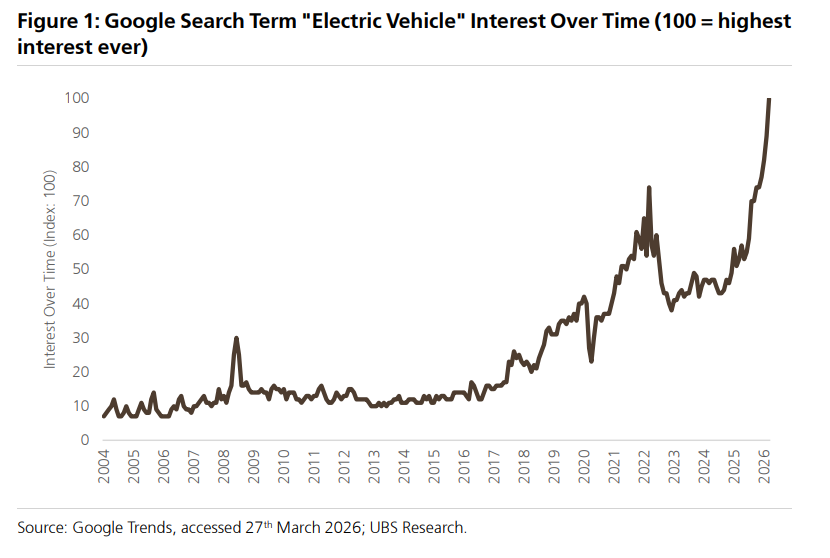
Google Trends data shows that global search interest in "electric vehicle" has reached an all-time high (index of 100), reflecting peak consumer interest in electric vehicles. However, actual electric vehicle sales data for early 2026 is relatively lackluster, showing a clear divergence between the two.
In terms of regional distribution, China remains the world's largest electric vehicle market, accounting for 61% of global sales in the past 12 months; Europe accounts for 21%; North America accounts for 9%; Asia (excluding China) accounts for 6%; and other regions account for 3%.
UBS's global automotive team currently forecasts global electric vehicle demand growth of approximately 9% in 2026. While still robust, this is significantly lower than the growth rates of previous years. In the Chinese market, weak consumption in the post-stimulus period may limit the potential for further growth.In markets with high oil prices, the total cost of ownership (TCO) advantage of low-cost Chinese electric vehicle exports is becoming increasingly significant.
Inventory continues to decline, and the battery energy storage pipeline remains strong.
The upstream lithium market is also sending positive signals.
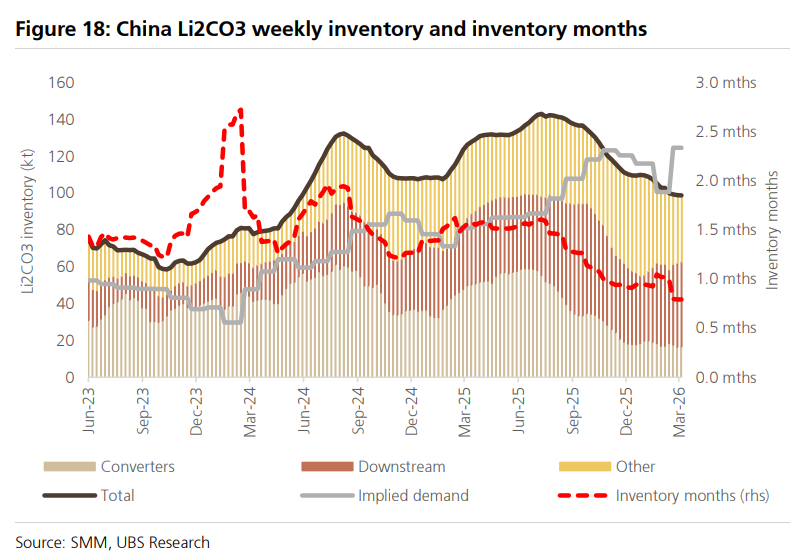
UBS stated that after a significant decline at the end of 2025, China's lithium carbonate inventory briefly stopped falling in early 2026, but resumed its depletion trajectory after the Spring Festival. Currently, the entire supply chain inventory remains at a low level of less than one month's supply (both monthly and weekly for lithium carbonate and monthly for lithium hydroxide), indicating a clear tightening of the supply chain. UBS estimates the current inventory depletion rate at approximately 25,000 tons per year.
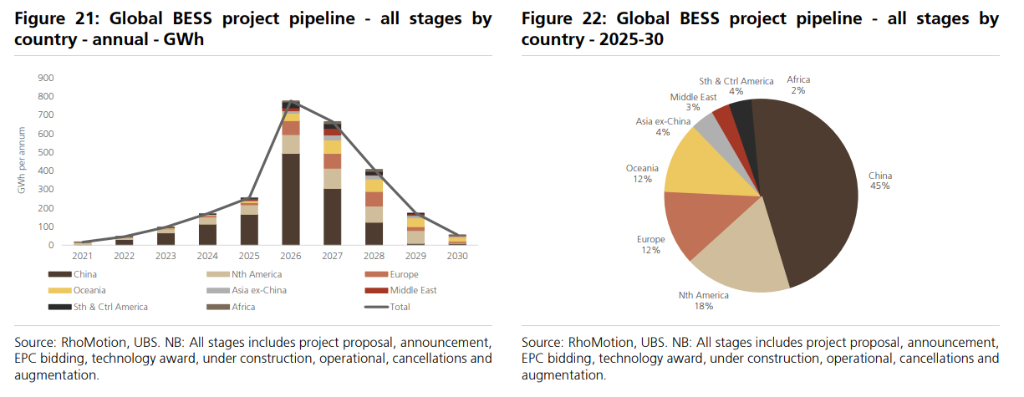
At the same time, the strong momentum of projects in the battery energy storage (BESS) sector further supports the demand outlook for lithium.
The global BESS project pipeline will total approximately 2.1 terawatt-hours (2,077 GWh) from 2026 to 2030, covering all stages from project proposal to construction/operation. In terms of regional distribution, China accounts for 45%, North America 18%, and Europe and Oceania each 12%. The average project duration is projected to exceed 4 hours by 2029.
UBS concludes that in the short term, the demand shock and cost pressure brought about by the current geopolitical conflict cannot be ignored; however, for investors with a longer investment horizon, the energy crisis may drive a structural demand surge in the electric vehicle sector, thereby bringing substantial benefits to upstream materials such as lithium.
~~~~~~~~~~~~~~~~~~~~~~~~
The above exciting content comes from
For more detailed analysis, including real-time updates and firsthand research, please join [the group/group].














![When copper prices rise, who is buying, who is pushing up prices, and who is buying on dips? [Peifengke Master Class 3.1]](http://img.528btc.com.cn/pro/2026-04-07/img/1775556730039cc9499b27xjjh6h6ba865524b31x86h8.jpg)